Showing posts with label j nonfiction. Show all posts

Tuesday, December 10, 2013

Various Star Wars Books

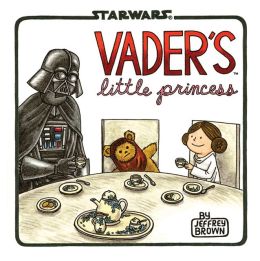
Vader's Little Princess. Jeffrey Brown. 2013. Chronicle Books. 64 pages. [Source: Library]

I read this one several times. Most pages stand alone; the book is more a collection of comic strips than a graphic novel telling one, big story. The premise behind this one and in Jeffrey Brown's previous book, Darth Vader and Son, is simple. Brown has reimagined the evil Darth Vader as a single dad raising two kids. He's still evil, but, he's actively involved with Luke and Leia's upbringing. Some pages are hilarious and just fun. Others not so much. I think there is something for everyone to enjoy, however!
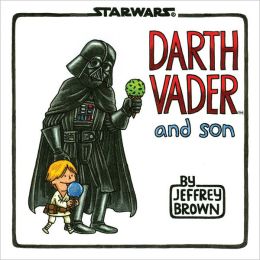
 Darth Vader and Son. Jeffrey Brown. 2012. Chronicle Books. 64 pages. [Source: Library]

I read Darth Vader and Son after reading Vader's Little Princess. I really, really, really enjoyed both books very much. However, I must say that I laughed more with this first book. I liked the parenting advice. I liked how they used or nearly used, I should say, direct quotes from the trilogies and gave the words a whole new meaning! For example, "This is not the toy you are looking for..." instead of "This is not the droid you are looking for." (It was also fun seeing WHICH toy it was (Jar Jar). These comic strips are just fun. I'd recommend these easily!
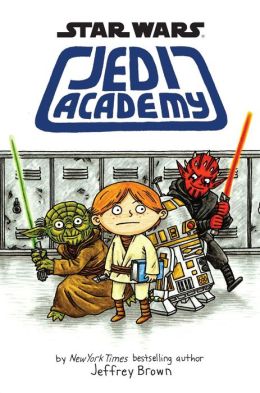
Star Wars: Jedi Academy. Jeffrey Brown. 2013. Scholastic. 160 pages. [Source: Library]

Roan Novachez, our young hero, desperately wants to be accepted into the pilot academy. It is not to be. Just when Roan thinks he'll be stuck on Tatooine forever, he receives a letter he wasn't expecting. Been accepted into Jedi School, he has. A student of Master Yoda, he will be. He goes. He tries. He really tries. But the other younglings have been using the force for years, have grown up knowing or at least hoping to become Jedi. It is their first choice, not second choice or last choice for a vocation. The book is a blend of journal entries and comic strips. The book captures his awkwardness of growing up and adapting to new situations with a generous dose of humor.

I liked it. There were definitely some funny scenes in it. I'm not sure I LOVED it however.


Star Wars Science Fair Book. Samantha Margles. 2013. Scholastic. 128 pages. [Source: Review Copy]
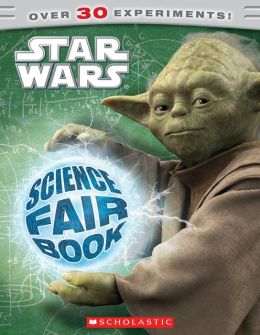
This is an interesting book for upper elementary on up. (The recommended age is 10 and up.) The introduction reads:
Have you ever wondered how much of the science-fiction world of Star Wars is based on real-life science? Are some of the situations in the films possible or simply part of a fantastic story? Now you have a chance to find out. In this book we've pulled together an assortment of experiments and activities that examine the science of Star Wars. Some of the experiments are inspired by the planets, creatures, droids, and technology from the films, and some go a step further to answer related scientific questions you'll find exciting and fun. Perhaps one day you'll find yourself on a path toward becoming a scientist and explorer of galaxies far, far away! May the Force be with you!
The book is a step-by-step guide to experimenting. Sometimes they give clues about the results, other times not a bit. Here's an idea of the types of experiments to expect:
  • creating a lava lamp
  • making icicles
  • water in the desert
  • sound in space
  • create lightning
  • make your own clouds
  • homemade periscope
  • grow your own crystals
  • your very own lie detector 

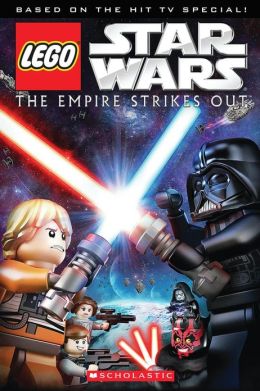
    Lego Star Wars: The Empire Strikes Out. Based on the TV Special. 2013. Scholastic. 48 pages. [Source: Review Copy]

    It is oh-so-easy to recommend the TV special, Empire Strikes Out. It has some great scenes in it! And the Darth Vader and Darth Maul scenes work so much better in the special than they do in the book! But the book is nice. It's a typical novelization. I do like seeing the mostly-Lego illustrations, however.
    You might be able to catch part of it online. 

    Star Wars Episode IV: A New Hope. George Lucas, Alan Dean Foster. 1977. 247 pages. [Source: Own] 

    I managed to read this one at last. I'd started it a few years ago, but I thought the writing was so poor in the opening chapter or two that I just wasn't motivated to continue on. As soon as the action really begins, once Luke Skywalker is introduced, this one gets much better! That is not to say that reading the story adds anything substantive and wonderful to the movie experience. I think an appreciation of the movie is a big help. It helps to make sense of the text of the book. There are some pages that are a bit messy--jumping back and forth between characters and locales. It makes complete sense if you are familiar with the movie, if you know the order of things. But transitions of points of views isn't all that well done.

    Years ago, I read other Star Wars novels including a novelization of the second movie. That book added SO MUCH to the story, really filled in anything and everything I wanted in terms of characterization and motivation and intent. This one, not as much. Still, it was a fun read.

    Star Wars: Episode V: Empire Strikes Back. Donald F. Glut. 1980. 214 pages.  [Source: Bought]

    This one was good for the most part. I enjoyed reading it, noticing the tiny differences between the book and the movie. I was looking for any differences in dialogue between the two. I was in particular watching the developing romance between Han and Leia. Another relationship I was paying attention to is Yoda and Luke. I was looking for something more, little things, perhaps, that made the book add something to the overall Star Wars experience. I will say I liked this one. It had a few confusing moments now and then, again with the transitions, for the most part I liked it though.

    Star Wars: Episode VI Return of the Jedi. James Kahn, George Lucas, Lawrence Kasdan. 1983. 181 pages. [Source: Bought]

    The dialogue was truly awful in places in this one. Once I gave myself permission to skip entire sections of dialogue of certain characters, I began to enjoy it a little bit. There was much to suffer through in this one, but, it had a few scenes that made it all worth while! The writing I felt wasn't wonderful, if these books in the trilogy weren't movies, I'm not sure they'd be anything fantastic to recommend them, to make them classics. 
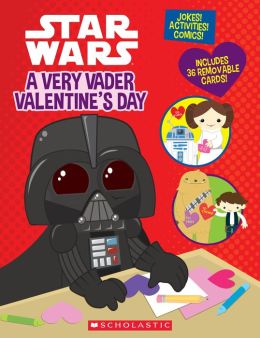
    Star Wars: A Very Vader Valentine's Day. Scholastic. 2013. 16 pages. [Source: Review Copy]

    What can you expect from this one? A silly introduction, a tribute to five friendships, two pages of awful jokes, four comic strips, two word search puzzles, a maze puzzle, a mad lib, two how-to-draw features, and thirty-six removable Valentine's Day cards. How bad are the jokes? Well, you be the judge: "Where does the Emperor go when he wants to buy something cheap? He looks for a sale at the Maul." There were several relatively cute cards. Like C-3PO's "I want to be the droid you're looking for" and Han Solo in carbonite: "Valentine, don't make me spend the day SOLO."

    © 2013 SukaYuka.com of SukaYuka's Book Reviews

    Monday, November 18, 2013

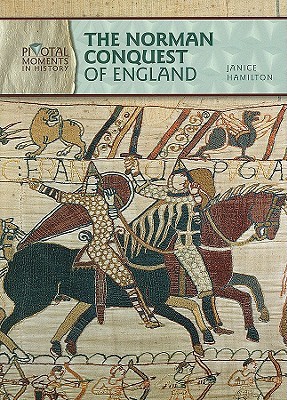
    The Norman Conquest of England

    The Norman Conquest. Janice Hamilton. 2007. Twenty-First Century Books. 160 pages. [Source: Library]

    I really enjoyed Janice Hamilton's The Norman Conquest of England. I thought the layout was great. It was very reader-friendly. The information was clearly presented, very straight-forward. I thought they did a great job in conveying just enough background to make it all make sense. It is important to have a big picture before going into the little details in my opinion.

    There are seven chapters and an epilogue: "Anglo-Saxon England," "The Kings of England," "Normandy," "A Question of Succession," "The Battle of Hastings," "After the Battle," "A Blended Society," and "The Conquest Remembered."

    I really enjoyed learning about the culture and the times. I really thought they did a great job in providing a framework. The most helpful chapter, perhaps, is "The Kings of England." This chapter takes readers from the 790s (when the Vikings first started raiding) to the death of Edward the Confessor (1065). Readers learn about Alfred the Great, Ethelred the Redeless, Queen Emma, Sweyn and Canute, the Godwin family, Edward the Confessor, etc. I think it is important to grasp the connection between England and Normandy BEFORE the "invasion." Queen Emma was Norman, the daughter of the duke of Normandy, she married the English King Ethelred "the Unready"; at some point (either when her husband was defeated OR when he died) her children with him took refuge in Normandy with her relatives. Emma also married King Canute and had children with him. She saw several of her children on the throne--from both marriages. Edward the Confessor was her son. William the Conqueror was her great-nephew. This truly is a fascinating time period!

    © 2013 SukaYuka.com of SukaYuka's Book Reviews
    Thursday, October 31, 2013

    Handel Who Knew What He Liked

    Handel, Who Knew What He Liked. M.T. Anderson. Illustrated by Kevin Hawkes. 2004/2013. Candlewick. 48 pages. [Source: Review copy]

    Oh, how I loved this little chapter-book biography of Handel!!! M.T. Anderson should write more books just like this! I loved the book's liveliness. It was clever and full of personality. I love the touch of humor and wit!

    Favorite quotes:
    Right from an early age, George Frideric Handel knew just what he liked. He wanted to study music. His father said he couldn't. His father said nobody ever made any money as a musician. He told the boy to study something that would make him money. Handel's father was a doctor. But little Handel knew what he liked. What he liked was music. So he smuggled a clavichord up into the attic without his parents knowing. Late at night, he taught himself to play. Handel was an unusual boy. Not everyone has the courage to smuggle a clavichord past their parents. (1)
    Handel studied first in his own city of Halle, and later, when he was eighteen, in the city of Hamburg. One of his best friends in Hamburg was a composer named Mattheson. They both loved music. In particular, they loved operas. Sometimes they even performed operas together. Mattheson couldn't get enough opera--especially his own. He would write an opera, and then he would star in it himself. He would often arrange to play a character who died partway through the opera. That way he could jog down and lead the orchestra from the harpsichord. Handel, who'd be playing when Mattheson got there, would have to stop and move aside for his friend. Handel thought Mattheson was a bit of a pain. One night when Mattheson had killed himself onstage and come down to play the harpsichord, Handel refused to get up. Mattheson threatened him. Handel was very stubborn; he kept right on playing. So right there and then, Mattheson challenged Handel to a duel. They walked out of the theater into the cold winter's night. They drew their swords and set upon each other in the square. Mattheson thrust his rapier right toward Handel's heart--but luckily the blade hit Handel's coat button, and broke. Later that night, they went out for a big dinner. After all, they were still good friends. Big dinners always made Handel feel a lot better. (6, 8)
    © 2013 SukaYuka.com of SukaYuka's Book Reviews

    Monday, September 23, 2013

    The Wicked History of the World

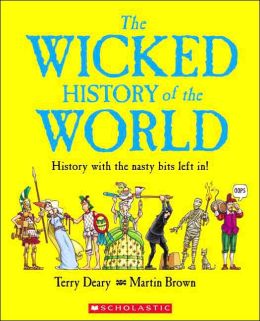
    The Wicked History of the World: History With the Nasty Bits Left In. Terry Deary. Illustrated by Martin Brown. 2006. Scholastic. 96 pages. [Source: Library]

    The Wicked History of the World is a reader-friendly introduction to world history. A lot of subjects are introduced and discussed quite briefly; it is not a complete and thorough introduction to any time period. This one seems perfect for browsing. It isn't just prose; there are quizzes, "diary entries," and comics too.

    This is one of many books published in the "Horrible Histories" series. (Before the television show, there were books.) For those wanting to make a connection to the WONDERFUL show...

    Roman Funerals 
    Vikings Song "Literally"
    Blackbeard's Song
    Dick Turpin's Song

    I liked this one. I wish my library had more of the series. 

    © 2013 SukaYuka.com of SukaYuka's Book Reviews
    Monday, September 2, 2013

    Creative Writing (2013)

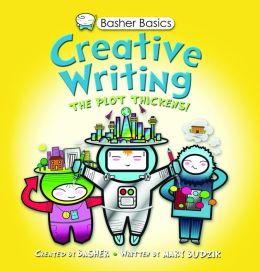
    Creative Writing: The Plot Thickens. Mary Budzik. 2013. Kingfisher. 64 pages. [Source: Review Copy]

    Creative Writing is a book in the Basher Basics series published by Kingfisher. (Other titles in the series include: Grammar, Punctuation, Music, Weather, Math, etc. There are two other lines as well: "Basher History" and "Basher Science".) This one would be perfect for middle grade (upper elementary school and/or junior high).

    In the first chapter entitled "What's The Story?" readers learn about genres. Seven genres are included in chapter one: adventure, horror, science fiction, fantasy, mystery, diary, and poetry. Each genre has its own two-page spread. Mystery is found on page sixteen.
    Mystery
    *Story in which a protagonist investigates a mystery or crime
    *The detective (amateur or professional) often has a sidekick
    *Canny clues help connect the dots

    I'm a cagey type whose world is seldom as it seems. Wary Protagonist might look for the story behind the story but, dogged by dastardly deeds, seems instead to stumble into muddles, mayhem, and even murder.
    I scatter clues for detectives, private investigators, and interfering old ladies. I lead Protagonist into some sticky situations and courageous capers, but good old Pro is always equal to the challenge, refusing to back off despite ominous omens, threats from thieves, or pleas from the police. It is a question of having to be supremely self-confident, of trusting that gumption and grit will save the day. Even then, with criminals corralled and cooped up for good, it won't be long before I set yet another trail of trouble.  This game of wits is just too much fun to play.

    Three to Read:
    *Detectives in Togas by Henry Winterfeld (1956)
    *Cam Jansen and the Mystery of the Stolen Diamonds by David A. Adler (1980)
    * Hoot by Carl Hiaasen (2002)
    The second chapter is entitled "Scene Setters." This chapter explores the concept or significance of title, theme, setting, and atmosphere. Theme is found on page twenty-six.
    Theme
    *A Central message or idea expressed by a story or poem
    *Usually woven into a story rather than stated outright
    *Often has a significance beyond the story itself

    I'm a thoughtful type and sometimes a bit shy. Sure, Plot likes to scurry here and there, Plot Device teases readers with its tricks and colorful Figurative Language draws all eyes. Meanwhile, I meditate peacefully at the very center of a story, waiting patiently for you to find me. I often speak through other elements of a story rather than in a voice of my own, which means I can be a little hard to spot. I am worth seeking out, though. If you pay close attention and, like me, practice quiet reflection, you will hear my message, I'm sure--I'm intuitive! Ask yourself: Are there subjects in the story that reappear in different ways in different episodes? What makes Protagonist especially happy or sad? Does the story's title offer any clues? Before you know it, you'll have found me!

    Try these:
    *Identify the different themes in your favorite novel
    *Choose a simple theme (for example, "friends are found in unexpected places") then work on a story to illustrate the theme.
    Chapter three is entitled "Schemers and Dreamers." It introduces these concepts: plot, structure, flashback and flashforward, plot device, and denouement. Structure is found on page thirty-six.
    Structure
    *The arrangement of the events within a plot
    *Gives a story a beginning, a middle, and an end
    *Getting the order of events just so increases a story's impact

    I am Plot's conscience. Addicted to the roller-coaster ride of events, Plot has a tendency to overwhelm a story like a tsunami, scattering mishap and misfortune all around. Well, it's my job to make Plot stop and think. I show that hothead some restraint! Yes, with me on board, plot chooses balance over bedlam and cause over coincidence. You see, I have a set of tools that help organize events in a logical progression, each incident causing the next. Thus Plot is able to set the scene (exposition), get things moving (rising action), stir things up (conflict), put on the brakes (suspense), cue the thunder (climax), and let everything settle back to earth (denouement). If I've done my job well, you'll feel like everything that happened was meant to be!

    Try these:
    *See if you can find the exposition, rising action, conflict, climax, and denouement in your favorite book
    *Can you reorder some of the events without altering the outcome of the story?
    The fourth chapter is "Heroes and Villains." It introduces these concepts: character, protagonist, antagonist, viewpoint, first person, and third person.

    The fifth and final chapter is "Wordsmiths." It introduces the following: figurative language (more can be found in the glossary), diction, and dialogue.

    I found Creative Writing to be packed with information in a reader-friendly way. I thought they did a great job in defining terms. I think the book could be just as useful for helping people talk about literature (stories, poems, novels, etc.) as it is for helping people write creatively.

    © 2013 SukaYuka.com of SukaYuka's Book Reviews
    Monday, August 26, 2013

    Two More "You Wouldn't Want To" Books

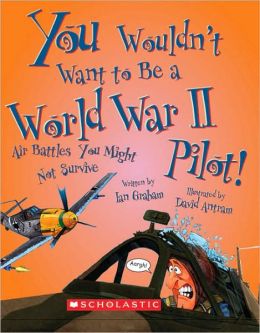
    You Wouldn't Want To Be A World War II: Air Battles You Might Not Survive. Ian Graham. Illustrated by David Antram. 2009. Scholastic. 32 pages. [Source: Library]

    Last Monday, I reviewed two books in this series, You Wouldn't Want to Be in Alexander The Great's Army and You Wouldn't Want to Be Joan of Arc. Today I am sharing two more books with you. The first is You Wouldn't Want To Be A World War II Pilot! This nonfiction picture book would be a good introduction of the subject for young readers. Older readers would probably want to know even more.

    From the introduction: "You are 16. Home is San Antonio, Texas. The year is 1934. You're crazy about aircraft and flying. Your room is filled with models and posters of airplanes. You go to your local airfield, Stinson Field, to study pilots and their planes at every opportunity..."

    The spreads include: "Learning to Fly," "Joining Up," "Fighter Training," "The Spitfire," "First Post," "Combat," "Passing Time," "Bailing Out," "Pearl Harbor," "Pacific Fighters," "Under U.S. Command," and "Peace at Last."

    While this picture book may begin in the United States, it soon crosses the Atlantic. After the war begins, American pilots volunteer for Britain's RAF. This picture book, in a way, tells that story. After all, it takes several years for the U.S. to enter the war.

    I liked this one. I didn't quite love it like some of the others in the series. But I thought it was good.

    Horrible Histories, Woeful Second World War, RAF Song


    You Wouldn't Want To Be A Shakespearean Actor. Jacqueline Morley. Illustrated by David Antram. 2010. Scholastic. 32 pages. [Source: Library] 

    I loved You Wouldn't Want To Be A Shakespearean Actor by Jacqueline Morley. I thought it was a great introduction to the Elizabethan theatre. Readers learn about James and Richard Burbage and William Shakespeare, of course. It was very reader-friendly. I thought it was informative and straight-forward.

    From the introduction:
     "It's 1594 and you're a young boy growing up in Shoreditch, a neighborhood on the outskirts of London. Until about 20 years ago, it was a quiet spot. Then actors from the city arrived and put up a "playhouse" here--a building just for putting on plays! Before this, actors--who are called players--had always traveled the country, setting up makeshift stages wherever they could find an audience. Puritans, like your parents, don't approve of acting. They say that players don't do real work--they just play. They also say that plays are just longer versions of the foolish shows that wandering entertainers have been putting on since medieval times. But you think your parents are wrong to say that plays are displeasing to God; they've never been to one! Well, you have (unknown to them, of course), and you think plays are the best thing ever. You'd love to act in one."
    I loved learning all the behind-the-scenes details. For example, from the spread "Stretching Your Memory,":
    You're a star player now, the company's first choice for female leads. But there's a downside to success. You're up till midnight, studying lines until you feel your head will split. The trouble is, to keep the audiences coming, the company performs a different play each day. There are some 40 plays to choose from, and you must act in all of them. You have to remember every part you've ever learned! About 15 plays a year will be new; the rest are revivals of old plays. In some plays, you perform more than one role, so altogether you need to keep at least 50 parts in your head. Minor actors, who each play more than one part, may need to memorize 100 roles. (14)
    I would definitely recommend this one!!!

    Horrible Histories, William Shakespeare Song


    © 2013 SukaYuka.com of SukaYuka's Book Reviews
    Monday, August 19, 2013

    Two "You Wouldn't Want To Be" Books

    You Wouldn't Want To Be In Alexander The Great's Army. Jacqueline Morley. 2005. Scholastic. 32 pages. [Source: Library]

    I have only recently discovered the "You Wouldn't Want To Be" nonfiction picture book series published by Scholastic. You Wouldn't Want To Be in Alexander The Great's Army: Miles You'd Rather Not March was the first I read. I really enjoyed it. It's reader-friendly, conversational, and informative as well. When I say the book is conversational, I mean it. The book is addressed to the reader; the reader is the YOU of the text.
    It is the 4th Century BC and you are a sheep farmer living in the hilly land just north of Greece known as Macedonia. You Macedonians are tough country people, used to a hard life. Though you might speak Greek and worship Greek gods, the Greeks of the south look down on you as rough and uncivilized foreigners. However, Macedonians have been teaching those soft-living southern Greeks a thing or two recently. Macedonia used to be weak and divided but your previous king, Philip II, made it united and strong and turned the Macedonians into a fighting force that now controls most of Greece. His son, Alexander III, who is only 20, is about to start on a great scheme that his father was planning when he died. He is going to invade the mighty Persian Empire. He needs soldiers, so why not leave those bleak hills, join him and see the world?
    Alexander's story is told in two-page spreads: "Joining up," "334 BC Alexander Sets Off," "332 BC Siege of Tyre," "332-331 BC In Egypt," "331 BC The Battle of Gaugamela," "330 BC Sacking of Persepolis," "330 BC King Darius Dies," "329 BC Crossing the Hindu Kush," "327 BC Scaling the Sogdian Rock," "326 BC Into India," "325 BC The Gedrosian Desert," "323 BC: The Death of Alexander."

    I really enjoyed the way the information was conveyed to the reader. The information was clearly presented and quite interesting. While the illustrations by David Antram aren't what I consider great, they began to grow on me as I read and reread this one.

    Horrible Histories, Alexander the Great:


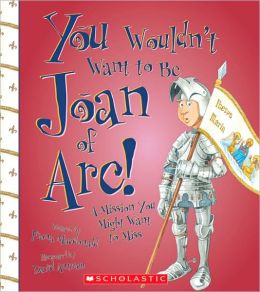
    You Wouldn't Want To Be Joan of Arc! A Mission You Might Want To Miss. Fiona MacDonald. 2010. Illustrated by David Antram. Scholastic. 32 pages. [Source: Library]

    I really enjoyed reading Fiona MacDonald's You Wouldn't Want To Be Joan of Arc! I wish my library had every single book in this series. This one had me at hello.
    The year? It's 1428. The place? Domremy, a village in northeast France. And you? You're Joan, the daughter of peasant farmers. Your family is neither very rich nor very poor. Like all the other local youngsters, you've grown up living in fear. For years, war has been raging throughout France. One of your cousins has been killed in battle, and the village church--next door to your family's house--has been burned down by the enemy. So far, you've managed to stay safe. But you face great dangers ahead. Why? Because you dream of a secret, sacred mission: to rescue France from its attackers! You're young--just 16. You're not a famous or powerful person. You can't read or write, and you haven't been trained to use weapons. You don't understand politics or know how to plan a battle. But you're utterly convinced that you must save your country. How can you fulfill your dream?
    This picture book biography of Joan of Arc is simple and straight-forward. There is enough information for younger readers; obviously, older readers might want or need a more in-depth biography more appropriate for their age-group. But this picture book biography is fun and clearly presented. I love how the information is shared with readers.

    The two page spreads include: "Dutiful Daughter," "In The War Zone," "Rival Rulers," "Hearing Voices," "An Urgent Mission," "Royal Meeting," "Saving a City," "The King is Crowned," "Sensing Doom," "A Terrifying Trial," "Life--or Death?," "Glorious Memory."

    I think this series is good because it makes history exciting and entertaining. It's never too early to cultivate a love of history, perhaps, the earlier the better!

    Horrible Histories, Joan of Arc


    © 2013 SukaYuka.com of SukaYuka's Book Reviews

    Monday, July 15, 2013

    Four Nonfiction Biographies (2013)

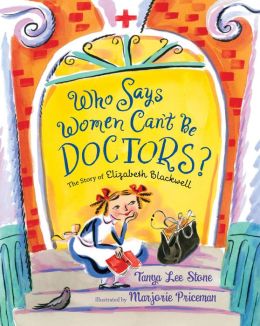
    Who Says Women Can't Be Doctors? The Story of Elizabeth Blackwell. Tanya Lee Stone. Illustrated by Marjorie Priceman. 2013. 40 pages. [Source: Library]

    I'll bet you've met plenty of doctors in your life. And I'll bet lots of them were women. Well, you might find this hard to believe, but there once was a time when girls weren't allowed to become doctors. Back int he 1830s, there were lots of things girls couldn't be. Girls were only supposed to become wives and mothers. Or maybe teachers, or seamstresses. Being a doctor was definitely not an option. What do you think changed all that? Or should I say....WHO?

    I love this picture book biography of Elizabeth Blackwell. I love the narrative! It isn't just sharing simple information with readers; it is telling a vibrant, exciting story. Elizabeth Blackwell has PERSONALITY in this one. And that is what I love most in this one. History comes alive in this one! The illustrations by Marjorie Priceman are just perfect: so bold, so colorful, so expressive! (Especially the illustration showing Elizabeth Blackwell with her acceptance letter.)

    This picture book biography would make a great read aloud.

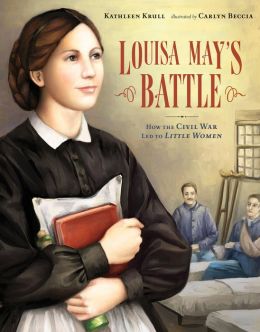
    Louisa May's Battle: How the Civil War Led to Little Women. Kathleen Krull. Illustrated by Carlyn Beccia. 2013. Walker Books. 48 pages. [Source: Library]

    For older readers, Louisa May's Battle is an interesting biographical story starring Louisa May Alcott. (The book is not a complete biography; it focuses specifically on Louisa May Alcott's life in the 1860s as she first becomes a nurse during the Civil War, and then becomes an author first publishing Hospital Sketches and later Little Women.)

    Before the Civil War, there weren't many women nurses. But the war gave women the opportunity to fill an urgent need, and also the opportunity to prove themselves capable and skilled. For women who met these qualifications: at least thirty, very plain, unmarried, strong, and two reference letters proving their moral quality, there was an opportunity to serve their country well during a time of great need. Louisa May Alcott was one woman who answered the call.

    After several months nursing, Louisa May Alcott became very ill. She was unable to keep nursing; it took her months in bed to recover her health. After she recovered, she wrote Hospital Sketches. This was her first publication. This book was very significant. And its success in part led her to write another book: Little Women.

    I enjoyed Kathleen Krull's newest biography.

    Look Up! Henrietta Leavitt, Pioneering Woman Astronomer. Robert Burleigh. Illustrated by Raul Colon. 2013. Simon & Schuster. 32 pages. [Source: Library]

    Night after night, Henrietta sat on her front porch, gazing up at the stars. How high? How high is the sky? She wanted to know everything about the wonderful bigness of all she saw. The more she looked up, the bigger the sky seemed to get. It seemed endless!

    Look up! is a picture book biography of the astronomer Henrietta Leavitt. The story is of a little girl who loved the night sky, who loved the stars, who followed her dream and persevered academically in a man's field. Most astronomers, at the time, being men, of course. But she knew what she wanted, and she knew she could do it. Henrietta's job--she got paid thirty cents an hour--was not to gaze through the telescope. Her job was to examine, to study, the photographs taken by others. She was good at her job, and through her measuring, through her detailed study, she made an important discovery, a discovery having to do with measuring distances and the vastness of galaxies.

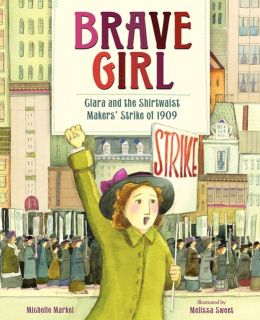
    Brave Girl: Clara and the Shirtwaist Makers' Strike of 1909. Michelle Markel. Illustrated by Melissa Sweet. 2013. HarperCollins. 32 pages. [Source: Library]

    A steamship pulls into the harbor, carrying hundreds of immigrants--and a surprise for New York City. The surprise is dirt poor, just five feet tall, and hardly speaks a word of English. Her name is Clara Lemlich. This girl's got grit, and she's going to prove it. Look out, New York!

    Brave Girl is a picture book biography of Clara Lemlich, a young woman who led women factory workers to strike. This picture book focuses on the social injustices of the times, and how important it was for workers to be able to form unions, and make a stand together for what they believed to be right and fair. Clara's story is inspiring. Her determination and strength seem incredible. "She wants to read, she wants to learn! At the end of her shift, though her eyes hurt from straining in the gaslight and her back hurts from hunching over the sewing machine, she walks to the library. She fills her empty stomach with a single glass of milk and goes to school at night. When she gets home in the late evening, she sleeps only a few hours before rising again."

    Definitely recommended.

    © 2013 SukaYuka.com of SukaYuka's Book Reviews

    Monday, July 8, 2013

    Abraham Lincoln and Frederick Douglass (2012)

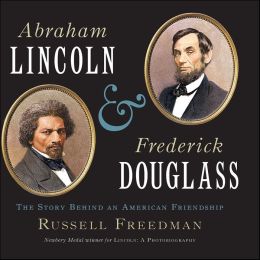
    Abraham Lincoln and Frederick Douglass. The Story Behind An American Friendship. Russell Freedman. 2012. Houghton Mifflin Harcourt. 128 pages. [Source: Review Copy]

    I do enjoy Russell Freedman's nonfiction works for children and teens. Abraham Lincoln and Frederick Douglass includes a brief biography or introduction to two well-known men; each man, of course, deserving fuller treatment than this one book allows. The book begins with Frederick Douglass waiting to meet the President, Mr. Lincoln. The president has visiting hours every day, and Mr. Douglass is hopeful that he will get the chance to speak with him. Though Douglass hasn't always supported Lincoln's politics completely, or his policies completely. It is because of certain grievances that he is visiting there. He wants the president to be aware of certain conditions facing black soldiers. He wants the president to do something, to act. After that first brief glimpse of a meeting, readers then get the opportunity to learn about both men. There are chapters devoted to Frederick Douglass and chapters devoted to Abraham Lincoln. Through the biographies of both men--well partial biographies bringing the reader up to date, up to the Civil War--readers get a glimpse of the problems facing the nation. There is a definite focus on the war years 1861-1865.


    © 2013 SukaYuka.com of SukaYuka's Book Reviews
    Thursday, April 18, 2013

    Four Board Books (2013)

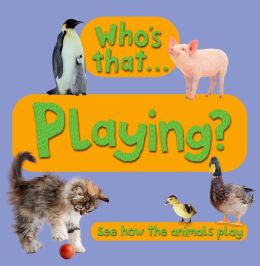
    Who's That...Playing? See How The Animals Play.  Kingfisher. 2013. 14 pages.
    Who's that playing?
    Tip tap
    I am a kitten.
    I have long fur and pointed ears.

    Who's that splashing?
    Splish splosh
    I am a duckling.
    I have a beak and webbed feet.
    Who's That...Playing is a fun board book for young readers--toddlers and preschoolers. Each two-page spread focuses on a different animal at play: kittens, puppies, ducklings, bear cubs, lambs, penguin chicks, piglets. Real photographs are used throughout. It is in a series of board books published by Kingfisher. Other titles include: "Who's That? Roaring," "Who's That? Jumping," "Who's That? Eating."

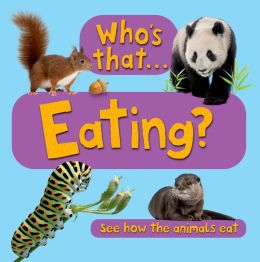
    Who's That...Eating? See How The Animals Eat. Kingfisher. 2013. 14 pages.
    Who's that eating?
    Chomp
    I am a giant panda.
    I have black and white fur and I like munching bamboo.

    Who's that gnawing?
    Gnaw
    I am an otter.
    I have whiskers and I use my tail to help me swim.
    If you're looking to share simple animal facts with your little one, this new series by Kingfisher would be a great choice. There are four books in this series, each focusing on a different aspect of animal life. Different animals are featured in each book. In this title, the focus is on eating. The animals featured include pandas, otters, caterpillars, squirrels, anteaters, chickens, and giraffes.

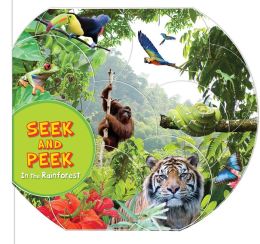
    Seek and Peek In the Rainforest. Kingfisher. 2013. 8 pages.

    Another series published by Kingfisher is the Seek and Peek series. There are four titles in the series: Seek and Peek in the Rainforest, Seek and Peek On the Farm, Seek and Peek Dinosaurs, and Seek and Peek at the Zoo. The books are oddly shaped, which may appeal to young readers who love to grasp. Readers can choose which animal they want to read about--learn about--and turn directly to that page. But some pages feature more than one animal. And some animals are not featured on the cover.

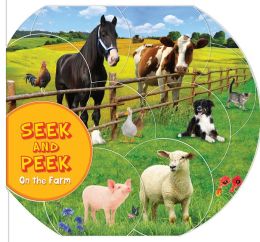
    Seek and Peek On the Farm. Kingfisher. 2013. 8 pages.

    The final book I'll be reviewing today is another in the Kingfisher's Seek and Peek series. I'm curious if little hands will appreciate the oddly shaped board book--it is almost a circle. It is easy to grasp and turn pages, which may be a plus! Farm books are almost always fun, and this one isn't an exception. Little ones can learn simple facts about farm animals like pigs, horses, chickens, cows, ducks, etc.


    © 2013 SukaYuka.com of SukaYuka's Book Reviews