Showing posts with label 2007. Show all posts

Tuesday, December 24, 2013

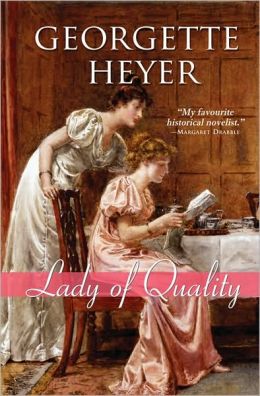
Lady of Quality (1972)

Lady of Quality. Georgette Heyer. 1972. Sourcebooks. 300 pages. [Source: Review Copy]

It is finished. My gloriously grand goal of reading all of Georgette Heyer's romance novels in one year, in order of publication! And it ended on a wonderful note as well. Lady of Quality is among the best of her romances. If you enjoy the friction of Much Ado About Nothing and Pride and Prejudice, you may just adore Lady of Quality. Oh how the sparks fly between the hero and heroine! These two who simply can't stand to be in the same room together, right?!

Miss Annis Wychwood is almost thirty years old. And in that time, the Regency period, thirty might as well have been sixty. Spinster is spinster no matter if you're thirty, blond, and witty or wrinkly, gray, and stubborn. But Annis is comfortable in her singleness. Or at least she prefers to see herself as comfortable. It helps that in Annis' situation, she's wealthy enough to have her own house and household. (By household I mean servants and such). If Annis had to live under her brother's roof, well, it would be a different story altogether. She does NOT get along with her brother, Geoffrey, though she does get along in a way with her sister-in-law. Yes, folks might think it a bit strange that she'd rather be independent and living on her own--and a good day's travel away from her brother and his wife--but they've become accustomed to it. But when our novel opens, Annis is about to do something a bit more unexpected, a bit more shocking.

Lucilla Carleton is just a young thing--not even eighteen--when she decides to run away from her aunt. (Her aunt is her primary guardian.) Her aunt wants her to marry the son of her father's best friend. A man, Ninian, that she's practically grown up with. It's not that she doesn't like him. But she doesn't like him like him. At least she says as much. As does he when given the opportunity. (The two like to bicker about how they don't want to be together.) Annis comes across this bickering pair on her way to Bath. Their carriage (or vehicle) has broken down--a problem with one of the wheels. Annis is too much of a lady to leave the poor girl in distress. She invites the young woman to come with her, to stay with her. Through their trip and the first day back at home, Annis hears all about Lucilla, her aunt, Ninian, and his over-bearing parents the Lord and Lady Iverley. Lucilla has runaway it's true but it's because her aunt is passive aggressive. She manipulates through tears and pleas and looks.

What is Annis to do? Welcome her home to this girl she barely knows yet instantly likes? Or send her packing with much tears of distress? She decides that the girl must write a letter to an aunt. She'll be allowed to stay with Miss Wychwood in Bath, it's true, but it's a temporary solution to the girl's problem. But this nice letter home has unattended results. Her aunt being of the nervous sort on the best of days writes a letter--a tear-soaked and illegible letter to the girl's legal guardian--Lucilla's Uncle Oliver. Oliver Carleton.

The last thing Annis expected was to be visited by Oliver Carleton. A man (from London) with the reputation of the worst sort. A truly grumpy, stubborn sort of man who speaks without thinking of the consequences, who enjoys speaking the truth, the whole truth, and nothing but the truth come what may. Obey society's nicety-nice rules? Not a chance! A man with a sharp but witty tongue comes to Bath to get to the bottom of this mess. He doesn't want Lucilla. He's not there to take her away, he's there to investigate this woman, this stranger who has interfered and butted into his business, his family.

Let the fun begin.

Oliver and Annis. Oh the sparks will fly. Despite her claims of being ancient and spinsterly, Oliver can't help thinking that she's entirely unsuitable for chaperoning his niece. She should be the one being courted and pursued and wooed by men. She's beautiful. She's witty. She's intelligent. There's just a certain something about her that he can't ignore. Annis never in a million years thought she'd feel this way, this maddeningly confusingly wonderful feeling. She can't stand him; and yet, she keeps hoping she'll see him again.


© 2013 SukaYuka.com of SukaYuka's Book Reviews

Monday, November 18, 2013

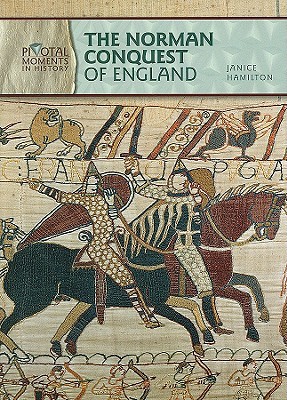
The Norman Conquest of England

The Norman Conquest. Janice Hamilton. 2007. Twenty-First Century Books. 160 pages. [Source: Library]

I really enjoyed Janice Hamilton's The Norman Conquest of England. I thought the layout was great. It was very reader-friendly. The information was clearly presented, very straight-forward. I thought they did a great job in conveying just enough background to make it all make sense. It is important to have a big picture before going into the little details in my opinion.

There are seven chapters and an epilogue: "Anglo-Saxon England," "The Kings of England," "Normandy," "A Question of Succession," "The Battle of Hastings," "After the Battle," "A Blended Society," and "The Conquest Remembered."

I really enjoyed learning about the culture and the times. I really thought they did a great job in providing a framework. The most helpful chapter, perhaps, is "The Kings of England." This chapter takes readers from the 790s (when the Vikings first started raiding) to the death of Edward the Confessor (1065). Readers learn about Alfred the Great, Ethelred the Redeless, Queen Emma, Sweyn and Canute, the Godwin family, Edward the Confessor, etc. I think it is important to grasp the connection between England and Normandy BEFORE the "invasion." Queen Emma was Norman, the daughter of the duke of Normandy, she married the English King Ethelred "the Unready"; at some point (either when her husband was defeated OR when he died) her children with him took refuge in Normandy with her relatives. Emma also married King Canute and had children with him. She saw several of her children on the throne--from both marriages. Edward the Confessor was her son. William the Conqueror was her great-nephew. This truly is a fascinating time period!

© 2013 SukaYuka.com of SukaYuka's Book Reviews
Monday, November 4, 2013

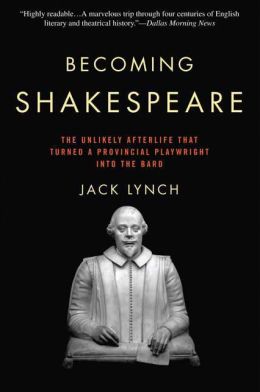
Becoming Shakespeare (2007)

Becoming Shakespeare: The Unlikely Afterlife That Turned a Provincial Playwright Into the Bard. Jack Lynch. 2007. Walker. 320 pages. [Source: Library]

I'm so glad whimsy led me to Becoming Shakespeare! This is a little book about how Shakespeare became SHAKESPEARE, the one and only. After all, in his lifetime, he was one of many successful playwrights in Elizabethan England. But he wasn't recognized as THE BARD during his life. His universal genius was far from recognized. In chapter one, "Reviving Shakespeare" Lynch discusses how Shakespeare's resurrection was due in part to the restoration of the monarchy. Before Charles II was restored to the throne, plays were banned; theatres were sinful, don't you know! But the oh-so-merry monarch changed the rules. New plays were produced, of course, during this time. But Shakespeare was revived as well. In chapter two, "Performing Shakespeare," Lynch discusses several centuries worth of actors whose claim to fame was due in part to playing Shakespeare roles. Notable actors mentioned include: Thomas Betterton, Colley Cibber, James Quin, David Garrick, John Philip Kemble, Sarah Kemble Siddons, Fanny Kemble, Mary Robinson, Dorothy Jordan, and Edmund Kean. Chapter three, "Studying Shakespeare" is the story of Shakespeare scholarship through the centuries. This focuses on publishing and editing and various editions, changes to the texts, etc. This chapter is not about censoring Shakespeare, that story is saved for another chapter. Chapter Four, "Improving Shakespeare," is about adapting or editing Shakespeare for the stage. This chapter focuses on producers changing or rewriting Shakespeare to meet their needs and satisfy their audiences. This included changing endings in some cases! It also included adding scenes, adding characters, adding lines. In some cases, these "new" editions of Shakespeare were produced on the stage for decades while the original play was not. So one's new-and-improved King Lear might be the only one seen by many generations! Chapter five, "Co-opting Shakespeare" is all about politics, about using Shakespeare lines or quotes for your own purposes, to prove your point or make an argument, as propaganda in a way. This wasn't a favorite chapter. But it had its moments. It discusses how people read politics into his plays. How they could watch a play on the stage and come away with an opinion about modern politics. Chapter six, "Domesticating Shakespeare" is about making Shakespeare family-friendly and safe for all ages. This is about censorship or "bowdlerizing" the text. Removing puns and innuendos and such. But this is also the chapter that talks about retelling Shakespeare the right way (Tales from Shakespear). Chapter seven, "Forging Shakespeare" is about writers or historians who have "found" or "discovered" documents (signatures, plays, poems, etc.) It is about various attempts to hoax the public and achieve fame. Chapter eight, "Worshipping Shakespeare" is all about celebrating Shakespeare making him larger-than-life in some instances. This is about cultivating and celebrating his legacy. For example, Shakespeare celebrations and Shakespeare-related tourist attractions.

I definitely enjoyed this one! Some chapters I appreciated more than others. Some I thought did a great job in capturing culture and society.

© 2013 SukaYuka.com of SukaYuka's Book Reviews
Monday, October 21, 2013

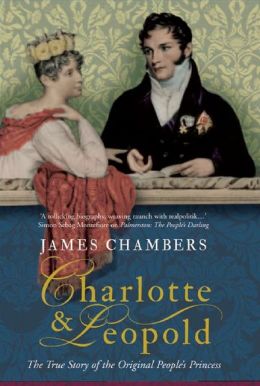
Charlotte & Leopold

Charlotte & Leopold: The True Story of the Original People's Princess. James Chambers. 2007. 256 pages.

During her life, Princess Charlotte was the most popular member of the royal family. She was more popular than her grandfather, George III, and her father, the Prince Regent (George IV). Her life was certainly interesting. Her father and mother were CHARACTERS. They often made fools of themselves to the media and society in general. They were always fighting one another, always bickering, always trying to outdo one another. I'd already read a biography of Caroline. The focus on her parents is almost necessary to explain her childhood and upbringing. It also helps explain her popularity, to a certain degree.

The second half focuses on her love life, on her suitors and would-be suitors. The book focuses, of course, on the man she married, Prince Leopold. He's an interesting character as well! And his story does not end with his wife's death. The last chapters of the book follow his life...

I liked this one. I did. I also really loved Becoming Queen Victoria: The Tragic Death of Princess Charlotte and the Unexpected Rise of Britain's Greatest Monarch. The books overlap on their focus of Princess Charlotte. Both books bring the Georgian royalty to life, highlighting some of the more interesting members of the family!

© 2013 SukaYuka.com of SukaYuka's Book Reviews
Tuesday, August 6, 2013

Cotillion (1953)

Cotillion. Georgette Heyer. 1953/2007. Sourcebooks. 362 pages. [Source: Review Copy]

Cotillion was one of the first Georgette Heyer novels I ever read. I appreciated it even more as a reread. When I (first) read Cotillion, I didn't know Heyer yet; I didn't LOVE Heyer yet. I didn't know her style, her wit, her techniques. Now I do. And it made quite the difference. In my first review, I complained about the slow start. Now, I see Cotillion as being a joy from the very start! I now love it cover to cover!!!

I love how Cotillion begins: with some confusion and a bit of a fuss. A room full of men talking about their eccentric great-uncle, about his money and his will, about his ward, Miss Kitty Charing. Almost all the men in the room feel they know the reason they were invited to visit. Great-Uncle Matthew wants one of his great-nephews to propose to Miss Kitty. The happy couple will receive an inheritance. Otherwise, he will leave his money to charity. Not all the men are eligible. At least one is married already. Not all the men are willing. Three potential suitors are noticeably missing from the party. One of the three is a soldier, he never is part of the story. The other two, however, are key players! Freddy Standen and Jack Westruther. Several proposals are given that weekend...

Freddy Standen is late in arriving. In fact, Miss Kitty encounters him only because she is running away from home. (The whole situation is so embarrassing for her!) He was clueless about the weekend, about the reason for the family get together. Miss Kitty has an aha moment. She does something surprising: she proposes to him. She convinces him that a FAKE betrothal would be just the thing. She could go with him to London, to stay with his family; she could see the sights, she could go shopping, she could go to parties, she could have a life. The betrothal would only last a month or so at most. Just enough for her to have a great time away from home. Perhaps just long enough to make a certain other 'cousin' jealous. He says yes. It's a reluctant yes; Freddy isn't as clever at scheming as Miss Kitty. (And this is Miss Kitty's very first scheme! But it won't be her last...)

Cotillion was enjoyable from start to finish!!! The ending is oh-so-satisfying!!! I enjoyed Miss Kitty and I adored Freddy! I would definitely recommend this one.


© 2013 SukaYuka.com of SukaYuka's Book Reviews

Thursday, July 4, 2013

Zoo Station (2007)

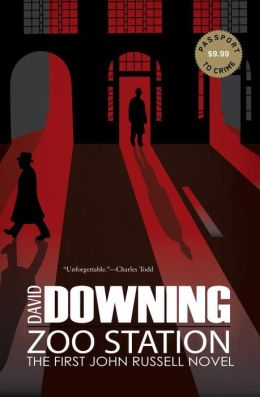
Zoo Station. David Downing. 2007. Soho Press. 304 pages. [Source: Bought]

John Russell is a British journalist living in Nazi Germany in 1939. While he doesn't like the Nazi regime, he loves his (German) son very much. (He's divorced from his wife.) He's also been in a good and steady relationship with his German girlfriend, Effi, an actress, for many years. One day he's presented with an opportunity, the Russians want him to write articles; he'll be well paid, but Russell fears that if he begins working for another country he'll soon be asked to do more than write--perhaps spying or smuggling or something much more dangerous. But after some doubts, he talks himself into it. He gets the permission of the Nazis--who want the articles in advance so they can be approved--and his work begins. The British take notice and also want to see the articles in advance. They want to be very friendly with Russell just in case he proves useful. (Russell suspects they want him to be a spy as well.) Most of Zoo Station seems to be setting the stage for the 'real story' that may be revealed in later novels.

John Russell has some decisions to make. He has to decide how much he's willing to do to risk his comfortable life in order to stand up for what he knows is right. Is he willing to ask his Nazi acquaintances about the fate of his Jewish friends? How much is he willing to do to let the world know the truth about the Nazis? Is he willing to risk his own life? Should he keep silent with the truth? Can he manage to put his conscience on hold and wait for the right moment?

Zoo Station was an interesting read. It definitely held my interest! I'm not sure I loved it, but I definitely want to know what happens next!


© 2013 SukaYuka.com of SukaYuka's Book Reviews
Tuesday, April 9, 2013

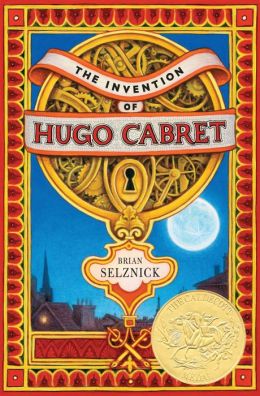
Invention of Hugo Cabret (2007)

Invention of Hugo Cabret. Brian Selznick. 2007. Scholastic. 525 pages.

I hadn't really planned on rereading Brian Selznick's Invention of Hugo Cabret, but this year I joined the book to movie challenge. I'd been curious about the film, Hugo. This "review" will share what I thought about both the book and the movie.

I found the movie wonderful. I found it very compelling. I was drawn into the story--the time and place. This is a movie (and a book) where setting is just as important if not MORE important than the characters. Because it is set in a train station in Paris, France, in the early 1930s, because it focuses on such an intriguing orphan who is desperate to make sense of the world and fix what needs fixing, because it was a story with such a strong emphasis on friendship and making your own family, it worked for me. The book and the movie are different from one another. The movie adds characters and even gives them story-lines. The movie changes some of the relationships as well. But I thought some of the changes--at least--worked better. I liked the Hugo of the movie better than the Hugo of the book! While the novel's focus on old cinema was interesting, on film it meant SO MUCH MORE. This book was meant to be filmed.

I originally read the book in 2007. I watched the movie a few weeks ago and then decided to reread the book. I definitely preferred the movie to the book. But the book is a very quick read! It takes longer to watch the movie than it does to read the book!

© 2013 SukaYuka.com of SukaYuka's Book Reviews