Showing posts with label 2005. Show all posts

Monday, November 25, 2013

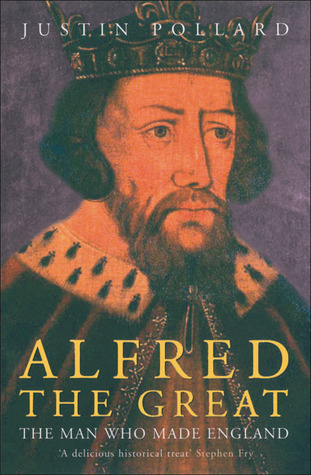
Alfred the Great (2005)

Alfred the Great. Justin Pollard. 2005. John Murray. 368 pages. [Source: Library]

I liked this biography of Alfred the Great. I can see why it might not appeal to every reader. Why it might not be considered a must-read by everyone. Not everyone gets excited by history. But I did enjoy learning more about Alfred the Great. This biography was pleasantly complex. It was rich in detail; it wasn't always the easiest to follow. I wouldn't want to be quizzed necessarily. But at the same time I was fascinated that there was so much to know, that so much has been passed down to us, that there are historians who specialize in this time period. There is a great deal about Vikings in this biography, which is just what I was looking for...

Since falling in love with Vikingland, I wanted to learn more. The song goes, "We split your isles diagonally from south-east to north-west. Our section was called the Danelaw, King Alfred ruled the rest" and "though we began as raiders so well-planned you accepted us as traders." The song does have a propaganda feel (in a good way) to it.

I found plenty within this one to interest me. Readers can learn a lot about Anglo-Saxon culture through the centuries. My goal was mainly big-picture. As I said earlier, there was a lot of information that could be absorbed by a careful reader or scholar. I wasn't trying to learn-to-remember every little thing. 

© 2013 SukaYuka.com of SukaYuka's Book Reviews

Monday, August 19, 2013

Two "You Wouldn't Want To Be" Books

You Wouldn't Want To Be In Alexander The Great's Army. Jacqueline Morley. 2005. Scholastic. 32 pages. [Source: Library]

I have only recently discovered the "You Wouldn't Want To Be" nonfiction picture book series published by Scholastic. You Wouldn't Want To Be in Alexander The Great's Army: Miles You'd Rather Not March was the first I read. I really enjoyed it. It's reader-friendly, conversational, and informative as well. When I say the book is conversational, I mean it. The book is addressed to the reader; the reader is the YOU of the text.
It is the 4th Century BC and you are a sheep farmer living in the hilly land just north of Greece known as Macedonia. You Macedonians are tough country people, used to a hard life. Though you might speak Greek and worship Greek gods, the Greeks of the south look down on you as rough and uncivilized foreigners. However, Macedonians have been teaching those soft-living southern Greeks a thing or two recently. Macedonia used to be weak and divided but your previous king, Philip II, made it united and strong and turned the Macedonians into a fighting force that now controls most of Greece. His son, Alexander III, who is only 20, is about to start on a great scheme that his father was planning when he died. He is going to invade the mighty Persian Empire. He needs soldiers, so why not leave those bleak hills, join him and see the world?
Alexander's story is told in two-page spreads: "Joining up," "334 BC Alexander Sets Off," "332 BC Siege of Tyre," "332-331 BC In Egypt," "331 BC The Battle of Gaugamela," "330 BC Sacking of Persepolis," "330 BC King Darius Dies," "329 BC Crossing the Hindu Kush," "327 BC Scaling the Sogdian Rock," "326 BC Into India," "325 BC The Gedrosian Desert," "323 BC: The Death of Alexander."

I really enjoyed the way the information was conveyed to the reader. The information was clearly presented and quite interesting. While the illustrations by David Antram aren't what I consider great, they began to grow on me as I read and reread this one.

Horrible Histories, Alexander the Great:


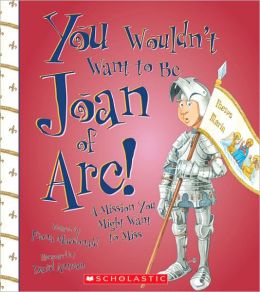
You Wouldn't Want To Be Joan of Arc! A Mission You Might Want To Miss. Fiona MacDonald. 2010. Illustrated by David Antram. Scholastic. 32 pages. [Source: Library]

I really enjoyed reading Fiona MacDonald's You Wouldn't Want To Be Joan of Arc! I wish my library had every single book in this series. This one had me at hello.
The year? It's 1428. The place? Domremy, a village in northeast France. And you? You're Joan, the daughter of peasant farmers. Your family is neither very rich nor very poor. Like all the other local youngsters, you've grown up living in fear. For years, war has been raging throughout France. One of your cousins has been killed in battle, and the village church--next door to your family's house--has been burned down by the enemy. So far, you've managed to stay safe. But you face great dangers ahead. Why? Because you dream of a secret, sacred mission: to rescue France from its attackers! You're young--just 16. You're not a famous or powerful person. You can't read or write, and you haven't been trained to use weapons. You don't understand politics or know how to plan a battle. But you're utterly convinced that you must save your country. How can you fulfill your dream?
This picture book biography of Joan of Arc is simple and straight-forward. There is enough information for younger readers; obviously, older readers might want or need a more in-depth biography more appropriate for their age-group. But this picture book biography is fun and clearly presented. I love how the information is shared with readers.

The two page spreads include: "Dutiful Daughter," "In The War Zone," "Rival Rulers," "Hearing Voices," "An Urgent Mission," "Royal Meeting," "Saving a City," "The King is Crowned," "Sensing Doom," "A Terrifying Trial," "Life--or Death?," "Glorious Memory."

I think this series is good because it makes history exciting and entertaining. It's never too early to cultivate a love of history, perhaps, the earlier the better!

Horrible Histories, Joan of Arc


© 2013 SukaYuka.com of SukaYuka's Book Reviews
Monday, August 5, 2013

Queen Emma and the Vikings (2005)

Queen Emma and the Vikings. Harriet O'Brien. 2005. Bloomsbury. 288 pages. [Source: Library]

I enjoyed reading this biography. This biography starts around the year 1000 and ends around 1052.  As a young girl, Emma was married to Aethelred (the Unready), the Anglo-Saxon king of England. The couple had two sons and a daughter. One of those sons, Edward, would later become king himself as "Edward the Confessor." England during this time was a mess with plenty of Vikings raiding and pillaging. After her husband's death (and I am simplifying the story in this summary), she married the Viking king, Cnut. This couple would have two children. Their son, Harthacnut, would eventually be king as well. As if that wasn't quite complex enough, Emma is the great-aunt of William the Conqueror. So Emma's importance is clear.

I found this biography complex but fascinating. The author did a great job in providing clarifying resources for her readers. The front of the book contains an extremely helpful dramatis personae. There is a full paragraph of background and summary for each person in the book. There are family trees. There are maps. There is a timeline. The text itself is as clear as it probably can be. If it reads like a tangled mess at times, it is precisely because it was a tangled state of affairs. This biography is full of tension between the Anglo-Saxons, the Normans, the Vikings, the Church, the "old ways" and "the new ways." There is a focus on politics, the economy, law-making, and the church. (Plenty of talk about monks and their record-keeping and book writing. I was surprised by all the texts and records kept during this period.)

One of the things discussed in this biography is the shaping or crafting of history. Emma commissioned a monk to write a history for her, this book could be seen, in a way, as a tool of propaganda. Writing with a specific audience and purpose in mind and "making" the facts fit that purpose.

Two Horrible Histories Songs:


© 2013 SukaYuka.com of SukaYuka's Book Reviews

Thursday, August 1, 2013

The Borgia Bride (2005)

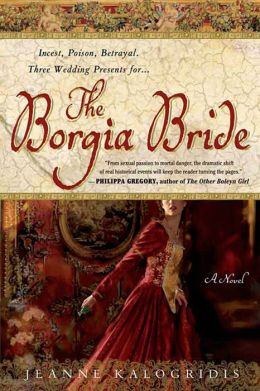
The Borgia Bride. Jeanne Kalogridis. 2005. St. Martin's Press. 528 pages. [Source: Library]

The Borgia Bride is not a romance novel. If you expect it to be strictly a "romance novel", you may be shocked at how unromantic it is. If you're reading it because you love history, you may also be disappointed, because of the way Kalogridis has decided to interpret history--or "the facts" as she sees them. (I think she was going for shock.) If you are looking for a book with well-rounded characters, look elsewhere.

The novel is set in Renaissance Italy, roughly around 1492-1503. The heroine of the novel is Sancha of Aragon, the wife of Jofre Borgia. It was an arranged marriage, as many were at the time. The trouble for Sancha truly begins when the couple goes to Rome to live with the rest of the Borgia family. It is then that Sancha meets her father-in-law (Rodrigo Borgia, Pope Alexander VI), her sister-in-law, Lucrezia, and her brother-in-law Cesare. The author has Sancha falling into instant love (or should that be lust?) with Cesare. This is perhaps helped along by the fact that Cesare "saves" her from being raped by her father-in-law. The two speak the next day, and when he apologizes for wanting to seduce her himself, she confesses that she wouldn't mind--she loves him so it would be different. But Sancha though an adulteress soon realizes that the Borgia family is way too immoral for her to ever belong. She discovers the sick, disturbing secrets of the family; if the family learns that she knows these secrets, well, it wouldn't be pretty. For Sancha realizes that Cesare may be oh-so-dreamy and have a voice like velvet (the book does say that, his voice and manners were like velvet), but he is a murderer; he is cold, calculating, selfish. She's brave enough to end the relationship, but, she still remains trapped in this horribly dysfunctional family. Over half the novel is about Sancha gaining the strength and perhaps stealth needed to defeat evil and make a stand for justice.

The Borgia Bride definitely has adult content. It is historical fiction. Its focus is on the outrageous, scandalous, reprehensible behavior of the Borgia family. I'm not sure how much of this is based on actual historical evidence--not historical allegations, because allegations are sometimes known to be questionable or controversial or completely false. The Borgias as depicted by Kalogridis are evil through and through with absolutely no good to them at all. The father, the sons, the daughter. They are not a little bad, a little dangerous--they are pure evil. Cesare is not a Byronic hero; he's the devil. There is absolutely no character depth in this novel. Villains can be exciting or fascinating. (Would Alias be the same without Arvin Sloane? Would Once Upon A Time be the same without Regina or Mr. Gold? There has to be substance even to villains for the story to work.)

The Borgia Bride's biggest weakness is it is almost impossible to truly care about any of the characters. 


© 2013 SukaYuka.com of SukaYuka's Book Reviews