Showing posts with label 2010. Show all posts

Saturday, December 14, 2013

Do you know Pete?

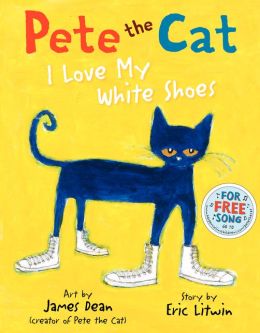
Pete the Cat: I Love My White Shoes. Eric Litwin. Illustrated by James Dean. 2010. HarperCollins. 40 pages. [Source: Library]

Pete the Cat was walking down the street in his brand-new white shoes. Pete loved his white shoes so much, he sang this song:
"I love my white shoes,
I love my white shoes,
I love my white shoes."

I love, love, love, REALLY REALLY love Pete the Cat. He is my kind of cat. You should definitely download the free song(s) as well, so you can really sing right along with the book(s). True, you could make up your own tune, but, the song is so perfectly catchy.

So. Pete the Cat has white shoes which he loves. But, when he steps in some unpleasant things: strawberries, blueberries, a mud puddle, a bucket of water, does Pete cry?! Goodness no! He just keeps on walking and singing his song! Is this a concept book about colors (white, red, blue, brown)? Is this a book teaching necessary coping skills to preschoolers and kids? A bit of both. But. It is also just a really fun, very entertaining story about a groovy cat! I absolutely LOVE the repetition, and the fact that this is a book everyone can participate and join in on!

To get the full experience, watch this video with the narration/song!
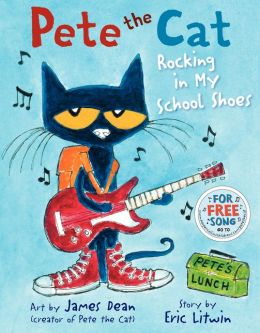
Pete the Cat: Rocking In My School Shoes. Eric Litwin. Illustrated by James Dean. 2011. HarperCollins. 40 pages. [Source: Library]

Here comes Pete strolling down the street, rocking red shoes on his four furry feet. Pete is going to school, and he sings this song: I'm rocking in my school shoes, I'm rocking in my school shoes, I'm rocking in my school shoes."

I really liked this one. I loved seeing Pete go to school. I loved seeing him read in his school shoes (the library), eating in his school shoes (the cafeteria), playing in his school shoes (the playground), etc. (There is also singing, painting, adding, and writing). I loved the descriptions of the school environment, the participatory way in which it's written so it gets everyone involved, and most of all the repetition. DOES PETE WORRY? Goodness no!!!

Here is a fan video of the book, I loved seeing the Pete the Cat doll.
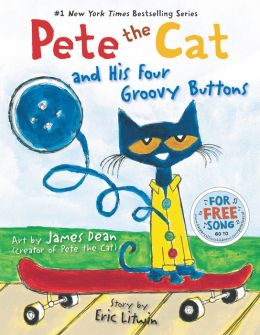

Pete the Cat And His Four Groovy Buttons. Eric Litwin. Illustrated by James Dean. 2012. HarperCollins. 40 pages. [Source: Library]

Pete the Cat put on his favorite shirt with four big, colorful, round, groovy buttons. He loved his buttons so much, he sang this song: 
"My buttons, my buttons,
my four groovy buttons.
My buttons, my buttons,
my four groovy buttons."

This one was the first Pete the Cat book I read, and I must say it is probably my favorite. I love, love, love it so much!!! If I Love My White Shoes was "teaching" colors, then Four Groovy Buttons is "teaching" subtraction. For, Pete the Cat loses each of his four buttons one by one. But does Pete cry?! Goodness no! I absolutely love the end of this one!!! And the moral this time: "I guess it simply goes to show that stuff will come and stuff will go. But do we cry? Goodness, NO! We keep on singing."

I'll share two videos this time. One with the HarperCollins narration, and the second of a teacher reading it aloud.

Pete The Cat Saves Christmas. Eric Litwin. Illustrated by James Dean. 2012. HarperCollins. 40 pages. [Source: Library]

Twas the day before Christmas and Santa was ill. In the cold winter wind he had caught a bad chill. Will Christmas be canceled? Will it come to that? "NEVER!" cried Santa. "Let's call Pete the Cat!" Santa asked Pete to deliver the toys to all the good girls and to all the good boys. "I'll do it!" says Pete. "And though I am small, at Christmas we give, so I'll give it my all."

I definitely liked this one! In this adventure, Pete the Cat helps Santa and thereby "saves" Christmas. It's a cute story. Not my favorite from the entire series, but, it's got a redeeming message all the same.

A video read aloud.
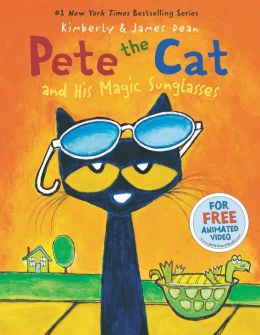
Pete the Cat And His Magic Sunglasses. Kimberley and James Dean. 2013. HarperCollins. 40 pages. [Source: Library]

Pete the Cat did not feel happy. Pete had never, ever, ever, ever been grumpy before. Pete had the blue cat blues. Then, as if things were not bad enough, along came Grumpy Toad. Grumpy Toad was never happy! He always wore a frown. But Grumpy Toad was not grumpy today. He said, "These cool, blue, magic sunglasses make the blues go away. They help you see things in a whole new way." Pete put on the cool, blue, magic sunglasses. He looked all around. "Right on! The birds are singing. The sky is bright. The sun is shining. I'm feeling alright!"

If only it were this easy to get rid of bad moods! Pete the Cat has the blues, but, a friend soon shows him a new way of looking at things. Not content to keep this to himself, Pete the Cat is soon helping everyone he meets cheer up. Lots of folks need magic sunglasses....

I enjoy this series very much. This book doesn't have an official song, but, this video gives you a tune to sing with it.

© 2013 SukaYuka.com of SukaYuka's Book Reviews

Thursday, October 17, 2013

Noah Barleywater Runs Away (2010)

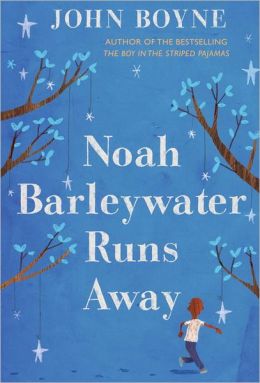
Noah Barleywater Runs Away. John Boyne. 2010/2012. Random House. 240 pages. [Source: Review Copy]

Noah Barleywater left home in the early morning, before the sun rose, before the dogs woke, before the dew stopped falling on the fields.

Would I have enjoyed Noah Barleywater Runs Away if I'd read it as a child? No, I'm sure I wouldn't have. Did I enjoy it as an adult? Yes. I've learned to handle those kinds of books now; I can even predict them early on. Plus I've read a certain children's classic twice now!

John Barleywater is running away from home. It becomes obvious within a few pages that this novel has some magical elements in it. By the time readers meet the talking dog and donkey, it's clear that readers are in for a fantastical treat. They may be disappointed that all the adventure happens in story format as an "old man" shares his life story with sprinkles of advice to John in the quirky corners of an old toy shop. I happened to enjoy this aspect of it. I think they have something to learn from one another; I think 'the gift' worked both ways. The old man was able to persuade the 8 year old boy to return home to his parents; and the young boy was able to give the old man some resolution, perhaps.

I guessed the reason why John Barleywater was running away from home. This is revealed to readers in several stories throughout the novel. While most of the stories concern the life of the "old man," he is able to coax the young boy into sharing stories of his own.

Quote:
'You should never want to be anything other than you are,' the old man said quietly. 'Remember that. You should never wish for more than you have been given. It could be the greatest mistake of your life.' (191)
© 2013 SukaYuka.com of SukaYuka's Book Reviews
Monday, August 26, 2013

Two More "You Wouldn't Want To" Books

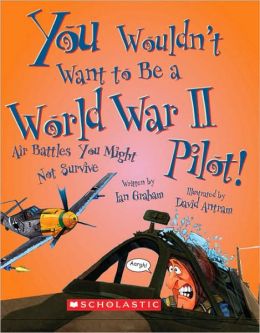
You Wouldn't Want To Be A World War II: Air Battles You Might Not Survive. Ian Graham. Illustrated by David Antram. 2009. Scholastic. 32 pages. [Source: Library]

Last Monday, I reviewed two books in this series, You Wouldn't Want to Be in Alexander The Great's Army and You Wouldn't Want to Be Joan of Arc. Today I am sharing two more books with you. The first is You Wouldn't Want To Be A World War II Pilot! This nonfiction picture book would be a good introduction of the subject for young readers. Older readers would probably want to know even more.

From the introduction: "You are 16. Home is San Antonio, Texas. The year is 1934. You're crazy about aircraft and flying. Your room is filled with models and posters of airplanes. You go to your local airfield, Stinson Field, to study pilots and their planes at every opportunity..."

The spreads include: "Learning to Fly," "Joining Up," "Fighter Training," "The Spitfire," "First Post," "Combat," "Passing Time," "Bailing Out," "Pearl Harbor," "Pacific Fighters," "Under U.S. Command," and "Peace at Last."

While this picture book may begin in the United States, it soon crosses the Atlantic. After the war begins, American pilots volunteer for Britain's RAF. This picture book, in a way, tells that story. After all, it takes several years for the U.S. to enter the war.

I liked this one. I didn't quite love it like some of the others in the series. But I thought it was good.

Horrible Histories, Woeful Second World War, RAF Song


You Wouldn't Want To Be A Shakespearean Actor. Jacqueline Morley. Illustrated by David Antram. 2010. Scholastic. 32 pages. [Source: Library] 

I loved You Wouldn't Want To Be A Shakespearean Actor by Jacqueline Morley. I thought it was a great introduction to the Elizabethan theatre. Readers learn about James and Richard Burbage and William Shakespeare, of course. It was very reader-friendly. I thought it was informative and straight-forward.

From the introduction:
 "It's 1594 and you're a young boy growing up in Shoreditch, a neighborhood on the outskirts of London. Until about 20 years ago, it was a quiet spot. Then actors from the city arrived and put up a "playhouse" here--a building just for putting on plays! Before this, actors--who are called players--had always traveled the country, setting up makeshift stages wherever they could find an audience. Puritans, like your parents, don't approve of acting. They say that players don't do real work--they just play. They also say that plays are just longer versions of the foolish shows that wandering entertainers have been putting on since medieval times. But you think your parents are wrong to say that plays are displeasing to God; they've never been to one! Well, you have (unknown to them, of course), and you think plays are the best thing ever. You'd love to act in one."
I loved learning all the behind-the-scenes details. For example, from the spread "Stretching Your Memory,":
You're a star player now, the company's first choice for female leads. But there's a downside to success. You're up till midnight, studying lines until you feel your head will split. The trouble is, to keep the audiences coming, the company performs a different play each day. There are some 40 plays to choose from, and you must act in all of them. You have to remember every part you've ever learned! About 15 plays a year will be new; the rest are revivals of old plays. In some plays, you perform more than one role, so altogether you need to keep at least 50 parts in your head. Minor actors, who each play more than one part, may need to memorize 100 roles. (14)
I would definitely recommend this one!!!

Horrible Histories, William Shakespeare Song


© 2013 SukaYuka.com of SukaYuka's Book Reviews
Monday, August 19, 2013

Two "You Wouldn't Want To Be" Books

You Wouldn't Want To Be In Alexander The Great's Army. Jacqueline Morley. 2005. Scholastic. 32 pages. [Source: Library]

I have only recently discovered the "You Wouldn't Want To Be" nonfiction picture book series published by Scholastic. You Wouldn't Want To Be in Alexander The Great's Army: Miles You'd Rather Not March was the first I read. I really enjoyed it. It's reader-friendly, conversational, and informative as well. When I say the book is conversational, I mean it. The book is addressed to the reader; the reader is the YOU of the text.
It is the 4th Century BC and you are a sheep farmer living in the hilly land just north of Greece known as Macedonia. You Macedonians are tough country people, used to a hard life. Though you might speak Greek and worship Greek gods, the Greeks of the south look down on you as rough and uncivilized foreigners. However, Macedonians have been teaching those soft-living southern Greeks a thing or two recently. Macedonia used to be weak and divided but your previous king, Philip II, made it united and strong and turned the Macedonians into a fighting force that now controls most of Greece. His son, Alexander III, who is only 20, is about to start on a great scheme that his father was planning when he died. He is going to invade the mighty Persian Empire. He needs soldiers, so why not leave those bleak hills, join him and see the world?
Alexander's story is told in two-page spreads: "Joining up," "334 BC Alexander Sets Off," "332 BC Siege of Tyre," "332-331 BC In Egypt," "331 BC The Battle of Gaugamela," "330 BC Sacking of Persepolis," "330 BC King Darius Dies," "329 BC Crossing the Hindu Kush," "327 BC Scaling the Sogdian Rock," "326 BC Into India," "325 BC The Gedrosian Desert," "323 BC: The Death of Alexander."

I really enjoyed the way the information was conveyed to the reader. The information was clearly presented and quite interesting. While the illustrations by David Antram aren't what I consider great, they began to grow on me as I read and reread this one.

Horrible Histories, Alexander the Great:


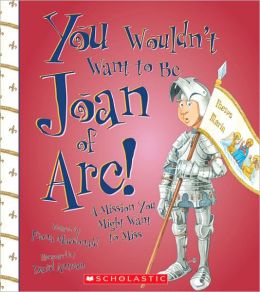
You Wouldn't Want To Be Joan of Arc! A Mission You Might Want To Miss. Fiona MacDonald. 2010. Illustrated by David Antram. Scholastic. 32 pages. [Source: Library]

I really enjoyed reading Fiona MacDonald's You Wouldn't Want To Be Joan of Arc! I wish my library had every single book in this series. This one had me at hello.
The year? It's 1428. The place? Domremy, a village in northeast France. And you? You're Joan, the daughter of peasant farmers. Your family is neither very rich nor very poor. Like all the other local youngsters, you've grown up living in fear. For years, war has been raging throughout France. One of your cousins has been killed in battle, and the village church--next door to your family's house--has been burned down by the enemy. So far, you've managed to stay safe. But you face great dangers ahead. Why? Because you dream of a secret, sacred mission: to rescue France from its attackers! You're young--just 16. You're not a famous or powerful person. You can't read or write, and you haven't been trained to use weapons. You don't understand politics or know how to plan a battle. But you're utterly convinced that you must save your country. How can you fulfill your dream?
This picture book biography of Joan of Arc is simple and straight-forward. There is enough information for younger readers; obviously, older readers might want or need a more in-depth biography more appropriate for their age-group. But this picture book biography is fun and clearly presented. I love how the information is shared with readers.

The two page spreads include: "Dutiful Daughter," "In The War Zone," "Rival Rulers," "Hearing Voices," "An Urgent Mission," "Royal Meeting," "Saving a City," "The King is Crowned," "Sensing Doom," "A Terrifying Trial," "Life--or Death?," "Glorious Memory."

I think this series is good because it makes history exciting and entertaining. It's never too early to cultivate a love of history, perhaps, the earlier the better!

Horrible Histories, Joan of Arc


© 2013 SukaYuka.com of SukaYuka's Book Reviews

Friday, July 5, 2013

Three Rivers Rising (2010)

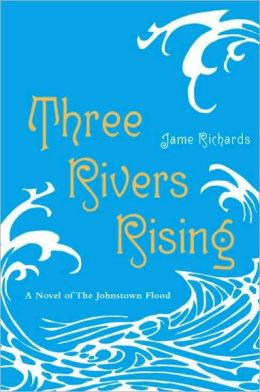
Three Rivers Rising. Jame Richards. 2010. Random House. 304 pages. [Source: Review Copy]

Three Rivers Rising is a historical romance novel written in verse. There are a handful of narrators: Celestia, Peter, Maura, and Kate. Three Rivers Rising uses the tragic Johnston Flood of 1889 as a setting for a forbidden romance between the wealthy Celestia and the poor working boy Peter. These two meet one summer--1888--and fall madly in love. Celestia isn't the only daughter falling in love; her older sister, Estrella, is also having her first taste of love, for better or worse. Unfortunately, her one "true love" isn't honorable. Estrella makes a hasty exit with an elderly aunt hoping that the society matrons won't notice. Her future is uncertain: will her family ever acknowledge her again? The summer ends with Celestia and Peter still in love and promising to write one another faithfully. A year later they meet again, though her father has arranged for Celestia to marry someone, Celestia KNOWS that Peter is the only husband she'll ever have. So she leaves her old life behind and goes to the valley, to Johnston to be with Peter. Days later, the flood occurs. Almost a third of this romance novel focuses on the flood itself. This is where the other narrative voices become very useful!

Overall, I did enjoy this one! The romance is lovely in this one. I thought it was well written.

© 2013 SukaYuka.com of SukaYuka's Book Reviews

Friday, April 19, 2013

The Grimm Legacy (2010)

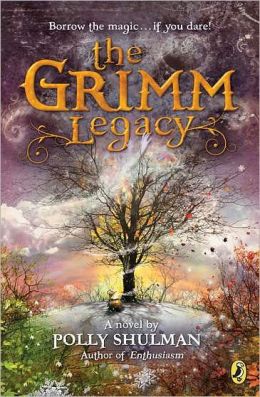
The Grimm Legacy. Polly Shulman. 2010. Penguin. 325 pages.

 The Grimm Legacy has an intriguing premise. Wouldn't it be fun if fairy tales were true and there were magical artifacts gathered together in a library collection in New York? Wouldn't it be fun to work in such a library, such a collection? To be able to 'try' some of these artifacts yourself. But it isn't all fun as our heroine, Elizabeth Rew, and her fellow pages (Marc Merrit, Anjali Rao, Aaron Rosendom) learn. For someone is attempting to steal the real magical objects and replace them with fakes. And the attempt is succeeding. These four teens (Elizabeth, Marc, Anjali, and Aaron) must learn to work together--despite great personality conflict--to solve the mystery of WHO is stealing from the Grimm Collection. This fantasy novel has mystery and drama for it's a dangerous task before them.

While I liked the book well enough to keep reading, I didn't love it. I just didn't make a good connection with the characters. Some of the characters were interesting; for example, Anjali has a very spirited sister that plays an important role in the novel. But I wasn't satisfied with their development; the characters just didn't feel believable enough.

Read The Grimm Legacy
  • If you enjoy YA fantasy
  • If you enjoy fantasy 
  • If you are interested in the second novel in the series which involves time travel! It's called The Wells Bequest!
© 2013 SukaYuka.com of SukaYuka's Book Reviews