Showing posts with label 2009. Show all posts

Saturday, October 26, 2013

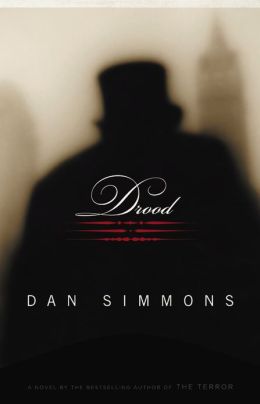
Drood

Drood. Dan Simmons. 2009. Little, Brown. 784 pages. [Source: Bought]

My name is Wilkie Collins, and my guess, since I plan to delay the publication of this document for at least a century and a quarter beyond the date of my demise, is that you do not recognise my name. Some say that I am a gambling man and those that say so are correct, so my wager with you, Dear Reader, would be that you have neither read nor heard of any of my books or plays. Even so, I would wager my current fortune, such as it is, and all future royalties from my plays and novels, such as they may be, on the fact that you do remember the name and books and plays and invented characters of my friend and former collaborator, a certain Charles Dickens.

I wish Drood had not had such an intriguing beginning. The opening chapters of Drood fooled me into thinking that Drood would be my kind of book. If I hadn't been convinced to buy based on these chapters, then I wouldn't have felt the almost-obligation to finish no matter what. I would say I definitely enjoyed the first third, for the most part; the middle third, well, I began to have some doubts and things began to annoy me; the last third, well, I was forcing myself to finish because I didn't want to fail at having read it. There were times I thought I was going to love this one, and then it started--slowly but surely--to turn to dislike.

Drood may not be for me, but that doesn't mean it won't be for you. Drood didn't work for me for a few reasons: 1) I don't like unreliable narrators 2) I don't like books with no likeable characters 3) I have little tolerance for horror novels. I thought perhaps my love for Dickens and Collins was enough, but, I think the opposite proved true. Because the more Simmons' characters deviated, the more angry I became. I found the narration tedious and repetitive among other things. Readers are reminded in almost every chapter of Collins inferiority complex and jealousy. He rambles on and on about how he's better, so much better, than Dickens. His envy and hatred of his friend gets old really quickly. He picks apart Dickens' books and elaborates on his own. I don't mind the discussion of these books: I've read most of them already and have opinions of my own. But what seemed quirky but charming the first few times became too much by the end. Especially when these two men would bicker it out as to who was best. And then there's Collins constant drug use.

For readers who enjoy dark mysteries or horror novels, this one does have spooky, creepy, horrific moments.

Favorite Quotes:
The man was such a convincing fictionalist, not to mention one of the most self-righteous fellows ever to have trod the Earth, that I doubt if he ever confronted and acknowledged his own deeper motivations, except when they were as pure as springwater.
One might have responded that Charles Dickens invariably gave his audiences credit for too much and, through his self-indulgent flights of impenetrable fantasy and unnecessary subtlety, left far too many ordinary readers lost in the thick forest of Dickensian prose.
I am… was… almost certainly always shall be… ten times the architect of plot that Charles Dickens ever was. For Dickens, plot was something that might incidentally grow from his marionette-machinations of bizarre characters; should his weekly sales begin slipping in one of his innumerable serialised tales, he would just march in more silly characters and have them strut and perform for the gullible reader, as easily as he banished poor Martin Chuzzlewit to the United States to pump up his (Dickens’s) readership. My plots are subtle in ways that Charles Dickens could never fully perceive, much less manage in his own obvious (to any discerning reader) meandering machinations of haphazard plotting and self-indulgent asides. Impudent and ignorant people, such as this orphan-whelp Edmond Dickenson, were always saying that I was constantly “learning from Charles Dickens,” but the truth is quite the opposite. Dickens himself admitted, as I have mentioned earlier, that his idea for self-sacrificing Sydney Carton in A Tale of Two Cities had come from my character of Richard Wardour in The Frozen Deep. And what was his “old woman in white” in Great Expectations, the much-ballyhooed Miss Haversham, if not a direct steal from my central character in The Woman in White?
The conversation was mostly from Dickens, of course, but was as animated and higgledy-piggledy as most conversations with the Inimitable.
For years—decades now—the fiction of Charles Dickens had grown darker and more serious, allowing themes to dictate the structure of his novels and causing his characters to fit neatly (too neatly) into the pigeonholes of the overall thematic structure much like library cards might be shuffled into the proper drawer. (This is not to say that even the most serious Dickens novels of recent years had been without humour; I do not believe that Dickens could write something totally devoid of humour, any more than he could be trusted to stay completely serious at a funeral. He was truly irrepressible in that regard. But his topics had been increasingly serious as he abandoned the largely unstructured Pickwickian celebrations of life that had made him the Inimitable Boz and as social critique and social satire—all-important to him personally—had moved more towards the centre of his work. But in Our Mutual Friend, Dickens had created a sustained comedic novel of more than eight hundred cramped pages without striking—as far as I could tell—a single false note. This was incredible. It made my joints ache and my eyes burn with pain. In Our Mutual Friend, Dickens had abandoned the grand motifs of Little Dorrit and Bleak House and Great Expectations and almost completely subordinated his personal and social opinions into a masterful display of language and nuance that came very close to perfection. Very close. The complexity of his characters in this book far surpassed anything he had done before; indeed, Dickens seemed to have resurrected many of his earlier characters and reimagined them with the focus of a newly gained maturity and a newly found sense of forgiveness. Thus the evil lawyer Tulkinghorn from Bleak House reappears as the young lawyer Mortimer Lightwood, but redeems himself as Tulkinghorn never could have.
THE TURKEY WAS good. Some people have written that no one in England had been more responsible in the past decades for turning English families gathering around their tables on Christmas away from the bony and greasy goose and towards the rich, plump turkey than had Charles Dickens. His ending to A Christmas Carol alone seems to have pushed thousands of our previously goosified countrymen over the poultry bodice brink onto the white breast of true turkey feasts.
All authors’ public readings are exhausting for the author. A Dickens reading is exhausting for the author and for everyone around him.
Even in the glare of those brilliant gaslights, a strange, iridescent cloud seemed to hover around Charles Dickens as he read from his most recent Christmas tale. That cloud, I believe, was the ectoplasmic manifestation of the many characters whom Dickens had created and whom he now summoned—one at a time—to speak and act before us. As these ghosts entered him, Dickens’s posture would change. He would jerk alert or slump in despondency or laziness as the character’s spirit dictated. The author’s face would change immediately and totally—some facial muscles used so frequently by Charles Dickens going lax, others coming into play. Smiles, leers, frowns, and conspiratorial glances never used by the man who lived at Gad’s Hill flitted across the face of this spirit-possessed receptacle in front of us. His voice changed from second to second, and even in rapid-fire exchanges of dialogue Dickens seemed to be inhabited by two or more possessing demons at once. 
© 2013 SukaYuka.com of SukaYuka's Book Reviews

Monday, August 26, 2013

Two More "You Wouldn't Want To" Books

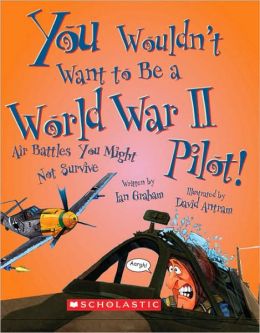
You Wouldn't Want To Be A World War II: Air Battles You Might Not Survive. Ian Graham. Illustrated by David Antram. 2009. Scholastic. 32 pages. [Source: Library]

Last Monday, I reviewed two books in this series, You Wouldn't Want to Be in Alexander The Great's Army and You Wouldn't Want to Be Joan of Arc. Today I am sharing two more books with you. The first is You Wouldn't Want To Be A World War II Pilot! This nonfiction picture book would be a good introduction of the subject for young readers. Older readers would probably want to know even more.

From the introduction: "You are 16. Home is San Antonio, Texas. The year is 1934. You're crazy about aircraft and flying. Your room is filled with models and posters of airplanes. You go to your local airfield, Stinson Field, to study pilots and their planes at every opportunity..."

The spreads include: "Learning to Fly," "Joining Up," "Fighter Training," "The Spitfire," "First Post," "Combat," "Passing Time," "Bailing Out," "Pearl Harbor," "Pacific Fighters," "Under U.S. Command," and "Peace at Last."

While this picture book may begin in the United States, it soon crosses the Atlantic. After the war begins, American pilots volunteer for Britain's RAF. This picture book, in a way, tells that story. After all, it takes several years for the U.S. to enter the war.

I liked this one. I didn't quite love it like some of the others in the series. But I thought it was good.

Horrible Histories, Woeful Second World War, RAF Song


You Wouldn't Want To Be A Shakespearean Actor. Jacqueline Morley. Illustrated by David Antram. 2010. Scholastic. 32 pages. [Source: Library] 

I loved You Wouldn't Want To Be A Shakespearean Actor by Jacqueline Morley. I thought it was a great introduction to the Elizabethan theatre. Readers learn about James and Richard Burbage and William Shakespeare, of course. It was very reader-friendly. I thought it was informative and straight-forward.

From the introduction:
 "It's 1594 and you're a young boy growing up in Shoreditch, a neighborhood on the outskirts of London. Until about 20 years ago, it was a quiet spot. Then actors from the city arrived and put up a "playhouse" here--a building just for putting on plays! Before this, actors--who are called players--had always traveled the country, setting up makeshift stages wherever they could find an audience. Puritans, like your parents, don't approve of acting. They say that players don't do real work--they just play. They also say that plays are just longer versions of the foolish shows that wandering entertainers have been putting on since medieval times. But you think your parents are wrong to say that plays are displeasing to God; they've never been to one! Well, you have (unknown to them, of course), and you think plays are the best thing ever. You'd love to act in one."
I loved learning all the behind-the-scenes details. For example, from the spread "Stretching Your Memory,":
You're a star player now, the company's first choice for female leads. But there's a downside to success. You're up till midnight, studying lines until you feel your head will split. The trouble is, to keep the audiences coming, the company performs a different play each day. There are some 40 plays to choose from, and you must act in all of them. You have to remember every part you've ever learned! About 15 plays a year will be new; the rest are revivals of old plays. In some plays, you perform more than one role, so altogether you need to keep at least 50 parts in your head. Minor actors, who each play more than one part, may need to memorize 100 roles. (14)
I would definitely recommend this one!!!

Horrible Histories, William Shakespeare Song


© 2013 SukaYuka.com of SukaYuka's Book Reviews
Thursday, June 20, 2013

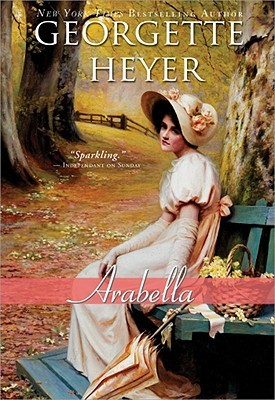
Arabella (1949)

Arabella. Georgette Heyer. 1949/2009. Sourcebooks. 312 pages.

I definitely enjoyed rereading Arabella by Georgette Heyer. Arabella is being treated to a season in London by her godmother. On her way, she runs into a little difficulty. She accidentally meets one of society's most eligible but oh-so-impossible-to-catch bachelors--wealthy of course--Mr. Robert Beaumaris. When she overhears a conversation not to her liking, she impulsively tells a few big lies. She's wealthy too. She understands what it is like to be chased for one's money. She hates all the fuss, too. Of course, at the time she had no idea who he was or how "important" he was in society. She just thought he was arrogant and insufferable! But when her godmother makes much of him, invites him to her debut party, well, Arabella begins to grasp the situation better!

Arabella is enjoyable as a heroine. I also really liked Mr. Beaumaris. I loved getting his point of view! It was fun to see him chase her!


© 2013 SukaYuka.com of SukaYuka's Book Reviews

Wednesday, June 19, 2013

Five 2009 picture books

Oh, What a Beautiful Day! A Counting Book. Jeanne Modesitt. Illustrated by Robin Spowart. 2009. Boyds Mill Press. 32 pages.

Oh, what a beautiful day! One pig is prancing. Two ducks are dancing. Three chicks are cheeping. 

I really love this one! It is charming; it is lovely. A cozy, gentle counting-to-ten book starring a young girl who's enjoying life. I love her "And I'm a part of it all." The illustrations are soft, sweet, and oh-so-perfect for this kind of book. 

Text: 4 out of 5
Illustrations:  4 out of 5
Total: 8 out of 10

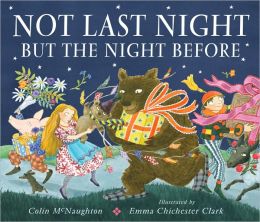
Not Last Night But The Night Before. Colin McNaugton. Illustrated by Emma Chichester Clark. 2009. Candlewick. 32 pages.

Not last night but the night before, three black cats came knocking at the door. I came downstairs to let them in; They knocked me down like a bowling pin. Not last night but the night before, the man in the moon came knocking at the door. He rushed right in; he didn't stop. He spun me round like a spinning top. 

Not Last Night But the Night Before is quirky. It is imaginative; it celebrates plenty of nursery tales (Little Miss Muffet, Little Bo Peep, Three Blind Mice, Three Little Pigs, Goldilocks and the Three Bears, etc) throughout the text. The illustrations reveal even more of the story. (The company makes an even bigger mess perhaps than the Cat in the Hat.) It's rhythmic. It's a bit crazy. You'll either love it or hate it, I suppose!

Text: 3 out of 5
Illustrations: 3 out of 5
Total: 6 out of 10

Grumpy Grandpa. Heather Henson. Illustrated by Ross Macdonald. 2009. Simon & Schuster. 40 pages.

I have one grandpa. He is always grumpy. I call him Grumpy Grandpa even though I'm not supposed to. Mom gets mad, but it's true. Grumpy Grandpa is always grumpy. And he's scary, too.

The little boy narrating Grumpy Grandpa is a little scared of his grandpa. He's come with his family to stay for two whole weeks. He can't imagine why anyone would come to spend time with someone who is just grumpy no matter what. But during this visit, the little boy learns a little more about his grandfather. And the two do become friends. 

Text: 3 out of 5
Illustrations: 3 out of 5
Total: 6 out of 10

Llama Llama Misses Mama. Anna Dewdney. 2009. Penguin. 40 pages. 

Llama Llama, warm in bed. 
Wakey, wakey, sleepyhead!
Llama school begins today!
Time to learn and time to play!

It is Llama Llama's first day of school. And will there be llama drama? Yes. But not as much as you might expect considering some of his tantrums in previous books. 

This one is part of a series. Other titles include Llama Llama Red Pajama, Llama Llama Time to Share, Llama Llama Mad at Mama, Llama Llama Home With Mama, Llama Llama Holiday Drama, Llama Llama Nighty-Night, Llama Llama Wakey-Wake, Llama Llama Zippity-Zoom, Llama Llama Hoppity-Hop.

Text: 3 out of 5
Illustrations: 3 out of 5
Total: 6 out of 10

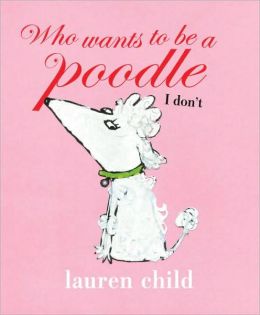
Who Wants to Be A Poodle I don't. Lauren Child. 2009. Candlewick. 40 pages. 

In a sumptuous apartment in a fashionable city lived the elegantly rich and divinely glamorous Mademoiselle Verity Brulee. Along with Verity Brulee, with her very own personal bedroom, lived Trixie Twinkle Toes Trot-a-Lot Delight or Trixie Toes for short or Trixie Twinkle Belle or Trixie Belle Baby, depending on Verity's mood.

 Trixie, our heroine, does NOT like her name. She wants to be an ordinary dog. She does not want to wear clothes or be styled or groomed all the time. She wants to be like all the other dogs. She wants to be free to step in puddles, among other things. But how will she ever convince her owner? This picture book is all about being misunderstood and finding your voice anyhow.

I thought the design of the book kept it from being reader friendly. It is hard on the eyes to have black text on dark backgrounds--like brown or dark gray. And perhaps it's fun or cute to have the text wrap around in circles and such, but I found it annoying.

Text: 3 out of 5
Illustrations: 2 out of 5
Total: 5 out of 10

© 2013 SukaYuka.com of SukaYuka's Book Reviews