Showing posts with label favorite books. Show all posts

Sunday, January 12, 2014

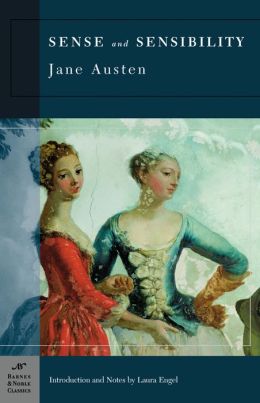
My Year With Jane: Sense and Sensibility

Sense and Sensibility. Jane Austen. 1811. 352 pages. [Source: Book I Bought]

Some Jane Austen novels, in my opinion, have to be read multiple times in order to fully love and appreciate them. I think that is the case with Sense and Sensibility. At least, I have found it to be so. I think I have "loved" it more each time I've read it. And, I believe, this is the third time I've read it. I do know it is the third time I'll be reviewing it for the blog.

Review #1 from 2008
Review #2 from 2011

Sense and Sensibility was Jane Austen's first published novel. The original readers would not have had Pride and Prejudice to compare it with, which may work in the books favor. They wouldn't have known Jane and Elizabeth, so there wouldn't be the temptation to compare these two sisters (Marianne and Elinor) with the angelic Jane and feisty Elizabeth. And I think there is the temptation to compare. I found myself constantly looking for traces and hints of Jane and Elizabeth. Is Elinor more like Jane or Elizabeth? Is Marianne more like Elizabeth or Lydia or a bit of both? And it isn't just the sisters. Lucy Steele versus Caroline Bingley. Wickham versus Willoughby. (Amanda Grange has written Wickham's Diary, but will she ever write Willoughby's diary?! I'd love to read it!!!)

I do love Jane Austen. I love spending time in her character-rich novels. I love getting to know her characters. Not just her main characters. But the minor ones as well. So many memorable characters. Even if they're memorable only because they're despicable. I love the pacing. I love the dialogue. I love how each rereading shows me something different about a character. Little things that just take a little time perhaps to fully realize a character. When you're reading for plot and plot alone, little things pass you by.

Favorite quotes:
She [Elinor] believed the regard to be mutual; but she required greater certainty of it to make Marianne’s conviction of their attachment agreeable to her. She knew that what Marianne and her mother conjectured one moment, they believed the next — that with them, to wish was to hope, and to hope was to expect. She tried to explain the real state of the case to her sister.
Men are very safe with us, let them be ever so rich.
Willoughby was a young man of good abilities, quick imagination, lively spirits, and open, affectionate manners. He was exactly formed to engage Marianne’s heart, for with all this, he joined not only a captivating person, but a natural ardour of mind which was now roused and increased by the example of her own, and which recommended him to her affection beyond every thing else. His society became gradually her most exquisite enjoyment. They read, they talked, they sang together; his musical talents were considerable; and he read with all the sensibility and spirit which Edward had unfortunately wanted.
When he was present she had no eyes for any one else. Every thing he did, was right. Every thing he said, was clever. If their evenings at the park were concluded with cards, he cheated himself and all the rest of the party to get her a good hand. If dancing formed the amusement of the night, they were partners for half the time; and when obliged to separate for a couple of dances, were careful to stand together and scarcely spoke a word to any body else. Such conduct made them of course most exceedingly laughed at; but ridicule could not shame, and seemed hardly to provoke them.
“Brandon is just the kind of man,” said Willoughby one day, when they were talking of him together, “whom every body speaks well of, and nobody cares about; whom all are delighted to see, and nobody remembers to talk to.”
“Does your sister make no distinction in her objections against a second attachment? or is it equally criminal in every body? Are those who have been disappointed in their first choice, whether from the inconstancy of its object, or the perverseness of circumstances, to be equally indifferent during the rest of their lives?” “Upon my word, I am not acquainted with the minutiƦ of her principles. I only know that I never yet heard her admit any instance of a second attachment’s being pardonable.”
“You are mistaken, Elinor,” said she warmly, “in supposing I know very little of Willoughby. I have not known him long indeed, but I am much better acquainted with him, than I am with any other creature in the world, except yourself and mama. It is not time or opportunity that is to determine intimacy; it is disposition alone. Seven years would be insufficient to make some people acquainted with each other, and seven days are more than enough for others. I should hold myself guilty of greater impropriety in accepting a horse from my brother, than from Willoughby. Of John I know very little, though we have lived together for years; but of Willoughby my judgment has long been formed.”
Elinor then heard Willoughby say, in a low voice to Marianne, “There are some people who cannot bear a party of pleasure. Brandon is one of them. He was afraid of catching cold I dare say, and invented this trick for getting out of it. I would lay fifty guineas the letter was of his own writing.” “I have no doubt of it,” replied Marianne.
“I am afraid,” replied Elinor, “that the pleasantness of an employment does not always evince its propriety.”
“On the contrary, nothing can be a stronger proof of it, Elinor; for if there had been any real impropriety in what I did, I should have been sensible of it at the time, for we always know when we are acting wrong, and with such a conviction I could have had no pleasure.”
Oh, Elinor, how incomprehensible are your feelings! You had rather take evil upon credit than good. You had rather look out for misery for Marianne, and guilt for poor Willoughby, than an apology for the latter. You are resolved to think him blamable, because he took leave of us with less affection than his usual behaviour has shown. And is no allowance to be made for inadvertence, or for spirits depressed by recent disappointment? Are no probabilities to be accepted, merely because they are not certainties? Is nothing due to the man whom we have all such reason to love, and no reason in the world to think ill of? — to the possibility of motives unanswerable in themselves, though unavoidably secret for a while? And, after all, what is it you suspect him of?”
Secrecy may be advisable; but still I cannot help wondering at its being practiced by him. 
“I have not wanted syllables where actions have spoken so plainly. Has not his behaviour to Marianne and to all of us, for at least the last fortnight, declared that he loved and considered her as his future wife, and that he felt for us the attachment of the nearest relation? Have we not perfectly understood each other? Has not my consent been daily asked by his looks, his manner, his attentive and affectionate respect? My Elinor, is it possible to doubt their engagement? How could such a thought occur to you? How is it to be supposed that Willoughby, persuaded as he must be of your sister’s love, should leave her, and leave her perhaps for months, without telling her of his affection, — that they should part without a mutual exchange of confidence?”
“You have no ambition, I well know. Your wishes are all moderate.” “As moderate as those of the rest of the world, I believe. I wish as well as every body else to be perfectly happy; but, like every body else it must be in my own way. Greatness will not make me so.” “Strange that it would!” cried Marianne. “What have wealth or grandeur to do with happiness?” “Grandeur has but little,” said Elinor, “but wealth has much to do with it.” “Elinor, for shame!” said Marianne, “money can only give happiness where there is nothing else to give it. Beyond a competence, it can afford no real satisfaction, as far as mere self is concerned.” “Perhaps,” said Elinor, smiling, “we may come to the same point. Your competence and my wealth are very much alike, I dare say; and without them, as the world goes now, we shall both agree that every kind of external comfort must be wanting. Your ideas are only more noble than mine. Come, what is your competence?” “About eighteen hundred or two thousand a year; not more than that.” Elinor laughed. “Two thousand a year! One is my wealth! I guessed how it would end.”
“I should hardly call her a lively girl — she is very earnest, very eager in all she does — sometimes talks a great deal and always with animation — but she is not often really merry.”
“I have frequently detected myself in such kind of mistakes,” said Elinor, “in a total misapprehension of character in some point or other: fancying people so much more gay or grave, or ingenious or stupid than they really are, and I can hardly tell why or in what the deception originated. Sometimes one is guided by what they say of themselves, and very frequently by what other people say of them, without giving oneself time to deliberate and judge.”
“Shyness is only the effect of a sense of inferiority in some way or other. If I could persuade myself that my manners were perfectly easy and graceful, I should not be shy.”
“But you would still be reserved,” said Marianne, “and that is worse.” Edward started. “Reserved! Am I reserved, Marianne?” “Yes, very.” “I do not understand you,” replied he, colouring. “Reserved! — how, in what manner? What am I to tell you? What can you suppose?” Elinor looked surprised at his emotion; but trying to laugh off the subject, she said to him, “Do not you know my sister well enough to understand what she means? Do not you know she calls every one reserved who does not talk as fast, and admire what she admires as rapturously as herself?”
“Mr. Palmer does not hear me,” said she, laughing; “he never does sometimes. It is so ridiculous!”
This was quite a new idea to Mrs. Dashwood; she had never been used to find wit in the inattention of any one, and could not help looking with surprise at them both.
But to appear happy when I am so miserable — Oh! who can require it?
“The unkindness of your own relations has made you astonished to find friendship any where.”
Marianne’s lips quivered, and she repeated the word “Selfish?” in a tone that implied, “do you really think him selfish?” “The whole of his behaviour,” replied Elinor, “from the beginning to the end of the affair, has been grounded on selfishness. It was selfishness which first made him sport with your affections; which afterwards, when his own were engaged, made him delay the confession of it, and which finally carried him from Barton. His own enjoyment, or his own ease, was, in every particular, his ruling principle.” “It is very true. My happiness never was his object.” “At present,” continued Elinor, “he regrets what he has done. And why does he regret it? — Because he finds it has not answered towards himself. It has not made him happy. But does it follow that had he married you, he would have been happy? — The inconveniences would have been different. He would then have suffered under the pecuniary distresses which, because they are removed, he now reckons as nothing. He would have had a wife of whose temper he could make no complaint, but he would have been always necessitous — always poor; and probably would soon have learned to rank the innumerable comforts of a clear estate and good income as of far more importance, even to domestic happiness, than the mere temper of a wife.”
I will be calm, I will be mistress of myself.
Mrs. Jennings’s prophecies, though rather jumbled together, were chiefly fulfilled; for she was able to visit Edward and his wife in their Parsonage by Michaelmas, and she found in Elinor and her husband, as she really believed, one of the happiest couples in the world. They had in fact nothing to wish for, but the marriage of Colonel Brandon and Marianne, and rather better pasturage for their cows.
Marianne Dashwood was born to an extraordinary fate. She was born to discover the falsehood of her own opinions, and to counteract, by her conduct, her most favourite maxims. She was born to overcome an affection formed so late in life as at seventeen, and with no sentiment superior to strong esteem and lively friendship, voluntarily to give her hand to another! — and that other, a man who had suffered no less than herself under the event of a former attachment, whom, two years before, she had considered too old to be married, — and who still sought the constitutional safeguard of a flannel waistcoat! But so it was.

© 2014 SukaYuka.com of SukaYuka's Book Reviews

Sunday, December 8, 2013

Sunday Salon: Reading Anne of Ingleside (1939)

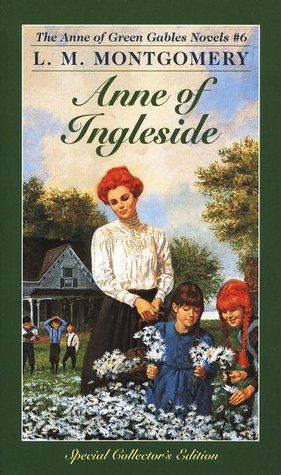
Anne of Ingleside. L.M. Montgomery. 1939. 274 pages. [Source: Bought]

Anne of Ingleside was L.M. Montgomery's last (published) novel. In the novel, she is revisiting her most beloved heroine, Anne. The novel opens with Anne visiting Avonlea in the spring of 1900; she is pregnant with Rilla. She is spending time with Marilla and Mrs. Lynde, of course, and making time to spend one whole day with Diana. If memory serves, Diana is not really mentioned again in the series (Rainbow Valley, Rilla of Ingleside). After a short visit, she returns to her own home, her waiting family. There is Gilbert, of course, and Susan Baker, and her five children: Jem, Walter, Nan and Di (the twins), and Shirley. The book, I believe, mentions around here that she's been married nine years and her oldest is seven. Imagine five children under the age of seven with one more on the way! So Anne is extremely fortunate to have Susan helping her with all those children! There is one person Anne isn't looking forward to seeing, Gilbert's Aunt Mary Maria. She comes for "two weeks" and stays over a year! The chapter on how they accidentally send her off is one of my favorites!!!

The narration of Anne of Ingleside is interesting. Readers spend time inside the minds of Anne, Jem, Walter, Di, Nan, Rilla, and perhaps Susan. I don't recall Gilbert or Shirley or Aunt Mary Maria! Montgomery devoted a certain amount of time to each child. These chapters capture different aspects of being a child, different fears and anxieties, different hopes and dreams. There is Jem's one desire for a dog who really truly loves him. There is Di's friendship troubles, I believe. Nan has a chapter about bargaining with God. My least favorite chapter, unfortunately, is near the end. Anne loses touch with reality and thinks Gilbert doesn't love her anymore and that he regrets marrying her. Seriously I'm not sure what Montgomery was thinking with this one!

I read this one trying to always keep in mind that this book serves as a goodbye. The original Anne audience would have been born circa 1895-1900. The first book was published in 1908. The last book was published in 1939. Those that grew up with Anne would have been able to introduce their children to Anne as well! Anne may have felt like a kindred spirit indeed, as her original audience was reaching their mid-to-late teens, Anne was falling in love and getting married. (Anne of the Island was published 1915. Anne's House of Dreams was published in 1917.) The following books, which focus on her raising a family. Rainbow Valley and Rilla of Ingleside were published in 1919 and 1921. This was "the" Anne series for almost fifteen years. Anne of Windy Poplars was published in 1936 and Anne of Ingleside in 1939.

Favorite quotes:
The only time I feel I'm getting along a bit is when I look at pictures in the magazines. The heroes and heroines in them are beginning to look too young to me. 
We'll enjoy each other's friendship today even if we are to be parted tomorrow. 
Our friendship has always been a very lovely thing, Diana.
Yes...and we've always...I mean...I never could say things like you, Anne, but we have kept our old 'solemn' vow and promise' haven't we?
Always...and always will.
Anne's hand found its way into Diana's. They sat for a long time in a silence too sweet for words. 
It was never quite safe to sit down on a chair at Ingleside without first making sure there wasn't a cat in it. 
This is no common day, Mrs. Dr. dear, she said solemnly.
Oh, Susan, there is no such thing as a common day. Every day has something about it no other day has. Haven't you noticed?
Half an hour later, Susan, reading her nightly chapter in her Bible, came across the verse, "Withdraw thy foot from thy neighbor's house lest he weary of thee and hate thee." She put a sprig of southernwood in it to mark the spot. Even in those days, she reflected.
If a minister preaches a sermon that hits home to some particular individual people always suppose he meant it for that very person, said Anne. A hand-me-down cap is bound to fit somebody's head but it doesn't follow that it was made for him.
I do not think, Mrs. Marshall Elliott, that people in these parts say half the things they are reported to have said.
© 2013 SukaYuka.com of SukaYuka's Book Reviews
Sunday, December 1, 2013

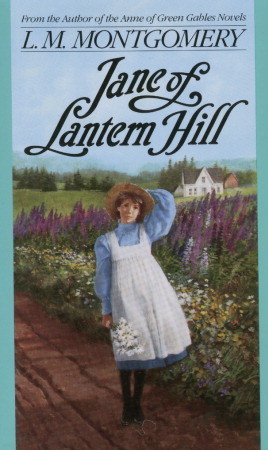
Sunday Salon: Reading Jane of Lantern Hill

Jane of Lantern Hill. L.M. Montgomery. 1937. 274 pages. [Source: Bought]

Jane of Lantern Hill was one of the few L.M. Montgomery books that I had not read before this year. While I found Pat of Silver Bush and Mistress Pat extremely disappointing, I found Jane of Lantern Hill to be practically perfect in every way. (If Pat had been my first introduction to L.M. Montgomery, I'm not sure I'd have ever voluntarily picked up another Montgomery book.) I just loved, loved, loved Jane of Lantern Hill.

Jane is our heroine. She lives with her mother, aunt, and grandmother. All three call her Victoria. It is not a happy home for all live in fear or reverence of the grandmother. Her mother is a forgiven prodigal. She returned home with a three year old daughter. (She did not divorce her husband; divorce is unforgivable.) Jane has always assumed that her father was dead. When she learns the truth, she's one confused child. Her relatives only confuse her more. If he is mentioned at all, it is to say that he did not want her, that he never loved her, that she is nothing to him. So it is with dread that Jane learns she is to spend an entire summer with him. He lives on Prince Edward Island. If he never wanted her, why does he want her now?

Once Jane is reunited with her father, her Dad, then the magic happens. It's a lovely coming-of-age novel about Jane discovering who she is and who she isn't! It's about her getting to know and love her Dad. It's about her finding a home, finding a place to belong, a place in the community. Jane is a great narrator! I can hardly do the book justice by summary.

Jane of Lantern Hill is thoroughly satisfying!

Favorite quotes:
Sometimes Jane thought drearily that there must be something the matter with her when there were so many people she didn't like. 
If any one doesn't like the Bible there's something wrong either with him or with the way he was introduced to it. We must do something about it. The Bible is a wonderful book, my Jane. Full of corking good stories and the greatest poetry in the world. Full of the most amazingly human 'human nature.' Full of incredible, ageless wisdom and truth and beauty and common sense. 
Dad read words as if he tasted them.
© 2013 SukaYuka.com of SukaYuka's Book Reviews
Sunday, November 24, 2013

Sunday Salon: Reading Anne of Windy Poplars

Anne of Windy Poplars. L.M. Montgomery. 1936. 288 pages. [Source: Bought]

Anne of Windy Poplars is such a lovely little epistolary novel. Readers are privileged to share in some of Anne's letters to her beloved Gilbert. In these letters there are hundreds (if not thousands) of character sketches sharing details about Anne's life and new experiences as she teaches at a high school in Summerside, Prince Edward Island. (Highlights include Rebecca Dew, "Little Elizabeth" (Grayson), Katherine Brooke, Aunt Chatty and Aunt Kate, Jen Pringle, Mrs. Gibson, Lewis Allen, Teddy Armstrong (Little Fellow), Gerald and Geraldine (the twins she babysits...once), Jarvis Morrow, Dovie Westcott, Miss Minerva Tomgallon, etc.) Some people just get a brief sentence or two, but oh what Montgomery can do with just a few sentences or even a few words! Montgomery, at her very best, can bring more life and humanity to a character than a good many contemporary writers do in an entire novel. Other characters have whole episodes about them. For example, readers really get to spend some time with Katherine Brooke! One of my favorite episodes--if episode is the right word--is Anne and Lewis out canvassing for subscriptions to the drama club. They meet a "little fellow" named Teddy Armstrong. That story just gets me every single time! Montgomery can bring me to near tears and yet not feel manipulative. How does she do that?!

Have you read Anne of Windy Poplars? How do you think it fits in with the rest of the series? Do you have a favorite character?

Favorite quotes:
I have a scratchy pen and I can't write love-letters with a scratchy pen...or a sharp pen...or a stub pen. So you'll only get that kind of letter from me when I have exactly the right kind of pen. 
You know I've always been one to whom adventures come unsought. I just seem to attract them, as it were.  
School begins tomorrow. I shall have to teach geometry! Surely that can't be any worse than learning it. 
Isn't it queer that the things we writhe over at night are seldom wicked things? Just humiliating ones.
I don't like reading about martyrs because they always make me feel petty and ashamed...ashamed to admit I hate to get out of bed on frosty mornings and shrink from a visit to the dentist!
Nobody is ever too old to dream. And dreams never grow old.
I said drenched and I mean drenched.
Oh, no, babies are never common," said Anne, bringing a bowl of water for Mrs. Gibson's roses. "Every one is a miracle."
It seems so strange to read over the stories of those old wars...things that can never happen again. I don't suppose any of us will ever have more than an academic interest in 'battles long ago.' It's impossible to think of Canada ever being at war again. I am so thankful that phase of history is over. 
Nobody is ever too old to wear just what she wants to wear. You wouldn't want to wear it if you were too old. 

© 2013 SukaYuka.com of SukaYuka's Book Reviews

Sunday, November 3, 2013

Sunday Salon: Reading Mandy (1971)

Mandy. Julie Andrews Edwards. 1971. HarperCollins. 320 pages. [Source: Bought Replacement Copy]

Long before I met Anne, Heidi, Pollyanna, Mary, Emily, or Sara, I met a young orphan girl named Mandy. She was quiet and loved to read. She had an inner thought life, as well as complex emotions that she just could not comprehend. There was something under the surface of Mandy that made her a good choice for me. It wasn't pity I felt. It was genuine affection. The story of Mandy is simple and straightforward. Young orphan climbs over wall and discovers an abandoned cottage (of sorts) with an out-of-control garden. She decides to adopt this place as her very own. She becomes completely absorbed in the home of her own creation. She weeds. She plants. She waters. She cleans. She scrubs. She has LOTS of tea. It is not a magical cure, and yet, it sets something in motion that helps her in the end. In the process of making this place hers, Mandy abandons her good-but-thoughtless obedience and begins to tell lies, to bend the truth, to sneak around, to covet, to steal. Mandy isn't a perfect heroine. She is all-too-human. She makes mistakes. She doesn't always think things through. I think I loved Mandy because she may have been the first heroine who dealt with some of the darker (but natural) emotions like sadness, loneliness, and disappointment.
She was a dreamer. Most of the time she lived in a make-believe world of her own. She loved to read. She exchanged books at the local library at least once a week. The wonders of Robinson Crusoe and Alice in Wonderland and Gulliver's Travels were very real to her and offered far more excitement than the reality of her life could ever provide. (6)
She occasionally experienced sad, disturbing feelings. Sometimes she felt an ache inside that would not go away. It seemed then as though her life were very empty. She would cry for no reason at all, seemingly, and it frightened her when she did. She tried to be brave and put away her feelings.
"I'm having one of my attacks again," she would think, trying hard not to let people see her tears.
Her attempts to keep busy were mostly an effort to fill her life so that she had no time to feel disconsolate. But the nagging sadness was persistent, and it would envelop her when she least expected it.
As Mandy grew, her longings grew stronger and sometimes she felt as though she must surely break apart with so much going on inside her. It was as though she were searching for something though what or where it was she could not say. (7-8) 
© 2013 SukaYuka.com of SukaYuka's Book Reviews

Sunday, October 27, 2013

Sunday Salon: Reading Through the Looking Glass

Through the Looking Glass. Lewis Carroll. 1871. 228 pages. [Source: Bought]

I love, love, love Through the Looking Glass. I think I might even love it more than Alice's Adventures in Wonderland. Together they are just a JOY to read. The thing I love the most about Through the Looking Glass is the language, the writing, the style. The book is just so very quotable!!! The scenes are fun, playful, and memorable.

Here are a few of my favorite quotes:
The rule is, jam tomorrow and jam yesterday--but never jam today.
Why, sometimes I've believed as many as six impossible things before breakfast.
They gave it to me--for an un-birthday present.
I beg your pardon? Alice said with a puzzled air.
I'm not offended said Humpty Dumpty.
I mean, what is an un-birthday present?
A present given when it isn't your birthday, of course.
Alice considered a little. I like birthday presents best, she said at last.
You don't know what you're talking about cried Humpty Dumpty. How many days are there in a year?
Three hundred and sixty-five said Alice.
And how many birthdays have you?
One.
And if you take one from three hundred and sixty-five, what remains?
Three hundred and sixty-four of course.
When I use a word, Humpty Dumpty said, in rather a scornful tone, it means just what I choose it to mean--neither more nor less.
The question is, said Alice, whether you can make words mean so many different things.
The question is, said Humpty Dumpty, which is to be master--that's all.
I see nobody on the road said Alice.
I only wish I had such eyes, the King remarked in a fretful tone. To be able to see Nobody! And at that distance too! Why, it's as much as I can do to see real people, by this light!
Always speak the truth -- think before you speak -- and write it down afterwards.
© 2013 SukaYuka.com of SukaYuka's Book Reviews

Tuesday, October 15, 2013

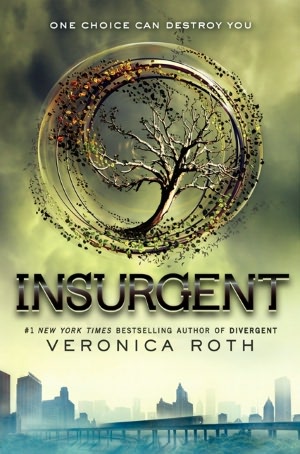
Rereading Insurgent (2012)

Insurgent. Veronica Roth. 2012. HarperCollins. 525 pages. [Source: Library]

I wake with his name in my mouth.
Will.
Before I open my eyes, I watch him crumple to the pavement again. Dead.
My doing.

Reading Insurgent the first time was an experience. A book that is felt and not "just read." (My first review.) I am so glad I decided to reread both Divergent and Insurgent before the release of Allegiant later this month.

Some novels stand on their own; Insurgent is not one of them. Divergent MUST be read first. Readers may remember that Divergent had quite an ending! The last third of the novel was so intense, so action-packed, so emotional; it was impossible to put down. Insurgent picks up right where Divergent left us.

If you've not read Divergent, this review will be full of spoilers. 

Tris, Tobias (Four), Peter, and Marcus (Tobias' father) on the run, on the way to unite with the Abnegation refugees seeking the mercy of the faction Amity. Tris is definitely in shock, and with good reason!!! Her mother was killed; her father was killed; she was wounded; she had to kill one of her friends, Will; she saw most of her friends mindlessly killing her old faction; she accomplished her one mission: to get the simulations shut off, but, it came at a high price. Yes, she's got Four back, but, still...a physically, mentally, emotionally overwhelming day! But her stamina cannot sustain her forever; the thoughts are coming. She is haunted by what she's seen and heard; she's haunted by what she's done, what she's chosen to do. And it's not over. She knows it. She knows the worst is still to come. There will be no easy peace. There will be no time to rest. Hard decisions will be demanded of her for days, weeks, perhaps months to come. And Tris isn't sure she's dauntless enough to handle it.

Insurgent is a thoughtful novel. It is suspenseful, dramatic, action-packed. It is emotional with plenty of surprises. But it is a thoughtful novel as well. What is right? What is wrong? Who is trustworthy? Who is telling the truth? Who is telling lies? Who is being the most manipulative? Who is twisting the truth? Can Tris discern the truth? Is she brave enough to act on what she perceives to be true even if it means going against those she loves?

Insurgent was a WOW novel for me. I absolutely LOVED, LOVED, LOVED Tris. It's a complicated situation--very messy. And Tris is courageous and vulnerable. She's her own person. And being in love with someone else isn't going to make her mindless and compliant. 

© 2013 SukaYuka.com of SukaYuka's Book Reviews
Sunday, October 13, 2013

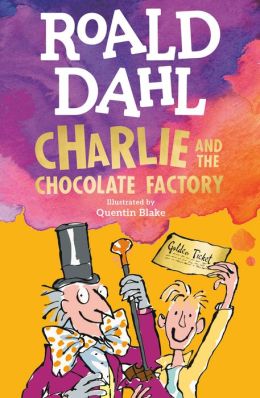
Sunday Salon: Reading Charlie and the Chocolate Factory

Charlie and the Chocolate Factory. Roald Dahl. 1964. 155 pages. [Source: Library]

Charlie and the Chocolate Factory is one of my favorite books to reread. I adore this one. Each chapter feels like a good friend. The text, the illustrations, everything just feels so right, so cozily right about this one.

Willy Wonka is an eccentric factory owner; he manufactures candy, chocolate mostly. He has a contest with five winners; he hides five golden tickets within his candy bars. Charlie Bucket, our hero, is desperate. Not necessarily desperate to win so much as desperate for a miracle. His family is starving. His father, his mother, all four grandparents, and himself--all are starving. If any boy deserves a life time's supply of chocolate, it's Charlie.

The book is quirky, delightful, and full of messages or morals. These messages aren't exactly hidden, they are obvious, especially in the lyrics of the songs. For example, Mike Teavee's song. No reader could miss that message! Is it a message for children or parents?!
"The most important thing we've learned,
So far as children are concerned,
Is never, NEVER, NEVER let
Them near your television set–
Or better still, just don't install
The idiotic thing at all.
In almost every house we've been,
We've watched them gaping at the screen.
They loll and slop and lounge about,
And stare until their eyes pop out.
(Last week in someone's place we saw
A dozen eyeballs on the floor.)
They sit and stare and stare and sit
Until they're hypnotised by it,
Until they're absolutely drunk
With all the shocking ghastly junk.
Oh yes, we know it keeps them still,
They don't climb out the window sill,
They never fight or kick or punch,
They leave you free to cook the lunch
And wash the dishes in the sink–
But did you ever stop to think,
To wonder just exactly what
This does to your beloved tot?
IT ROTS THE SENSES IN THE HEAD!
IT KILLS IMAGINATION DEAD!
IT CLOGS AND CLUTTERS UP THE MIND!
IT MAKES A CHILD SO DULL AND BLIND
HE CAN NO LONGER UNDERSTAND
A FANTASY, A FAIRYLAND!
HIS BRAIN BECOMES AS SOFT AS CHEESE!
HIS POWERS OF THINKING RUST AND FREEZE!
HE CANNOT THINK–HE ONLY SEES!
'All right!' you'll cry. 'All right!' you'll say,
'But if we take the set away,
What shall we do to entertain
Our darling children? Please explain!'
We'll answer this by asking you,
'What used the darling ones to do?
'How used they keep themselves contented
Before this monster was invented?'
Have you forgotten? Don't you know?
We'll say it very loud and slow:
THEY...USED...TO...READ! They'd READ and READ,
AND READ and READ, and then proceed
To READ some more. Great Scott! Gadzooks!
One half their lives was reading books!
The nursery shelves held books galore!
Books cluttered up the nursery floor!
And in the bedroom, by the bed,
More books were waiting to be read!
Such wondrous, fine, fantastic takes
Of dragons, gypsies, queens, and whales
And treasure isles, and distant shores
Where smugglers rowed with muffled oars,
And pirates wearing purple pants,
And sailing ships and elephants,
And cannibals crouching 'round the pot,
Stirring away at something hot.
(It smells so good, what can it be?
Good gracious, it's Penelope.)
The younger ones had Beatrix Potter
With Mr. Tod, the dirty rotter,
And Squirrel Nutkin, Pigling Bland,
And Mrs. Tiggy–Winkle and–
Just How The Camel Got His Hump,
And How The Monkey Lost His Rump,
And Mr. Toad, and bless my soul,
There's Mr. Rat and Mr. Mole–
Oh, books, what books they used to know,
Those children living long ago!
So please, oh please, we beg, we pray,
Go throw your TV set away,
And in its place you can install
A lovely bookshelf on the wall.
Then fill the shelves with lots of books,
Ignoring all the dirty looks,
The screams and yells, the bites and kicks,
And children hitting you with sticks–
Fear not, because we promise you
That, in about a week or two
Of having nothing else to do,
They'll now begin to feel the need
Of having something good to read.
And once they start–oh boy, oh boy!
You watch the slowly growing joy
That fills their hears. They'll grow so keen
They'll wonder what they'd ever seen
In that ridiculous machine,
That nauseating, foul, unclean,
Repulsive television screen!
And later, each and every kid
Will love you more for what you did.
P.S. Regarding Mike Teavee,
We very much regret that we
Shall simply have to wait and see
If we can get him back his height.
But if we can't–it serves him right."
Do you have a favorite character? A favorite scene?


© 2013 SukaYuka.com of SukaYuka's Book Reviews
Tuesday, October 8, 2013

Rereading Divergent (Again)

Divergent. Veronica Roth. 2011. May 2011. HarperCollins. 496 pages. [Source: Library]

There is one mirror in my house. Our faction allows me to stand in front of it on the second day of every third month, the day my mother cuts my hair. It is behind a sliding panel in the hallway upstairs. 

If you noticed that this is my third time to review this book, you might guess how much I love, love, love this one. (My second review; my first review).

Factions are everything in Divergent; and there are five factions that make up the community: Abnegation values selflessness above all else; Amity values peace above all else; Candor values honesty above all else; the Erudite values knowledge above all else; Dauntless values courage above all else. Beatrice (Tris), our heroine, was born Abnegation, but she doesn't feel good enough for the faction. For, the truth is that she has selfish thoughts and desires. She's not exactly sure she could spend her whole life wearing gray, serving others, and blending into the background. Her test reveals something shocking--perhaps not shocking to readers, but certainly to her community IF it were to become known--she has aptitude for not one faction, but THREE. The simulation tests are supposed to show THE ONE place a person belongs. Beatrice's results make her Divergent. So when it comes time for Beatrice to choose--along with all the other of age teens--she has quite a decision to make. Should she remain in her own faction, keep her old friends, live the life that is perhaps expected of her? Any other choice essentially would divide her from her parents and keep them separated the rest of her life. Should she choose Erudite? No, that's not even a temptation. She knows that would be a mistake. Should she choose Dauntless? Part of her wants to risk it all and go with the unknown. Life with the Dauntless would be a complete change, offer a life of surprises, risks and dangers too.

Most of Divergent focuses on the initiation process, Tris' training as Dauntless. Readers get a chance to meet other transfers and other Dauntless-born initiates. It is a fierce competition. It is during this intense time that Tris meets Four. And meeting Four, well, it seems almost as life-changing as finding out her brain is different from everyone else's...

I absolutely love Four and Tris! I love them individually and as a couple. I love the characterization. I love the action, the drama, the suspense.

© 2013 SukaYuka.com of SukaYuka's Book Reviews

Sunday, September 29, 2013

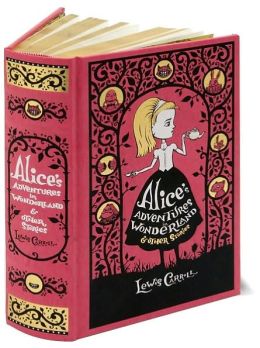
Sunday Salon: Reading Alice's Adventures in Wonderland

Alice's Adventures in Wonderland. Lewis Carroll. 1865. 192 pages. [Source: Bought]

Alice's Adventures in Wonderland is a great book to read again and again no matter your age. I think I've always adored this one and its sequel Through the Looking Glass. Each chapter feels so familiar and welcome. I love that books become friends. I think that is why I absolutely HAVE to reread books. It's a way of life for me.

The chapter titles: "Down The Rabbit-Hole," "The Pool of Tears," "A Caucus-Race and a Long Tale," "The Rabbit Sends In a Little Bill," "Advice From A Caterpillar," "Pig and Pepper," "A Mad Tea-Party," "The Queen's Croquet-Ground," "The Mock Turtle's Story," "The Lobster Quadrille," "Who Stole the Tarts?" and "Alice's Evidence." I love that simply reading the chapter titles takes you right into the heart and soul of this one!

What is your favorite thing about Alice in Wonderland? I think my favorite thing is the dreaminess of it. How perfectly bizarre and wonderful it is. It is whimsical, quirky, delightful. It is also very quotable! 

© 2013 SukaYuka.com of SukaYuka's Book Reviews
Sunday, September 15, 2013

Sunday Salon: Reading All-of-a-Kind-Family (1951)

All-of-a-Kind-Family. Sydney Taylor. 1951. 190 pages. [Source: Bought]

I enjoyed rereading All-of-a-Kind Family by Sydney Taylor. This historical fiction novel is set in New York City around 1912. When the novel opens, there are five sisters: Ella, Henrietta (Henny), Sarah, Charlotte, and Gertie. They are a "steps-and-stairs" family according to the oh-so-friendly librarian Miss Allen. (Yes, the librarian plays a good role in this one!) The chapters are episodic, occurring over the course of a year. The chapters detail what life was like in a Jewish household during the early years of the new century. Some chapters are about everyday things like shopping, cleaning, going to the library, eating in bed, picky-eating at the table, etc. Other chapters are about holidays or vacations: Purim, Passover, 4th of July, visiting Coney Island, etc. My least favorite chapter remains the same: the hiding of buttons to motivate the sisters into cleaning.

I liked this one. I like it because it is old-fashioned and simple and just good. I like it because it captures a special time and place in American history.

Have you read this one? What did you think?

© 2013 SukaYuka.com of SukaYuka's Book Reviews
Saturday, September 14, 2013

Rereading Fahrenheit 451

Fahrenheit 451. Ray Bradbury. 1953/2003. Random House. 190 pages.

It was a pleasure to burn. 

I first read and reviewed Fahrenheit 451 in May 2007. I then read the graphic novel in October 2010. I couldn't resist reading the "real" book at that time as well. I even sought out A Pleasure to Burn, a collection of stories that traces Bradbury's developing themes. That collection included two crucial stories: "The Fireman" and "Long After Midnight." (Also I watched the movie.) The summer of 2012, I read tons of Ray Bradbury, and, of course, I had to reread Fahrenheit 451!

I definitely consider Fahrenheit 451 one of the rare must-reads. It is intense and thought-provoking. The novel, as a whole, is powerful. But it is in conversation (or dialogue) that this one truly shines. Guy Montag's conversations with Clarisse, with Faber, and to some extent even his boss and wife. It's a very reflective novel as well. In its pages, readers get a glimpse of a man at his most vulnerable: a self awakening of sorts as a man wakes up to the nightmare world in which he's been a part of all along.

Favorite quotes:

Who knows who might be the target of the well-read man? Me? I won't stomach them for a minute...Remember, Montag, we're the happiness boys. We stand against the small tide of those who want to make everyone unhappy with conflicting theory and thought. (50-1)  
 We've started and won two atomic wars since 1990! Is it because we're having so much fun at home we've forgotten the world? Is it because we're so rich and the rest of the world's so poor and we just don't care if they are? Is that why we're hated so much? Do you know why? I don't, that's sure! Maybe the books can get us half out of the cave. God, Millie, don't you see? An hour a day, two hours, with these books, and maybe... (62)
Good God, it isn't as simple as just picking up a book you laid down half a century ago. Remember, the firemen are rarely necessary. The public itself stopped reading of its own accord. (78)
 It’s been a long time. I’m not a religious man. But it’s been a long time.’ Faber turned the pages, stopping here and there to read. ‘It’s as good as I remember. Lord, how they’ve changed it in our parlors these days. Christ is one of the family now. I often wonder if God recognizes His own son the way we’ve dressed him up, or is it dressed him down? He’s a regular peppermint stick now, all sugar-crystal and saccharine when he isn’t making veiled references to certain commercial products that every worshiper absolutely needs.’ (81)
Do you know why books such as this are so important? Because they have quality. And what does the word quality mean? To me it means texture. This book has pores. It has features. This book can go under the microscope. You'd find life under the glass, streaming past in infinite profusion. The more pores, the more truthfully recorded details of life per square inch you can get on a sheet of paper, the more 'literary' you are. That's my definition, anyway. Telling detail. Fresh detail. The good writers touch life often. The mediocre ones run a quick hand over her. The bad ones rape her and leave her for the flies. So now do you see why books are hated and feared? They show the pores in the face of life. The comfortable people want only wax moon faces, poreless, hairless, expressionless. We are living in a time when flowers are trying to live on flowers, instead of growing on good rain and black loam. (83)
Though this one is "about" books, in a way, it is not. It is about the ideas, emotions, concepts behind the books. It is about the knowledge and wisdom sometimes contained in books, but never exclusively found in books. It is about choices and lifestyles. The nightmarish culture found in Fahrenheit 451 is a result of people choosing to be shallow, selfish, materialistic, technology-obsessed, and pleasure-seeking. People are "happy." But their "happiness" is fake. It comes at the cost of suppressing emotion and intellect. Free thinking is not encouraged. Thoughts shouldn't have depth and substance! One shouldn't ponder, consider, or reflect! It's about lives packed with noise and busyness--a blur of distractions--all designed to keep you from realizing there is something more, something that has been lost.

© 2013 SukaYuka.com of SukaYuka's Book Reviews

Sunday, September 1, 2013

Sunday Salon: Reading The Phantom Tollbooth (1961)

The Phantom Tollbooth. Norton Juster. Illustrated by Jules Feiffer. 1961/2011. Random House. 272 pages. [Source: Review copy]

There was once a boy named Milo who didn't know what to do with himself--not just sometimes, but always.

I loved, loved, loved this one! It is easily one of those books I could read over and over and over again. I didn't discover it as a child, but, I'm very glad I've discovered it now!

Milo, our hero, is about to have an "impossible" adventure. His day starts out very ordinary, however, by the end of the day Milo will be quite transformed!

It starts with a mysterious gift-box. It holds a tollbooth for him to construct, also included are instructions, rule books, and a map. He randomly chooses to go to Dictionopolis. But though that is his original destination, Milo finds that travels--magical or not--take some thought and intention.

The writing is AMAZING. It is clever, rich in meaning and symbolism. And it is oh so quotable! One of those rare books where you could almost open up the book to any page and find a gem worth quoting!

Loved the writing, loved the creativity, loved the characters!

Favorite quotes:
“Expect everything, I always say, and the unexpected never happens.”
“You may not see it now," said the Princess of Pure Reason, looking knowingly at Milo's puzzled face, "but whatever we learn has a purpose and whatever we do affects everything and everyone else, if even in the tiniest way. Why, when a housefly flaps his wings, a breeze goes round the world; when a speck of dust falls to the ground, the entire planet weighs a little more; and when you stamp your foot, the earth moves slightly off its course. Whenever you laugh, gladness spreads like the ripples in the pond; and whenever you're sad, no one anywhere can be really happy. And it's much the same thing with knowledge, for whenever you learn something new, the whole world becomes that much richer.”
“So many things are possible just as long as you don't know they're impossible.”
“Everybody is so terribly sensitive about the things they know best.”
“And remember, also," added the Princess of Sweet Rhyme, "that many places you would like to see are just off the map and many things you want to know are just out of sight or a little beyond your reach. But someday you'll reach them all, for what you learn today, for no reason at all, will help you discover all the wonderful secrets of tomorrow.”
“In this box are all the words I know…Most of them you will never need, some you will use constantly, but with them you may ask all the questions which have never been answered and answer all the questions which have never been asked. All the great books of the past and all the ones yet to come are made with these words. With them there is no obstacle you cannot overcome. All you must learn to do is to use them well and in the right places.” 
© 2013 SukaYuka.com of SukaYuka's Book Reviews

Sunday, July 21, 2013

Sunday Salon: Reading Mary Poppins (1934)

Mary Poppins. P.L. Travers. Illustrated by Mary Shepard. 1934/2006. Houghton Mifflin Harcourt. 224 pages. [Source: Library]

If you want to find Cherry-Tree Lane all you have to do is ask the Policeman at the cross-roads. He will push his helmet slightly to one side, scratch his head thoughtfully, and then he will point his huge white-gloved finger and say: "First to your right, second to your left, sharp right again, and you're there. Good-morning." 

I've read Mary Poppins three times now. I think I love it more each time. I find it funnier. There are twelve chapters; each chapter is a story or episode: "East Wind," "The Day Out," "Laughing Gas," "Miss Lark's Andrew," "The Dancing Cow," "Bad Tuesday," "The Bird Woman," "Mrs. Corry," "John and Barbara's Story," "Full Moon," "Christmas Shopping," and "West Wind." These stories tell of Mary Poppins and the four children in her charge: Jane, Michael, and the twins Barbara and John. My least favorite story is probably "The Bird Woman." My most favorite story is probably "John and Barbara's Story."

Favorite quotes:
Mary Poppins took out a large bottle labelled "One Tea-Spoon to be Taken at Bed-Time."
A spoon was attached to the neck of the bottle, and into this Mary Poppins poured a dark crimson fluid. "Is that your medicine?" enquired Michael, looking very interested.
"No, yours," said Mary Poppins, holding out the spoon to him. Michael stared. He wrinkled up his nose. He began to protest.
"I don't want it. I don't need it. I won't!"
But Mary Poppins's eyes were fixed upon him, and Michael suddenly discovered that you could not look at Mary Poppins and disobey her. There was something strange and extraordinary about her--something that was frightening and at the same time most exciting. The spoon came nearer. He held his breath, shut his eyes and gulped. A delicious taste ran round his mouth. He turned his tongue in it. He swallowed, and a happy smile ran round his face.
"Strawberry ice," he said ecstatically. "More, more, more!" (10)
So Mary Poppins put on her white gloves and tucked her umbrella under her arm--not because it was raining but because it had such a beautiful handle that she couldn't possibly leave it at home. How could you leave your umbrella behind if it had a parrot's head for a handle? Besides, Mary Poppins was very vain and liked to look her best. Indeed, she was quite sure that she never looked anything else. (13)
"Where have you been?" they asked her.
"In Fairyland," said Mary Poppins.
"Did you see Cinderella?" said Jane.
"Huh, Cinderella? Not me," said Mary Poppins contemptuously. "Cinderella, indeed!"
"Or Robinson Crusoe?" asked Michael.
"Robinson Crusoe--pooh!" said Mary Poppins rudely.
"Then how could you have been there? It couldn't have been our Fairyland!"
Mary Poppins gave a superior sniff.
"Don't you know," she said pityingly, "that everybody's got a Fairyland of their own?" (21) 
"Are you quite sure he will be at home?" said Jane, as they got off the Bus, she and Michael and Mary Poppins.
"Would my Uncle ask me to bring you to tea if he intended to go out, I'd like to know?" said Mary Poppins, who was evidently very offended by the question. She was wearing her blue coat with the silver buttons and the blue hat to match, and on the days when she wore these it was the easiest thing in the world to offend her. (22)
Upstairs in the Nursery Mary Poppins was airing the clothes by the fire, and the sunlight poured in at the window, flickering on the white walls, dancing over the cots where the babies were lying.
"I say, move over! You're right in my eyes," said John in a loud voice.
"Sorry!" said the sunlight. "But I can't help it. I've got to get across this room somehow. Orders is orders. I must move from East to West in a day and my way lies through this Nursery. Sorry! Shut your eyes and you won't notice me."
The gold shaft of sunlight lengthened across the room. It was obviously moving as quickly as it could in order to oblige John.
"How soft, how sweet you are! I love you," said Barbara, holding out her hands to its shining warmth.
"Good girl," said the sunlight approvingly and moved up over her cheeks and into her hair with a light, caressing movement. "Do you like the feel of me?" it said, as though it loved being praised.
"Dee-licious!" said Barbara, with a happy sigh. (93)
The room was very quiet.
John, drowsing in the sunlight, put the toes of his right foot into his mouth and ran them along the place where his teeth were just beginning to come through.
"Why do you bother to do that?" said Barbara, in her soft, amused voice that seemed always to be full of laughter. "There's nobody to see you."
"I know," said John, playing a tune on his toes. "But I like to keep in practice. It does so amuse the Grown-ups. Did you notice that Aunt Flossie nearly went mad with delight when I did it yesterday? 'The Darling, the Clever, the Marvel, the Creature!' -- didn't you hear her saying all that?" And John threw his foot from him and roared with laughter as he thought of Aunt Flossie.
"She liked my trick, too," said Barbara complacently. "I took off both my socks and she said I was so sweet she would like to eat me. Isn't it funny--when I say I'd like to eat something I really mean it...But Grown-ups never mean what they say, it seems to me. She couldn't have really wanted to eat me, could she?" (95)
"That will do nicely for Daddy," said Michael, selecting a clockwork train with special signals. "I will take care of it for him when he goes to the City."
"I think I will get this for Mother," said Jane, pushing a small doll's perambulator which, she felt sure, her Mother had always wanted. "Perhaps she will lend it to me sometimes."
After that, Michael chose a packet of hairpins for each of the Twins and a Meccano set for his Mother, a mechanical beetle for Robertson Ay, a pair of spectacles for Ellen whose eyesight was perfectly good, and some bootlaces for Mrs. Brill who always wore slippers.
Jane, after some hesitation, eventually decided that a white dickey would be just the thing for Mr. Banks, and she bought Robinson Crusoe for the Twins to read when they grew up.
"Until they are old enough, I can read it myself," she said. "I am sure they will lend it to me." (124)

© 2013 SukaYuka.com of SukaYuka's Book Reviews

Tuesday, June 11, 2013

Strong Poison (1930)

Strong Poison. Dorothy L. Sayers. 1930/1995. HarperCollins. 272 pages.

There were crimson roses on the bench; they looked like splashes of blood.

I am rereading Dorothy Sayer's mysteries this year. Strong Poison was one of the first mysteries I read, and it was great fun to return to it! Strong Poison introduces Harriet Vane into Lord Peter Wimsey's life. She is on trial for murder, suspected of poisoning an ex-boyfriend. Lord Peter falls in love with her almost instantly, and decides to trust his instincts that she just has to be innocent of the crime. In a very short time, her fate will be decided. So if Lord Peter is to have a chance of a happily ever after, he must get his new love acquitted! He needs to solve this case quickly! He has quite a bit of help in gathering together clues and evidence and building a strong case to prove Harriet's innocence and another person's guilt.

  I really enjoyed this one cover to cover! I love Lord Peter and Bunter and Inspector Charles Parker and the Dowager! I think I was able to appreciate the characters more since I've become familiar with the whole story now.

Favorite quotes:
I have been reading one of her books, really quite good and so well-written, and I didn't guess the murderer till page 200, rather clever, because I usually do it about page 15. So very curious to write books about crimes and then be accused of a crime one's self, some people might say it was a judgment. (27) -- The Dowager to her son
Wimsey sat down and waited, a prey to curious sensations. Presently there was a noise of footsteps, and the prisoner was brought in, attended by a female wardress. She took the chair opposite to Wimsey, the wardress withdrew and the door was shut. Wimsey, who had risen, cleared his throat.
"Good afternoon, Miss Vane," he said unimpressively.
The prisoner looked at him.
"Please sit down," she said in the curious, deep voice which had attracted him in Court. "You are Lord Peter Wimsey, I believe, and have come from Mr. Crofts."
"Yes," said Wimsey. Her steady gaze was unnerving him.
"Yes, I--er--I heard the case and all that, and--er--I thought there might be something I could do, don't you know."
"That was very good of you," said the prisoner.
"Not at all, not at all, dash it! I mean to say, I rather enjoy investigating things, if you know what I mean."
"I know. Being a writer of detective stories, I have naturally studied your career with interest."
She smiled suddenly at him and his heart turned to water.
"Well, that's rather a good thing in a way, because you'll understand that I'm not really such an ass as I'm looking at present."
That made her laugh.
"You're not looking an ass--at least, not more so than any gentleman should under the circumstances. The background doesn't altogether suit your style, but you are a very refreshing sight. And I'm really very grateful to you, though I'm afraid I'm rather a hopeless case." (37)
"I quite see that," said Wimsey. "Such a Victorian attitude, too, for a man with advanced ideas. He for God only, she for God in him, and so on. Well, I'm glad you feel like that about it."
"Are you? It's not going to be exactly helpful in the present crisis."
"No, I was looking beyond that. What I mean to say is, when all this is over, I want to marry you, if you can put up with me and all that."
Harriet Vane, who had been smiling at him, frowned, and an indefinable expression of distaste came into her eyes.
"Oh, are you another of them? That makes forty-seven."
"Forty-seven what?" asked Wimsey, much taken aback.
"Proposals. They come in by every post. I suppose there are a lot of imbeciles who want to marry anybody who's at all notorious."
"Oh," said Wimsey. "Dear me, that makes it very awkward. As a matter of fact, you know, I don't need any notoriety. I can get into the papers off my own bat. It's no treat to me. Perhaps I'd better not mention it again."
His voice sounded hurt, and the girl eyed him rather remorsefully.
"I'm sorry--but one gets rather a bruised sort of feeling in my position. There have been so many beastlinesses."
"I know," said Lord Peter. "It was stupid of me--"
"No, I think it was stupid of me. But why--?"
"Why? Oh, well--I thought you'd be rather an attractive person to marry. That's all. I mean, I sort of took a fancy to you. I can't tell you why. There's no rule about it, you know."
"I see. Well, it's very nice of you."
"I wish you wouldn't sound as if you thought it was rather funny. I know I've got a silly face, but I can't help that. As a matter of fact, I'd like somebody I could talk sensibly to, who would make life interesting. And I could give you a lot of plots for your books, if that's any inducement."
"But you wouldn't want a wife who wrote books, would you?"
"But I should; it would be great fun. So much more interesting than the ordinary kind that is only keen on clothes and people. Though of course, clothes and people are all right too, in moderation. I don't mean to say I object to clothes."
"And how about the old oaks and the family plate?"
"Oh, you wouldn't be bothered with them. My brother does all that…" (39-40)
"What a clear mind you have," said Miss Climpson.
"When I die you will find 'Efficiency' written on my heart. (47)
"Oh, and Bunter."
"My lord?"
"It seems that I am being obvious. I have no wish to be anything of the kind. If you see me being obvious, will you drop me a hint?"
"Certainly, my lord." (70)
It was natural that the conversation should turn to the subject of murder. Nothing goes so well with a hot fire and buttered crumpets as a wet day without and a good dose of comfortable horrors within. (85) 
"If anybody ever marries you, it will be for the pleasure of hearing you talk piffle," said Harriet, severely. (111)
"Damn it, she writes detective stories and in detective stories virtue is always triumphant. They're the purest literature we have." (115)
"Oh, God! Shall I ever live down this disastrous reputation for tom-foolery?" (150)
"Anything a Wimsey does is is right and heaven help the person who gets in the way. We've even got a damned old family motto about it…" (213)


© 2013 SukaYuka.com of SukaYuka's Book Reviews
Friday, June 7, 2013

Blue Castle (1926)

The Blue Castle. L.M. Montgomery. 1926. 218 pages.

If it had not rained on a certain May morning Valancy Stirling's whole life would have been entirely different. She would have gone, with the rest of her clan, to Aunt Wellington's engagement picnic and Dr. Trent would have gone to Montreal. But it did rain and you shall hear what happened because of it.

The Blue Castle is a giddy-making romance by one of my favorite authors, L.M. Montgomery. I LOVE so many of Montgomery's books, but this one is one of my favorite favorites. One of those perfectly perfect books. For readers who don't appreciate old-fashioned, sweet romances, it may not be exceptional. But for me, it is near perfect! 

Valancy Stirling is the heroine. An uncomfortable birthday is approaching, and she's never been in love, never even come close to falling in love. She hates the teasing she receives from her family because of her unmarried status. Hates it not only because it's rude, but because she longs for love, and aches for a happily ever after. She hates how everyone takes her for granted, how no one ever shows her any real consideration.

So one day Valancy decides to go to a doctor--a man who was not the official family doctor--with her symptoms of heart pain and palpitations. A family emergency calls the doctor away before he can share his diagnosis with her, but a letter arrives in the mail a few days letter, a letter with shocking news. SHE IS DYING. There are two things Valancy decides: 1) she will never, ever tell her family the news and 2) she will make all her own decisions and will start LIVING each day as if it were her very last.

The change in Valancy is oh-so-sudden and oh-so-shocking. The new Valancy has a voice, a loud voice, and a rebellious spirit. She will do things her way from now on. One of the first decisions she makes is that she will nurse a dying relative, Cissy, who is in disgrace with the family. She will keep house for "Roaring Abel." It is in her new position that she first meets Barney Snaith. And it is LOVE. The old Valancy would never have met him, would never have dared talk to him, but the new Valancy? Well, she has NOTHING to lose! So the two become friends--good friends. After Cissy's death, Valancy decides to take a big risk:
"I thought I'd run down and ask if there was anything I could do for you," said Barney.
Valancy took it with a canter.
"Yes, there is something you can do for me," she said, evenly and distinctly. "Will you marry me?"
For a moment Barney was silent. There was no particular expression on his face. Then he gave an odd laugh.
"Come, now! I knew luck was just waiting around the corner for me. All the signs have been pointing that way today."
"Wait." Valancy lifted her hand. "I'm in earnest--but I want to get my breath after that question. Of course, with my bringing up, I realize perfectly well that this is one of the things 'a lady should not do.'"
"But why--why?"
"For two reasons." Valancy was still a little breathless, but she looked Barney straight in the eyes while all the dead Stirlings revolved rapidly in their graves and the living ones did nothing because they did not know that Valancy was at that moment proposing lawful marriage to the notorious Barney Snaith. "The first reason is, I--I"--Valancy tried to say "I love you" but could not. She had to take refuge in a pretended flippancy. "I'm crazy about you. the second is--this."
She handed him Dr. Trent's letter.
Barney opened it with the air of a man thankful to find some safe, sane thing to do. As he read it his face changed. He understood--perhaps more than Valancy wanted him to.
"Are you sure nothing can be done for you?"
Valancy did not misunderstand the question.
"Yes. You know Dr. Trent's reputation in regard to heart disease. I haven't long to live--perhaps only a few months--a few weeks. I want to live them. I can't go back to Deerwood--you know what my life was like there. And"--she managed it this time--"I love you. I want to spend the rest of my life with you. That's all." (127, 128)
Will Barney say yes?! Will Valancy have her one happy year of real living, of JOY?

I adore this book! I love the romance. I love the characterization. I love the descriptive writing!

Favorite quotes:
Valancy never persisted. She was afraid to.
They never knew that Valancy had two homes--the ugly red brick box of a home, on Elm Street, and the Blue Castle in Spain. Valancy had lived spiritually in the Blue Castle ever since she could remember...
Reality pressed on her too hardly, barking at her heels like a maddening little dog.
Dr. Trent was over seventy and there had been rumours that he meant to retire soon. None of the Stirling clan had ever gone to him since he had told Cousin Gladys, ten years before, that her neuritis was all imaginary and that she enjoyed it. You couldn't patronise a doctor who insulted your first-cousin-once-removed like that--not to mention that he was a Presbyterian when all the Stirlings went to the Anglican church. But Valancy, between the devil of disloyalty to clan and the deep sea of fuss and clatter and advice, thought she would take a chance with the devil.
Fear--fear--fear--she could never escape from it. It bound her and enmeshed her like a spider's web of steel.
"Fear is the original sin," wrote John Foster. "Almost all the evil in the world has its origin in the fact that some one is afraid of something. It is a cold, slimy serpent coiling about you. It is horrible to live with fear; and it is of all things degrading."
"'If you can sit in silence with a person for half an hour and yet be entirely comfortable, you and that person can be friends. If you cannot, friends you'll never be and you need not waste time in trying.'"

© 2013 SukaYuka.com of SukaYuka's Book Reviews
Sunday, May 19, 2013

Sunday Salon: Reading Emily of New Moon (1923)

Emily of New Moon. L.M. Montgomery. 1923. Bantam. 352 pages.

Have you met Emily Starr? Fifteen years after introducing children to the oh-so-lovable Anne Shirley, L.M. Montgomery introduces another young orphan to the world: Emily Starr. While Anne Shirley had no memories of her parents, Emily Starr remembers her father very well. In fact, readers meet him as well. When Emily of New Moon opens, Emily is about to learn the devastating truth: her father has only a few more weeks to live. He is dying; there is no cure, no hope for a cure. After her father dies, the relatives gather together. They hated Emily's father and have had nothing to do with Emily all these years. But now there is one question to be settled: who will get the "privilege"of taking Emily Starr home to raise?! She goes with Aunt Laura and Aunt Elizabeth to Prince Edward Island.

How does Emily Starr compare to Anne Shirley? Well, she's imaginative, spirited, struggles to adapt to school at least at first, loves to write...but in many ways she is quite unique. While she doesn't automatically love Aunt Elizabeth and her new home, she does come to peace with her new life. And there are many things she LOVES. Aunt Laura, Cousin Jimmy, Ilse Burnley, and Teddy Kent come to mind! But Teddy Kent is not the only boy in her life, there is also that Perry Miller and Dean "Jarback" Priest!

I do love Emily of New Moon. I'm not sure I LOVE this book as much as I love the earliest Anne books (Anne of Green Gables, Anne of Avonlea), but, there are many things I do LOVE about it. It is always great to spend time on Prince Edward Island. And L.M. Montgomery's characters can't help feeling human. She had such a great gift for bringing all of her characters to life!

 Favorite quotes:
“It had always seemed to Emily, ever since she could remember, that she was very, very near to a world of wonderful beauty. Between it and herself hung only a thin curtain; she could never draw the curtain aside-- but sometimes, just for a moment, a wind fluttered it and then it was as if she caught a glimpse of the enchanting realm beyond-- only a glimpse-- and heard a note of unearthly music.”
“Ten good lines out of four hundred, Emily—comparatively good, that is—and all the rest balderdash—balderdash, Emily."
"I—suppose so," said Emily faintly.
Her eyes brimmed with tears—her lips quivered. She could not help it. Pride was hopelessly submerged in the bitterness of her disappointment. She felt exactly like a candle that somebody had blown out.
"What are you crying for? demanded Mr. Carpenter.
Emily blinked away tears and tried to laugh.
"I—I'm sorry—you think it's no good—" she said.
Mr. Carpenter gave the desk a mighty thump.
"No good! Didn't I tell you there were ten good lines? Jade, for ten righteous men Sodom had been spared."
"Do you mean—that—after all—" The candle was being relighted again.
"Of course, I mean. If at thirteen you can write ten good lines, at twenty you'll write ten times ten—if the gods are kind. Stop messing over months, though—and don't imagine you're a genius, either, if you have written ten decent lines. I think there's something trying to speak through you—but you'll have to make yourself a fit instrument for it. You've got to work hard and sacrifice—by gad, girl, you've chosen a jealous goddess. And she never lets her votaries go—not even when she shuts her ears forever to their plea.” 
“Tell me this--if you knew you would be poor as a church mouse all your life--if you knew you'd never have a line published--would you still go on writing--would you?'
'Of course I would,' said Emily disdainfully. 'Why, I have to write--I can't help it at times--I've just got to.”

© 2013 SukaYuka.com of SukaYuka's Book Reviews

Wednesday, May 15, 2013

The Daughter of Time (1951)

The Daughter of Time. (Inspector Grant #5). Josephine Tey. 1955/1995. Touchstone. 206 pages.

I reread books. I do. I can't help myself. If I truly love a book, then I'll reread it again and again. I've now read Josephine Tey's mystery novel, The Daughter of Time, three times. I've wanted to reread it even more than that. But I've shown some restraint.

The Daughter of Time is an unusual mystery novel for the hero, the detector, Inspector Grant, "solves" the case in a hospital bed. He has visitors bringing him books, bringing him copies of portraits, and he has assigned people to do research on his behalf, seeking answers to his questions. But he never leaves the room. What case is he trying to solve? It's not a current case, a contemporary one. It's historical in nature. He's trying to solve the case of WHO murdered the two princes in the tower during the reign of Richard III.

He starts with simple history textbooks, and moves on to look at other sources. He QUESTIONS the material at hand, always curious as to where they got their information, and IF that information would be admissible in a courtroom. Would there be enough real proof to convict the prime suspect Richard III of the crime. What he reasons is that most of the source material that has been taken for granted--to a degree--was all written decades after the crime, during the reign of Henry VII or even Henry VIII. Tudors have tempers! To upset a Tudor king (or queen) is NOT a good idea. So were these books written to please the crown? Perhaps! The historian Grant questions most is Thomas More. More was just a boy--five years old--when Richard III was struggling to keep his kingdom. He may have talked to many who were still alive, who still remembered, but his facts are uneven in their believability. (You might have to read the book to learn the details!) Grant struggles to find genuine closer-to-primary-documents to recreate the events. He looks at ALL the key players, all the men and women, and traces their steps, their whereabouts. He also examines motives. Who has the most to gain and who has the most to lose? Once Grant has all the information he can, he pieces together a case showing that Richard III should not be the primary suspect after all.

I love the subject of this one! I also love the writing!

Alan Grant on popular fiction authors:
The Sweat and the Furrow was Silas Weekley being earthly and spade-conscious all over seven hundred pages. The situation, to judge from the first paragraph, had not materially changed since Silas's last book: mother lying-in with her eleventh upstairs, father laid-out after his ninth downstairs, eldest son lying to the Government in the cow-shed, eldest daughter lying with her lover in the the hayloft, everyone else lying low in the barn. The rain dripped from the thatch, and the manure steamed in the midden. Silas never omitted the manure. It was not Silas's fault that its steam provided the only uprising element in the picture. If Silas could have discovered a brand of steam that steamed downwards, Silas would have introduced it. (13)
Did no one, any more, no one in all this wide world, change their record now and then? Was everyone nowadays thirled to a formula? Authors today wrote so much to a pattern that their public expected it. The public talked about "a new Silas Weekley" or "a new Lavinia Fitch" exactly as they talked about "a new brick" or a "new hairbrush." They never said "a new book by" whoever it might be. Their interest was not in the book but in its newness. They knew quite well what the book would be like. (14)
The Rose of Raby proved to be fiction, but at least easier to hold than Tanner's Constitutional History of England. It was, moreover, the almost-respectable form of historical fiction which is merely history-with-conversation, so to speak. An imaginative biography rather than an imagined story. Evelyn Payne-Ellis, whoever she might be, had provided portraits and a family tree, and had made no attempt, it seemed, to what he and his cousin Laura used to call in their childhood "write forsoothly." There were no "by our Ladys," no "nathelesses" or "varlets." It was an honest affair according to its lights. And its lights were more illuminating than Mr. Tanner. Much more illuminating. It was Grant's belief that if you could not find out about a man, the next best way to arrive at an estimate of him was to find out about his mother. (59)
Alan Grant on Sir Thomas More
He came to the surface an hour later, vaguely puzzled and ill at ease. It was not that the matter surprised him, the facts were very much what he had expected them to be. It was that this was not how he had expected Sir Thomas to write. "He took ill rest at nights, lay long waking and musing; sore wearied with care and watch, he slumbered rather than slept. So was his restless heart continually tossed and tumbled with the tedious impression and stormy remembrance of his most abominable deeds." That was all right. But when he added that "this he had from such as were secret with his chamberers" one was suddenly repelled. An aroma of back-stair gossip and servants' spying came off the page. So that one's sympathy tilted before one was aware of it from the smug commentator to the tortured creature sleeping on his bed. The murderer seemed of greater stature than the man who was writing of him. Which was all wrong. Grant was conscious too of the same unease that filled him when he listened to a witness telling a perfect story that he knew to be flawed somewhere... (71)
He was five. When that dramatic council scene had taken place at the Tower, Thomas More had been five years old. He had been only eight when Richard died at Bosworth. Everything in that history had been hearsay. And if there was one word that a policeman loathed more than another it was hearsay. Especially when applied to evidence. He was so disgusted that he flung the precious book on to the floor before he remembered that it was the property of a Public Library and his only by grace and for fourteen days. More had never known Richard III at all. He had indeed grown up under a Tudor administration. That book was the Bible of the whole historical world on the subject of Richard III--and it was from that account that Holinshed had taken his material, and from that Shakespeare had written his--and except that More believed what he wrote to be true it was of no more value than what the soldier said.... Grant had dealt too long with the human intelligence to accept as truth someone's report of someone's report of what that someone remembered to have seen or been told. (81)
Other favorite quotes:
"One would expect boredom to be a great yawning emotion, but it isn't, of course. It's a small niggling thing." (16)
"I'm feeling like a policeman. I'm thinking like a policeman. I'm asking myself the question that every policeman asks in every case of murder: Who benefits? And for the first time it occurs to me that the glib theory that Richard got rid of the boys to make himself safer on the throne is so much nonsense. Supposing that he had got rid of the boys. There were still the boys' five sisters between him and the throne. To say nothing of George's toy: the boy and girl. George's son and daughter were barred by their father's attainder; but I take it that an attainder can be reversed, or annulled, or something. If Richard's claim was shaky, all those lives stood between him and safety."
"And did they all survive him?"
"I don't know. But I shall make it my business to find out. The boys' eldest sister certainly did because she became Queen of England as Henry's wife." (105)
It was brought home to him for the first time not only what a useless thing the murder of the boys would have been, but what a silly thing. And if there was anything that Richard of Gloucester was not, beyond a shadow of a doubt, it was silly. (137)
"Of course I'm only a policeman," Grant said. "Perhaps I never moved in the right circles. It may be that I've met only nice people. Where would one have to go to meet a woman who became matey with the murderer of her two boys?"
"Greece, I should think," Marta said. "Ancient Greece."
"I can't remember a sample even there."
"Or a lunatic asylum, perhaps. Was there any sign of idiocy about Elizabeth Woodville?"
"Not that anyone ever noticed. And she was Queen for twenty years or so."
...
"Yes of course. It's the height of absurdity. It belongs to Ruthless Rhymes, not to sober history. That is why historians surprise me. They seem to have no talent for the likeliness of any situation. They see history like a peepshow; with two-dimensional figures against a distant background."
"Perhaps when you are grubbing about with tattered records you haven't time to learn about people. I don't mean about the people in the records, but just about People. Flesh and blood. And how they react to circumstances." (151)

© 2013 SukaYuka.com of SukaYuka's Book Reviews
Sunday, April 21, 2013

Sunday Salon: Reading A Little Princess (1905)

A Little Princess. Frances Hodgson Burnett. 1905. 264 pages.

I really enjoyed reading A Little Princess. I think I loved it even more than Secret Garden. (Which is your favorite?) The novel begins with a sad goodbye: Captain Crewe is placing his daughter, Sara, in a boarding school. Their parting is perhaps necessary, but, difficult all the same. Neither know that it is forever. For Sara Crewe's status will change from daughter of a wealthy well-respected man to penniless orphan girl. Only Sara's truest friends will be with her to support her. Through it all, Sara holds on to her dignity. Is Sara as spirited as some of the other heroines we've read about? I think she has great spirit to her. 

I love A Little Princess because of the writing--the descriptions, the characterization, the storytelling. It's a great story. 

Just as Pollyanna reminded me of the story of Joseph (from Genesis), A Little Princess reminds me of the story of Job (from Job). 

Sara with her father:
Then he went with Sara into her little sitting room and they bade each other good-by. Sara sat on his knee and held the lapels of his coat in her small hands, and looked long and hard at his face. "Are you learning me by heart, little Sara?" he said, stroking her hair. "No," she answered. "I know you by heart. You are inside my heart." And they put their arms round each other and kissed as if they would never let each other go.
Other favorite quotes:
"Why," she said, "we are just the same—I am only a little girl like you. It's just an accident that I am not you, and you are not me!"
"I've often thought," said Sara, in her reflecting voice, "that I should like to be a princess; I wonder what it feels like. I believe I will begin pretending I am one."
"She says it has nothing to do with what you look like, or what you have. It has only to do with what you THINK of, and what you DO."
If Nature has made you for a giver, your hands are born open, and so is your heart; and though there may be times when your hands are empty, your heart is always full, and you can give things out of that—warm things, kind things, sweet things—help and comfort and laughter—and sometimes gay, kind laughter is the best help of all.
"You are always supposing things," said Lavinia, and her air was very superior. "I know I am," answered Sara, undisturbedly. "I like it. There is nothing so nice as supposing. It's almost like being a fairy. If you suppose anything hard enough it seems as if it were real." "It's all very well to suppose things if you have everything," said Lavinia. "Could you suppose and pretend if you were a beggar and lived in a garret?"
You see how true it is. There's no difference now. I'm not a princess anymore." SukaYuka ran to her and caught her hand, and hugged it to her breast, kneeling beside her and sobbing with love and pain. "Yes, miss, you are," she cried, and her words were all broken. "Whats'ever 'appens to you—whats'ever—you'd be a princess all the same—an' nothin' couldn't make you nothin' different."
"You are nicer than I am," said Sara. "I was too proud to try and make friends. You see, now that trials have come, they have shown that I am NOT a nice child. I was afraid they would. Perhaps"—wrinkling her forehead wisely—"that is what they were sent for." "I don't see any good in them," said Ermengarde stoutly. "Neither do I—to speak the truth," admitted Sara, frankly. "But I suppose there MIGHT be good in things, even if we don't see it. There MIGHT"—DOUBTFULLY—"Be good in Miss Minchin." Ermengarde looked round the attic with a rather fearsome curiosity. "Sara," she said, "do you think you can bear living here?" Sara looked round also. "If I pretend it's quite different, I can," she answered; "or if I pretend it is a place in a story."
"Oh, Sara!" she said. "You ARE queer—but you are nice." "I know I am queer," admitted Sara, cheerfully; "and I TRY to be nice." She rubbed her forehead with her little brown paw, and a puzzled, tender look came into her face. "Papa always laughed at me," she said; "but I liked it. He thought I was queer, but he liked me to make up things. I—I can't help making up things. If I didn't, I don't believe I could live." She paused and glanced around the attic. "I'm sure I couldn't live here," she added in a low voice.
When people are insulting you, there is nothing so good for them as not to say a word—just to look at them and THINK.
Then it was Sara's turn again. "I will attend to you tomorrow. You shall have neither breakfast, dinner, nor supper!" "I have not had either dinner or supper today, Miss Minchin," said Sara, rather faintly. "Then all the better. You will have something to remember. Don't stand there. Put those things into the hamper again." She began to sweep them off the table into the hamper herself, and caught sight of Ermengarde's new books. "And you"—to Ermengarde—"have brought your beautiful new books into this dirty attic. Take them up and go back to bed. You will stay there all day tomorrow, and I shall write to your papa. What would HE say if he knew where you are tonight?" Something she saw in Sara's grave, fixed gaze at this moment made her turn on her fiercely. "What are you thinking of?" she demanded. "Why do you look at me like that?" "I was wondering," answered Sara, as she had answered that notable day in the schoolroom. "What were you wondering?" It was very like the scene in the schoolroom. There was no pertness in Sara's manner. It was only sad and quiet. "I was wondering," she said in a low voice, "what MY papa would say if he knew where I am tonight." 


© 2013 SukaYuka.com of SukaYuka's Book Reviews
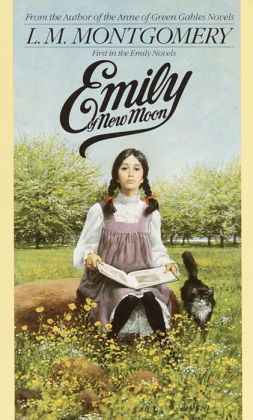
Wednesday, April 17, 2013

The Annotated Hobbit (2002)

The Annotated Hobbit. Revised and Expanded Edition. J.R.R. Tolkien. Annotated by Douglas A. Anderson. 2002. (1937, original Hobbit pub. date). Houghton Mifflin Harcourt. 416 pages.

The Hobbit is one of my favorite books even though I didn't discover it until I was an adult. It's a children's book that I've read several times as an adult. One of those feel-good books that you can happily, joyfully read each and every year without tiring of it. The Annotated Hobbit makes a lovely present for people who can't get enough of The Hobbit!

After viewing The Hobbit: The Unexpected Journey, I picked up The Annotated Hobbit. It was just what I needed! The film "covers" the first six chapters of the novel: "An Unexpected Party," "Roast Mutton," "A Short Rest," "Over Hill and Under Hill," "Riddles in the Dark," and "Out of the Frying-Pan Into the Fire." The most significant chapter in this annotated edition may just be "Riddles in the Dark." Fans most likely know already that the story of Bilbo's ring varies greatly from the original publication in 1937 and the later editions published after Tolkien wrote The Lord in the Rings, the variations even becoming a part of the story in a way. But this was the first time I was able to read the full, original ending to the story. (This is found in the notes on pages 128-131 and page 134.)

I came to the text needing to "check" the "faithfulness" of the film to the movie. True, I wanted to spend time with the characters, and, of course, I wanted to read it (again) because it's a great story. But. I wanted to see if the movie got it "wrong" or "right." While that was my original intention, I didn't always keep to it. I found the characters and story so irresistible. I was reminded once again of all the lovely little things that I just ADORE about the book. Things that didn't always translate as faithfully as I would have liked in the movie. Of course, some of what I ADORED about the book made it into the film, sometimes very faithful both in tone and detail.

There were some things that are technically "from the book" but taken completely out of proportion and focus, things that were made BIG AND SIGNIFICANT that barely got more than a sentence or two at most in the novel. The thing that stands out, for example, is how the party is HUNTED in the movie. Almost from the start, the journey is perilous because of a specific threat. And every single stage of the journey is equally dangerous and life-threatening. There is a purposeful, intentional darkness (evil) beginning to move in Middle Earth. In the novel, this isn't the case. The party faces danger, yes, sometimes a little danger, sometimes a lot of danger. But it isn't of an intentional hunted sort of danger. More of a being in the wrong place at the wrong time danger. They stumble almost on the trolls. (They also stumble upon the meeting place of the wolves or wargs.) And they face danger from rock slides and bad storms--but this is a natural threat. And yes, the stone giants exist but not so absurdly as in the movie:
There they were sheltering under a hanging rock for the night, and he lay beneath a blanket and shook from head to toe. When he peeped out in the lightning-flashes, he saw that across the valley the stone-giants were out, and were hurling rocks at one another for a game, and catching them, and tossing them down into the darkness where they smashed among the trees far below, or splintered into little bits with a bang. Then came a wind and a rain, and the wind whipped the rain and the hail about in every direction, so that an overhanging rock was no protection at all. Soon they were getting drenched and their ponies were standing with their heads down and their tails between their legs, and some of them were whinnying with fright. They could hear the giants guffawing and shouting all over the mountainsides.
"This won't do at all!" said Thorin. "If we don't get blown off, or drowned, or struck by lightning, we shall be picked up by some giant and kicked sky-high for a football."
"Well, if you know of anywhere better, take us there!" said Gandalf, who was feeling very grumpy, and was far from happy about the giants himself. (104)
The book doesn't exactly stay focused on the danger in any particularly threatening situation. The focus is on the adventure, the quest, the journey. There are plenty of in-between moments in the book. Moments where they might not be physically in danger from an enemy (goblins, trolls, angry elves, giant spiders), but might be facing discouragement, doubt, depression. Not to mention hunger, thirst, and exhaustion!!! 

There were isolated scenes that were especially faithful to the book and lovely to watch! But there were plenty of scenes that were pure interpretation. For better or worse. The film shows that there is more than one way to "read" a book or story.

Reading The Annotated Hobbit was beneficial. It reminded me of the creative process involved in writing and storytelling. Reading the annotations showed me that Tolkien never stopped creating this story. It was NOT "the end" of the story when it was published in 1937. The story kept changing and transforming and evolving through the decades. Tolkien stayed involved in the story. If Tolkien himself kept changing the story as his fantasy world kept growing and expanding, then it only makes sense that the film would be free to do the same.

I personally enjoyed reading almost all of the annotations. Some notes are mainly textual revision notes, letting readers know the differences between the different editions of the text (1937, 1951, 1966, etc.) Other notes tend to be scholarly and focused on literature. But some provide insights on The Hobbit or Middle Earth. (I liked notes about authors that influenced Tolkien.)


© 2013 SukaYuka.com of SukaYuka's Book Reviews