Showing posts with label books reread in 2014. Show all posts

Friday, January 31, 2014

Reread #5 A Woman's Place

A Woman's Place. Lynn Austin. 2006. Bethany House. 450 pages. [Source: Book I Bought]

I first read and reviewed A Woman's Place in August 2007. I absolutely loved, loved, loved this book. And why wouldn't I?! After all, it's a book set during one of my favorite historical periods: World War II. The focus is on women on the American homefront: how the war effected women's lives in and out of the home. This book seems to be a written-just-for-me book. So, of course, I adored it.

Four women. Four very different, unique women come together as a team at Stockton Shipyards. With proper training, these four women will be helping build ships, ships that will help the Allied Forces win the war. An end to war is all these women want. Well, they'd also like a little respect and some justice.

From the original review:

Ginny, or "Virginia" as her husband insists on calling her, is a housewife in her thirties who feels underappreciated and unloved.

Helen is a woman in her fifties who is wealthy and bitter and angry.

Rosa is a young newlywed from Brooklyn. She met a young man in the Navy and suddenly finds herself living with her inlaws while the war is on.

And Jean is fresh out of high school--fresh from the farm, one of eighteen children. She has six brothers enlisted in various branches of the service.

Each woman finds herself employed at Stockton Shipyards. Each has felt called to serve her nation. Each one is there for their own personal reasons as well. Ginny is lacking self confidence, but seems to bloom under the circumstances of hard work and friendship. Rosa is a bit unwieldy at times but in need of love and guidance and wisdom from older women. Helen is there trying to escape the bitter aloneness she feels in her large home--one she inherited from a father that she hated. And Jean, well, Jean is trying to figure out what she wants for herself. Her boyfriend back home doesn't see any reason for her to go to college, to get an education. He doesn't see much point in her working so far away from home either--all the way from Indiana to Michigan. But Jean, Jean is finding herself, finding her independence.

Each character was well-developed. Each character was complex. Each circumstance was complex. Very different women, very different backgrounds. But one common goal. I loved how this novel came together--pieced together. How four women's lives were able to touch and connect and encourage and build up one another. Each woman's life was changed because of the others. Each one learned how important, how significant, how loved they really and truly were.

© 2014 SukaYuka.com of SukaYuka's Book Reviews

Friday, January 24, 2014

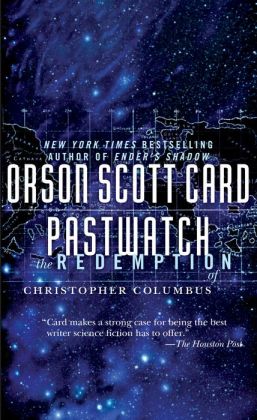
Reread #4 Pastwatch The Redemption of Christopher Columbus

Pastwatch The Redemption of Christopher Columbus. Orson Scott Card. 1996. Tor.  351 pages. [Source: Book I Bought]

I first reviewed Pastwatch for the blog in November 2007, but that was certainly not my first time to read it. I discovered Orson Scott Card's work in a library science class in the fall of 2000. I read everything I could find of his over the next year. It was my first venture into science fiction. It was LOVE.

Semi-Apocalyptic fiction. Alternate histories. Time Travel. Need I say more?! For anyone who enjoys dystopias or apocalyptic fiction, I'd say that Pastwatch was a must read! The same is true for anyone who loves reading time travel stories. The premise and plot is enough to keep one reading. But the characterization is wonderfully done as well.

In the world of Pastwatch, history can be viewed on the big screen. In the early stages, this technology could only watch vast regions--note climate changes and social changes--the building of communities and sometimes their collapses. But as this technology is developed further, it becomes possible to watch history in greater detail, minute detail. Scientists, historians, researchers (whatever you want to call them) can do studies on communities, societies, or individuals. What's the point of watching the past? To learn. To understand. To answer impossible questions. But a few historians hope for more. What if watching the past could change the past? Each historian researcher has his/her own speciality. Sometimes they work on something personally, other times they come together into various teams. Readers meet a handful of researchers--probably six or seven and learn of their lives, of their studies.

How is Christopher Columbus involved? Well, he's one of our narrators for one thing. But secondly, he becomes the subject of interest for most of our other narrators. It is HIS life that is being dissected and held up for study. What our researchers learn is that at some point in time, future scientists, interfered or manipulated the past that turned Christopher Columbus' interest to sailing west. Their quest to figure out how and why of this manipulation will lead them on a journey with massive consequences. For they're debating whether or not they should do something along the same lines...

It is a science fiction novel. And like many science fiction novels, it deals with aspects of playing God. One of the thought-provoking subjects in Pastwatch is suffering. The historian-researchers perhaps feel they can do a better job at writing or rewriting history. That they can do a better job at alleviating suffering and establishing peace and goodwill across the globe. The future-historians take on the role of God, manipulating people in the past making them believe that they are God or God's messengers. Pain and suffering was also a big, big subject in the Worthing Saga, another Card novel.

Quotes:
Though Tagiri did not put her own body back in time, it is still true to say that she was the one who stranded Christopher Columbus on the island of Hispaniola and changed the face of history forever. Though she was born seven centuries after Columbus's voyage and never left her birth continent of Africa, she found a way to reach back and sabotage the European conquest of America. It was not an act of malice. Some said that it was correcting a painful hernia in a brain damaged child: In the end, the child would still be severely limited, but it would not suffer as much along the way. But Tagiri saw it differently.
"History is not prelude," she said once. "We don't justify the suffering of people in the past because everything turned out well enough by the time we came along. Their suffering counts just as much as our peace and happiness. We look out of our golden windows and feel pity for the scenes of blood and blades, of plagues and famines that are played out in the surrounding country. When we believed that we could not go back in time and make changes, then we could be excused for shedding a tear for them and then going on about our happy lives. But once we know that it is in our power to help them, then, if we turn away and let their suffering go on, it is no golden age we live in, and we poison our own happiness. Good people do not let others suffer needlessly." What she asked was a hard thing, but some agreed with her. Not all, but in the end, enough. (25-6)
Till now, all the story-seekers in Pastwatch had devoted their careers to recording the stories of great, or at least influential men and women of the past. But Tagiri would study the slaves, not the owners; she would search throughout history, not to record the choices of the powerful, but to find the stories of those who had lost all choice. To remember the forgotten people, the ones whose dreams were murdered and whose bodies were stolen from themselves, so that they were not even featured players in their own autobiographies. The ones whose faces showed that they never forgot for one instant that they did not belong to themselves, and that there was no lasting joy possible in life because of that. (35)
 "It can be done," she said, blurting it out at once. "We can change it. We can stop--something. Something terrible, we can make it go away. We can reach back and make it better."
He said nothing. He waited.
"I know what you're thinking, Hassan. We might also make it worse."
"Do you think I haven't been going through this in my mind tonight?" said Hassan. "Over and over. Look at the world around us, Tagiri. Humanity is finally at peace. There are no plagues. No children die hungry or live untaught. The world is healing. That was not inevitable. It might have ended up far worse. What change could we possibly make in the past that would be worth the risk of creating a history without this resurrection of the world?"
"I'll tell you what change would be worth it," she said. "The world would not have needed resurrecting if it had never been killed."
"What, do you imagine that there's some change we could make that would improve human nature? Undo the rivalry of nations? Teach people that sharing is better than greed?"
"Has human nature changed even now?" asked Tagiri. "I think not. We still have as much greed, as much power-lust, as much pride and anger as we ever had. The only difference now is that we know the consequences and we fear them. We control ourselves. We have become, at long last, civilized."
"So you think that we can civilize our ancestors?"
"I think," said Tagiri, "that if we can find some way to do it, some sure way to stop the world from tearing itself to pieces as it did, then we must do it. To reach into the past and prevent the disease is better than to take the patient at the point of death and slowly, slowly bring her back to health. To create a world in which the destroyers did not triumph."
"If I know you at all, Tagiri," said Hassan, "you would not have come here tonight if you didn't know already what the change must be."
"Columbus," she said."
"One sailor? Caused the destruction of the world?" (50-1)
"I'm finding the place where the smallest, simplest change would save the world from the most suffering. That would cause the fewest cultures to be lost, the fewest people to be enslaved, the fewest species to fall extinct, the fewest resources to be exhausted. It comes together at the point where Columbus returns to Europe with his tales of gold and slaves and nations to be converted into Christian subjects of the king and queen." (52)
© 2014 SukaYuka.com of SukaYuka's Book Reviews
Sunday, January 19, 2014

Good Morning, Miss Dove

Good Morning, Miss Dove. Frances Gray Patton. 1954. 218 pages. [Source: Book I Bought]

Liberty Hill was a small freshwater town--not a hill, really, but just a modest rise in the land--where the streets were named for trees and heroes, and a sense of life's continuity ran in the air. It was like a hundred American towns, smug and cozy, and it put its special stamp upon its own. People born and raised there--high and low, rich and poor--were neighbors in an irrevocable way, because their imaginations had been nursed on the same sights and sounds and legends and early ordeals. (1)

I love, love, love Good Morning, Miss Dove. I've been wanting to read this one for years and years. I saw the movie decades ago and absolutely loved it. I knew that I wanted to read the book it was based on. I was not disappointed.

Good Morning, Miss Dove is a treat of a book. I absolutely loved it. I thought the use of flashbacks worked surprisingly well. I loved seeing Miss Dove's life story come together piece by piece by piece. I also loved the sense of community, of getting glimpses into ordinary and not-so-ordinary lives.

Miss Dove teaches geography in the local elementary school: first grade through sixth grade. She has done so for many, many years. She's taught the parents of her current students. Miss Dove is a force, a force for good, perhaps, but she's described as "the terrible Miss Dove" by young and old. One school day the unexpected happens: Miss Dove is teaching when she's overcome by a sudden, sharp, painful spasm in her back. Within minutes she's lost sensation in her right leg. She's calm, collected, but insistent. She'll send a student for help, for her doctor. The doctor that arrives, however, is not HER doctor, but a former student. She receives help from two of her former students: a minister (Alexander) and a doctor (Thomas). She's admitted to the hospital. The nurse, you guessed it, a former student as well (Billie Jean). As she's in the hospital, she reflects on her life. Readers are treated to dozens of flashbacks shedding light on Miss Dove's life and the lives of those in the community. Readers get to know plenty of former students, and see the effect that the "terrible Miss Dove" had on their lives. 

I would recommend Good Morning, Miss Dove to those who love good, satisfying, comforting feel-good reads. I would recommend it to those who love It's A Wonderful Life and/or Mr. Holland's Opus.

 Favorite quotes:
For Miss Dove had no moods. Miss Dove was a certainty. She would be today what she had been yesterday and would be tomorrow. And so, within limits, would they. Single file they would enter her room. Each child would pause on the threshold as its mother and father had paused, more than likely, and would say--just as the policeman had said--in distinct, formal accents: "Good morning, Miss Dove." And Miss Dove would look directly at each of them, fixing her eyes directly upon theirs, and replay: "Good morning, Jessamine," or "Margaret," or "Samuel." (Never "Sam," never "Peggy," never "Jess." She eschewed familiarity as she wished others to eschew it.) They would go to their appointed desks. Miss Dove would ascend to hers. The lesson would begin.
There was no need to waste time in preliminary admonitions. Miss Dove's rules were as fixed as the signs of the zodiac. And they were known. (8-9)
And on that unassaulted field--in that room where no leeway was given to the personality, where a thing was black or white, right or wrong, polite or rude, simply because Miss Dove said it was, there was a curiously soothing quality. The children left it refreshed and restored, ready for fray or frolic. For within its walls they enjoyed what was allowed them nowhere else--a complete suspension of will. (11-2)
"Is that the same map? Jincey asked. She pointed to the large map of the world that hung, rolled up for the summer, above the blackboard behind Miss Dove. "Is China still orange?"
"It is a new map," Miss Dove said. "China is purple."
"I liked the old map," Jincey said. "I liked the old world."
"Cartography is a fluid art," said Miss Dove.
With the flat of her hand Jincey pushed her hair back from her forehead. She had done that in moments of perplexity long ago. "Oh, Miss Dove," she said, and her voice shook, "tell me what to do!"
Miss Dove was not at a loss. She told Jincey in three short words. "Do your duty," she said.
Jincey's eyes filled with tears. "But what is your duty when your world has ended?"
"You are nineteen, I believe," said Miss Dove. Her statement was devoid of sarcasm. Miss Dove had been nineteen when her own world had ended and begun. And now she could remember without pain or longing for the old last world. It was a charming memory, like a fairy tale read to a sleepy child. But the new world was real. Whether she was happy in it she did not ask herself. She was strong. She was useful. She was Miss Dove." (74-5)
The room into which Miss Dove was wheeled was a small, blue room. Its window, giving upon budding treetops and gabled roofs, was like a big framed picture that dwarfed the wall.
"Now we'll take off our clothes and then we'll feel more comfy," said Billie Jean. She spoke in a humoring tone with steel behind it. It was clear that she intended to assume command.
"The pronoun "we" is misleading," said Miss Dove. "Unless you propose to take your clothes off." Billie Jean tittered nervously, but refused to be intimidated. (95)
Anything could be taught, of course--fine points of deportment as well as the names of the tributaries of the Nile. By six years of drill and example--forty-five minutes a day, Monday through Friday, September through May--Miss Dove had brought many a child to conform to a code that ran counter to his inclinations. But now and then--oh, a dozen times, perhaps, in the course of her teaching career--she had met a child in whom the ethical instinct, microscopic but fully-formed, was as innate as original sin. It was an almost mystical thing, that gift for goodness-and rarer than mathematical genius or perfect pitch. Hardened as she was to surprises, Miss Dove never recognized it without a sudden leap of the pulse. She had recognized it in William. (99)
 Miss Dove had been reading aloud from a book the dietary habits of undomesticated animals. "Bears like honey," she read. "They are also fond of red ants which have a flavor similar to that of pickles."
Angela had waved her hand. "How does he know, Miss Dove?" she had demanded. "How does the author know what ants taste like?"
The thirty-nine other children in the room had fixed their trusting eyes upon Miss Dove, waiting for her answer. Then Angela, herself, saved the day. Brash with the imminence of victory, she had pushed her advantage too far.
"Did he eat an ant to see?" she asked sarcastically. "Or did a bear tell him?" (115)
© 2014 SukaYuka.com of SukaYuka's Book Reviews

Friday, January 17, 2014

Reread #3 Doomsday Book

Doomsday Book. Connie Willis. 1992. Random House. 592 pages.  [Source: Book I Bought]

Mr. Dunworthy opened the door to the laboratory and his spectacles promptly steamed up.
"Am I too late?" he said, yanking them off and squinting at Mary.
"Shut the door," she said. "I can't hear you over the sound of those ghastly carols."
Dunworthy closed the door, but it didn't completely shut out the sound of "O Come, All Ye Faithful" wafting in from the quad. "Am I too late?" he said again. 

I first read and reviewed Doomsday Book in October 2010. I reread it in December of 2011. Yes, this is my third time to read Connie Willis' award-winning novel, Doomsday Book. (It won the Hugo and Nebula!) Quite simply Doomsday Book is one of my favorite, favorite, favorite books. It combines my love of history (the measly middle ages!) and my love of science fiction (time travel!!!). It is set--in the future and the past--during the Advent-Christmas-Epiphany season.

Kivrin has a dream. She'll be the first time traveler historian to go to the fourteenth century. If all goes well, and why wouldn't it boasts Gilchrist, then she'll spend two or three weeks in 1320 before returning. But Mr. Dunworthy (and subsequently Badri, the tech guy) aren't as confident that things will go smoothly. Dunworthy is sure that something will go wrong. Even if something doesn't go wrong with the time travel aspect (she lands in the right time, the right place), he's worried that something will happen to her in the past (she'll get beaten up, she'll get raped,  she'll be mistaken for a witch, she'll get sick, she'll die).

From the start, there is something wrong with the drop. It starts with the technician, Badri, becoming ill. Soon the whole area is quarantined. Cases start coming in--and soon medical staff are overwhelmed. What is this disease--this illness? How is it spread? Where did it come from? Is it fatal? Is there a cure? Did he have a chance to pass this on to Kivrin before she went through the Net? What was Badri trying to communicate to Dunworthy at the last minute?

Willis does a great job building the past--the fourteenth century--and the "present" which is a time-traveling future. (The story alternates between past and present.) She blends mystery, science fiction, and historical fiction--and blends them well! Readers meet dozens of characters in both centuries as this mystery unfolds. And while it is serious--dramatic--and emotional--people will die--it's not without its lighter moments of wit. There are personalities. The characters are oh-so-human.


Favorite quotes:
"I've just thought who you remind me of," Mary said, setting down her plate and a napkin. "William Gaddson's mother."
That was a truly unfair remark. William Gaddson was one of his first-year students. His mother had been up six times this term, the first time to bring William a pair of earmuffs. (23)
"Your tech seems to have done a passable job," Gilchrist said, turning to Dunworthy. "Medieval would like to arrange to borrow him on our next drop. We'll be sending Ms. Engle to 1355 to observe the effects of the Black Death. Contemporary accounts are completely unreliable, particularly in the area of mortality rates. The accepted figure of fifty million deaths is clearly inaccurate, and estimates that it killed one third to one half of Europe are obvious exaggerations. I'm eager to have Ms. Engle make trained observations."
"Aren't you being rather premature?" Dunworthy said. "Perhaps you should wait to see if Kivrin manages to survive this drop or at the very least gets through to 1320 safely."
Gilchrist's face took on its pinched look. "It strikes me as somewhat unjust that you constantly assume Medieval is incapable of carrying out a successful drop," he said. "I assure you we have carefully thought out its every aspect. The method of Kivrin's arrival has been researched in every detail. Probability puts the frequency of travelers on the Oxford-Bath road as one every 1.6 hours, and it indicates a 92 percent chance of her story of an assault being believed, due to the frequency of such assaults. A wayfarer in Oxfordshire had a 42.5 percent chance of being robbed in winter, 58.6 percent in summer. That's an average of course. The chances were greatly increased in parts of Otmoor and the Wychwood and on the smaller roads."
Dunworthy wondered how on earth Probability had arrived at those figures. The Domesday Book didn't list thieves, with the possible exception of the king's census takers, who sometimes took more than the census, and the cutthroats of the time surely hadn't kept records of whom they had robbed and murdered, the locations marked neatly on a map. Proofs of deaths away from home had been entirely de facto: the person had failed to come back. And how many bodies had lain in the woods, undiscovered and unmarked by anyone? (29)
"Mr. Dunworthy, I've been looking for you everywhere," Finch said. "The most dreadful thing's happened."
"What is it?" Dunworthy said. He glanced at his digital. It was ten o'clock. Too early for someone to have come down with the virus if the incubation period was twelve hours. "Is someone ill?"
"No sir. It's worse than that. It's Mrs. Gaddson. She's in Oxford. She got through the quarantine perimeter somehow."
"I know. The last train. She made them hold the doors."
"Yes, well, she called from hospital. She insists on staying at Balliol..."
"Tell her we haven't any room. Tell her the dormitories are being sterilized."
"I did, sir, but she said in that case she would room with William. I don't like to do that to him, sir."
"No," Dunworthy said. "There are some things one shouldn't have to endure, even in an epidemic." (117)
"I thought there'd be more going on," Colin said, sounding disappointed. "Sirens and all that."
"And dead-carts going through the streets, calling 'Bring out your dead'?" Dunworthy said. "You should have gone with Kivrin. Quarantines in the Middle Ages were far more exciting than this one's likely to be...(191)
19 December 1320 (Old Style). I'm feeling better. I can go three or four careful breaths at a time without coughing, and I was actually hungry this morning, though not for the greasy porridge Maisry brought me. I would kill for a plate of bacon and eggs. And a bath. I am absolutely filthy. Nothing's been washed since I got here except my forehead, and the last two days Lady Imeyne has glued poultices made of strips of linen covered with a disgusting-smelling paste to my chest. Between that, the intermittent sweats that I'm still having, and the bed (which hasn't been changed since the 1200s), I positively reek, and my hair, short as it is, is crawling. I'm the cleanest person here. (200)
Finch went to the door and then turned back. "About Mrs. Gaddson, sir. She's behaving dreadfully, criticizing the college and demanding that she be moved in with her son. She's completely undermining morale."
"I'll say," Colin said dumping the muffins on the table. "The Gallstone told me hot breads were bad for my immune system."
"Isn't there some sort of volunteer work she could do at Infirmary or something?" Finch asked. "To keep her out of college?"
"We can hardly inflict her on poor helpless flu victims. It might kill them. What about asking the vicar? He was looking for volunteers to run errands."
"The vicar?" Colin said. "Have a heart, Mr. Dunworthy. I'm working for the vicar."
"The priest from Holy Re-Formed then," Dunworthy said. "He's fond of reciting the Mass in Time of Pestilence for morale. They should get along swimmingly. (264)
© 2014 SukaYuka.com of SukaYuka's Book Reviews

Sunday, January 12, 2014

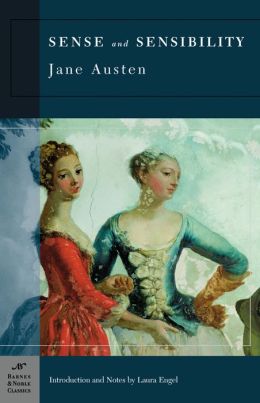
My Year With Jane: Sense and Sensibility

Sense and Sensibility. Jane Austen. 1811. 352 pages. [Source: Book I Bought]

Some Jane Austen novels, in my opinion, have to be read multiple times in order to fully love and appreciate them. I think that is the case with Sense and Sensibility. At least, I have found it to be so. I think I have "loved" it more each time I've read it. And, I believe, this is the third time I've read it. I do know it is the third time I'll be reviewing it for the blog.

Review #1 from 2008
Review #2 from 2011

Sense and Sensibility was Jane Austen's first published novel. The original readers would not have had Pride and Prejudice to compare it with, which may work in the books favor. They wouldn't have known Jane and Elizabeth, so there wouldn't be the temptation to compare these two sisters (Marianne and Elinor) with the angelic Jane and feisty Elizabeth. And I think there is the temptation to compare. I found myself constantly looking for traces and hints of Jane and Elizabeth. Is Elinor more like Jane or Elizabeth? Is Marianne more like Elizabeth or Lydia or a bit of both? And it isn't just the sisters. Lucy Steele versus Caroline Bingley. Wickham versus Willoughby. (Amanda Grange has written Wickham's Diary, but will she ever write Willoughby's diary?! I'd love to read it!!!)

I do love Jane Austen. I love spending time in her character-rich novels. I love getting to know her characters. Not just her main characters. But the minor ones as well. So many memorable characters. Even if they're memorable only because they're despicable. I love the pacing. I love the dialogue. I love how each rereading shows me something different about a character. Little things that just take a little time perhaps to fully realize a character. When you're reading for plot and plot alone, little things pass you by.

Favorite quotes:
She [Elinor] believed the regard to be mutual; but she required greater certainty of it to make Marianne’s conviction of their attachment agreeable to her. She knew that what Marianne and her mother conjectured one moment, they believed the next — that with them, to wish was to hope, and to hope was to expect. She tried to explain the real state of the case to her sister.
Men are very safe with us, let them be ever so rich.
Willoughby was a young man of good abilities, quick imagination, lively spirits, and open, affectionate manners. He was exactly formed to engage Marianne’s heart, for with all this, he joined not only a captivating person, but a natural ardour of mind which was now roused and increased by the example of her own, and which recommended him to her affection beyond every thing else. His society became gradually her most exquisite enjoyment. They read, they talked, they sang together; his musical talents were considerable; and he read with all the sensibility and spirit which Edward had unfortunately wanted.
When he was present she had no eyes for any one else. Every thing he did, was right. Every thing he said, was clever. If their evenings at the park were concluded with cards, he cheated himself and all the rest of the party to get her a good hand. If dancing formed the amusement of the night, they were partners for half the time; and when obliged to separate for a couple of dances, were careful to stand together and scarcely spoke a word to any body else. Such conduct made them of course most exceedingly laughed at; but ridicule could not shame, and seemed hardly to provoke them.
“Brandon is just the kind of man,” said Willoughby one day, when they were talking of him together, “whom every body speaks well of, and nobody cares about; whom all are delighted to see, and nobody remembers to talk to.”
“Does your sister make no distinction in her objections against a second attachment? or is it equally criminal in every body? Are those who have been disappointed in their first choice, whether from the inconstancy of its object, or the perverseness of circumstances, to be equally indifferent during the rest of their lives?” “Upon my word, I am not acquainted with the minutiƦ of her principles. I only know that I never yet heard her admit any instance of a second attachment’s being pardonable.”
“You are mistaken, Elinor,” said she warmly, “in supposing I know very little of Willoughby. I have not known him long indeed, but I am much better acquainted with him, than I am with any other creature in the world, except yourself and mama. It is not time or opportunity that is to determine intimacy; it is disposition alone. Seven years would be insufficient to make some people acquainted with each other, and seven days are more than enough for others. I should hold myself guilty of greater impropriety in accepting a horse from my brother, than from Willoughby. Of John I know very little, though we have lived together for years; but of Willoughby my judgment has long been formed.”
Elinor then heard Willoughby say, in a low voice to Marianne, “There are some people who cannot bear a party of pleasure. Brandon is one of them. He was afraid of catching cold I dare say, and invented this trick for getting out of it. I would lay fifty guineas the letter was of his own writing.” “I have no doubt of it,” replied Marianne.
“I am afraid,” replied Elinor, “that the pleasantness of an employment does not always evince its propriety.”
“On the contrary, nothing can be a stronger proof of it, Elinor; for if there had been any real impropriety in what I did, I should have been sensible of it at the time, for we always know when we are acting wrong, and with such a conviction I could have had no pleasure.”
Oh, Elinor, how incomprehensible are your feelings! You had rather take evil upon credit than good. You had rather look out for misery for Marianne, and guilt for poor Willoughby, than an apology for the latter. You are resolved to think him blamable, because he took leave of us with less affection than his usual behaviour has shown. And is no allowance to be made for inadvertence, or for spirits depressed by recent disappointment? Are no probabilities to be accepted, merely because they are not certainties? Is nothing due to the man whom we have all such reason to love, and no reason in the world to think ill of? — to the possibility of motives unanswerable in themselves, though unavoidably secret for a while? And, after all, what is it you suspect him of?”
Secrecy may be advisable; but still I cannot help wondering at its being practiced by him. 
“I have not wanted syllables where actions have spoken so plainly. Has not his behaviour to Marianne and to all of us, for at least the last fortnight, declared that he loved and considered her as his future wife, and that he felt for us the attachment of the nearest relation? Have we not perfectly understood each other? Has not my consent been daily asked by his looks, his manner, his attentive and affectionate respect? My Elinor, is it possible to doubt their engagement? How could such a thought occur to you? How is it to be supposed that Willoughby, persuaded as he must be of your sister’s love, should leave her, and leave her perhaps for months, without telling her of his affection, — that they should part without a mutual exchange of confidence?”
“You have no ambition, I well know. Your wishes are all moderate.” “As moderate as those of the rest of the world, I believe. I wish as well as every body else to be perfectly happy; but, like every body else it must be in my own way. Greatness will not make me so.” “Strange that it would!” cried Marianne. “What have wealth or grandeur to do with happiness?” “Grandeur has but little,” said Elinor, “but wealth has much to do with it.” “Elinor, for shame!” said Marianne, “money can only give happiness where there is nothing else to give it. Beyond a competence, it can afford no real satisfaction, as far as mere self is concerned.” “Perhaps,” said Elinor, smiling, “we may come to the same point. Your competence and my wealth are very much alike, I dare say; and without them, as the world goes now, we shall both agree that every kind of external comfort must be wanting. Your ideas are only more noble than mine. Come, what is your competence?” “About eighteen hundred or two thousand a year; not more than that.” Elinor laughed. “Two thousand a year! One is my wealth! I guessed how it would end.”
“I should hardly call her a lively girl — she is very earnest, very eager in all she does — sometimes talks a great deal and always with animation — but she is not often really merry.”
“I have frequently detected myself in such kind of mistakes,” said Elinor, “in a total misapprehension of character in some point or other: fancying people so much more gay or grave, or ingenious or stupid than they really are, and I can hardly tell why or in what the deception originated. Sometimes one is guided by what they say of themselves, and very frequently by what other people say of them, without giving oneself time to deliberate and judge.”
“Shyness is only the effect of a sense of inferiority in some way or other. If I could persuade myself that my manners were perfectly easy and graceful, I should not be shy.”
“But you would still be reserved,” said Marianne, “and that is worse.” Edward started. “Reserved! Am I reserved, Marianne?” “Yes, very.” “I do not understand you,” replied he, colouring. “Reserved! — how, in what manner? What am I to tell you? What can you suppose?” Elinor looked surprised at his emotion; but trying to laugh off the subject, she said to him, “Do not you know my sister well enough to understand what she means? Do not you know she calls every one reserved who does not talk as fast, and admire what she admires as rapturously as herself?”
“Mr. Palmer does not hear me,” said she, laughing; “he never does sometimes. It is so ridiculous!”
This was quite a new idea to Mrs. Dashwood; she had never been used to find wit in the inattention of any one, and could not help looking with surprise at them both.
But to appear happy when I am so miserable — Oh! who can require it?
“The unkindness of your own relations has made you astonished to find friendship any where.”
Marianne’s lips quivered, and she repeated the word “Selfish?” in a tone that implied, “do you really think him selfish?” “The whole of his behaviour,” replied Elinor, “from the beginning to the end of the affair, has been grounded on selfishness. It was selfishness which first made him sport with your affections; which afterwards, when his own were engaged, made him delay the confession of it, and which finally carried him from Barton. His own enjoyment, or his own ease, was, in every particular, his ruling principle.” “It is very true. My happiness never was his object.” “At present,” continued Elinor, “he regrets what he has done. And why does he regret it? — Because he finds it has not answered towards himself. It has not made him happy. But does it follow that had he married you, he would have been happy? — The inconveniences would have been different. He would then have suffered under the pecuniary distresses which, because they are removed, he now reckons as nothing. He would have had a wife of whose temper he could make no complaint, but he would have been always necessitous — always poor; and probably would soon have learned to rank the innumerable comforts of a clear estate and good income as of far more importance, even to domestic happiness, than the mere temper of a wife.”
I will be calm, I will be mistress of myself.
Mrs. Jennings’s prophecies, though rather jumbled together, were chiefly fulfilled; for she was able to visit Edward and his wife in their Parsonage by Michaelmas, and she found in Elinor and her husband, as she really believed, one of the happiest couples in the world. They had in fact nothing to wish for, but the marriage of Colonel Brandon and Marianne, and rather better pasturage for their cows.
Marianne Dashwood was born to an extraordinary fate. She was born to discover the falsehood of her own opinions, and to counteract, by her conduct, her most favourite maxims. She was born to overcome an affection formed so late in life as at seventeen, and with no sentiment superior to strong esteem and lively friendship, voluntarily to give her hand to another! — and that other, a man who had suffered no less than herself under the event of a former attachment, whom, two years before, she had considered too old to be married, — and who still sought the constitutional safeguard of a flannel waistcoat! But so it was.

© 2014 SukaYuka.com of SukaYuka's Book Reviews
Friday, January 10, 2014

Reread #2 The Time Machine

The Time Machine. H.G. Wells. 1895. Penguin. 128 pages. [Source: Book I Bought]

I first read and reviewed The Time Machine in June 2007. I really loved it. It was my introduction to H.G. Wells, and, to classic science fiction. I absolutely loved, loved, loved it then.

I decided to reread The Time Machine for Carl's Sci-Fi Experience this January. It was very fun to revisit this one. I still enjoy time travel novels very much. I may not be quite as passionate about the novel upon second reading; however, I am still glad I took the time to read it again. And I would definitely still recommend it!

The plot: A group of men are gathered together to discuss life. One of them, the one called "The Time Traveller" reveals to his friends and/or associates that he is working on an invention--a time machine. He intends to prove that it is possible to travel back and forth in the fourth dimension--time. A week later, at another party or gathering, he is then able to tell his tale. He tells of his travels to the year 802,701. The good. The bad. The ugly. Life on earth has changed quite a bit, as the Time Traveller witnesses. And as he journeys even to the very end of time, he learns some important truths about mankind past, present, and future. The storytelling element of the story is great.

Favorite quotes:
I think that at that time none of us quite believed in the Time Machine. The fact is, the Time Traveller was one of those men who are too clever to be believed: you never felt that you saw all round him; you always suspected some subtle reserve, some ingenuity in ambush, behind his lucid frankness.
I will,' he went on, 'tell you the story of what has happened to me, if you like, but you must refrain from interruptions. I want to tell it. Badly. Most of it will sound like lying. So be it! It's true—every word of it, all the same. I was in my laboratory at four o'clock, and since then … I've lived eight days … such days as no human being ever lived before! I'm nearly worn out, but I shan't sleep till I've told this thing over to you. Then I shall go to bed. But no interruptions! And with that the Time Traveller began his story as I have set it forth. He sat back in his chair at first, and spoke like a weary man. Afterwards he got more animated. In writing it down I feel with only too much keenness the inadequacy of pen and ink—and, above all, my own inadequacy—to express its quality. You read, I will suppose, attentively enough; but you cannot see the speaker's white, sincere face in the bright circle of the little lamp, nor hear the intonation of his voice. You cannot know how his expression followed the turns of his story! Most of us hearers were in shadow, for the candles in the smoking-room had not been lighted, and only the face of the Journalist and the legs of the Silent Man from the knees downward were illuminated.
The two species that had resulted from the evolution of man were sliding down towards, or had already arrived at, an altogether new relationship. The Eloi, like the Carolingian kings, had decayed to a mere beautiful futility. They still possessed the earth on sufferance: since the Morlocks, subterranean for innumerable generations, had come at last to find the daylit surface intolerable. And the Morlocks made their garments, I inferred, and maintained them in their habitual needs, perhaps through the survival of an old habit of service. They did it as a standing horse paws with his foot, or as a man enjoys killing animals in sport: because ancient and departed necessities had impressed it on the organism. But, clearly, the old order was already in part reversed. The Nemesis of the delicate ones was creeping on apace. Ages ago, thousands of generations ago, man had thrust his brother man out of the ease and the sunshine. And now that brother was coming back changed! Already the Eloi had begun to learn one old lesson anew. They were becoming reacquainted with Fear. And suddenly there came into my head the memory of the meat I had seen in the Under-world. It seemed odd how it floated into my mind: not stirred up as it were by the current of my meditations, but coming in almost like a question from outside. I tried to recall the form of it. I had a vague sense of something familiar, but I could not tell what it was at the time.
I understood now what all the beauty of the Over-world people covered. Very pleasant was their day, as pleasant as the day of the cattle in the field. Like the cattle, they knew of no enemies and provided against no needs. And their end was the same. 'I grieved to think how brief the dream of the human intellect had been. It had committed suicide. It had set itself steadfastly towards comfort and ease, a balanced society with security and permanency as its watchword, it had attained its hopes—to come to this at last. Once, life and property must have reached almost absolute safety. The rich had been assured of his wealth and comfort, the toiler assured of his life and work. No doubt in that perfect world there had been no unemployed problem, no social question left unsolved. And a great quiet had followed. 'It is a law of nature we overlook, that intellectual versatility is the compensation for change, danger, and trouble. An animal perfectly in harmony with its environment is a perfect mechanism. Nature never appeals to intelligence until habit and instinct are useless. There is no intelligence where there is no change and no need of change. Only those animals partake of intelligence that have to meet a huge variety of needs and dangers. 'So, as I see it, the Upper-world man had drifted towards his feeble prettiness, and the Under-world to mere mechanical industry. But that perfect state had lacked one thing even for mechanical perfection—absolute permanency.

© 2014 SukaYuka.com of SukaYuka's Book Reviews

Friday, January 3, 2014

Reread #1 The Story of the Treasure Seekers (1899)

The Story of the Treasure Seekers. E. Nesbit. 1899. Puffin. 250 pages. [Source: Bought]

This is the story of the different ways we looked for treasure, and I think when you have read it you will see that we were not lazy about the looking. 

I first reviewed The Story of the Treasure Seekers in August 2011. I definitely enjoyed it more the first time, perhaps, but it is still fun to revisit E. Nesbit. I really, really love some of her children's books. 

Original review:

I just loved The Story of the Treasure Seekers. I loved the Bastables. There are six children: Dora, Oswald, Dicky, Noel and Alice, and H.O. (Horace Octavius). The children have a father, but no mother. But the father, for the most part, is absent from their day to day lives. This one has a simple plot. The children know that the family is in desperate need of money, and, well, they decide to look for treasure. Each child has an opportunity (or two) to come up with a plan for 'finding' treasure (getting money). Some of the plans are silly and over the top. (Like Noel's plan to marry a princess when he grew up.) But many of their plans lead to a FUN adventure!

I definitely enjoyed this one and would recommend it! It's a great adventure story with many satisfying moments. IF you've only read Nesbit's fantasy, you should give this one a try. 

This novel ends with Christmas!

Quotes:
Oswald spoke first. 'I think we might stop people on Blackheath--with crape masks and horse-pistols--and say "Your money or your life! Resistance is useless, we are armed to the teeth"--like Dick Turpin and Claude Duval. It wouldn't matter about not having horses, because coaches have gone out too.'
I am afraid the last chapter was rather dull. It is always dull in books when people talk and talk, and don't do anything, but I was obliged to put it in, or else you wouldn't have understood all the rest...
The best part of books is when things are happening. That is the best part of real things too. This is why I shall not tell you in this story about all the days when nothing happened. You will not catch me saying, 'thus the sad days passed slowly by'--or 'the years rolled on their weary course'--or 'time went on'--because it is silly; of course time goes on--whether you say so or not. So I shall just tell you the nice, interesting parts--and in between you will understand that we had our meals and got up and went to bed, and dull things like that. It would be sickening to write all that down, though of course it happens.
I have often thought that if the people who write books for children knew a little more it would be better. I shall not tell you anything about us except what I should like to know about if I was reading the story and you were writing it. Albert's uncle says I ought to have put this in the preface, but I never read prefaces, and it is not much good writing things just for people to skip. I wonder other authors have never thought of this.
Albert is always very tidy. He wears frilly collars and velvet knickerbockers. I can't think how he can bear to.
THE PURRING CLASS (Instructive Article) If I ever keep a school everything shall be quite different. Nobody shall learn anything they don't want to. And sometimes instead of having masters and mistresses we will have cats, and we will dress up in cat skins and learn purring. 'Now, my dears,' the old cat will say, 'one, two, three all purr together,' and we shall purr like anything. She won't teach us to mew, but we shall know how without teaching. Children do know some things without being taught.--ALICE.
It is a mistake to think that cats are playful. I often try to get a cat to play with me, and she never seems to care about the game, no matter how little it hurts.--H. O.

© 2014 SukaYuka.com of SukaYuka's Book Reviews