Showing posts with label 1937. Show all posts

Sunday, December 1, 2013

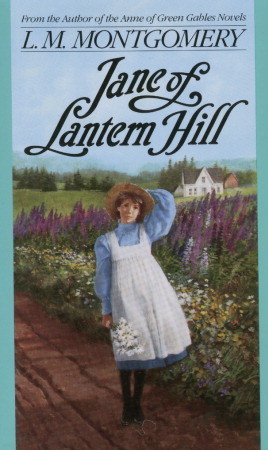
Sunday Salon: Reading Jane of Lantern Hill

Jane of Lantern Hill. L.M. Montgomery. 1937. 274 pages. [Source: Bought]

Jane of Lantern Hill was one of the few L.M. Montgomery books that I had not read before this year. While I found Pat of Silver Bush and Mistress Pat extremely disappointing, I found Jane of Lantern Hill to be practically perfect in every way. (If Pat had been my first introduction to L.M. Montgomery, I'm not sure I'd have ever voluntarily picked up another Montgomery book.) I just loved, loved, loved Jane of Lantern Hill.

Jane is our heroine. She lives with her mother, aunt, and grandmother. All three call her Victoria. It is not a happy home for all live in fear or reverence of the grandmother. Her mother is a forgiven prodigal. She returned home with a three year old daughter. (She did not divorce her husband; divorce is unforgivable.) Jane has always assumed that her father was dead. When she learns the truth, she's one confused child. Her relatives only confuse her more. If he is mentioned at all, it is to say that he did not want her, that he never loved her, that she is nothing to him. So it is with dread that Jane learns she is to spend an entire summer with him. He lives on Prince Edward Island. If he never wanted her, why does he want her now?

Once Jane is reunited with her father, her Dad, then the magic happens. It's a lovely coming-of-age novel about Jane discovering who she is and who she isn't! It's about her getting to know and love her Dad. It's about her finding a home, finding a place to belong, a place in the community. Jane is a great narrator! I can hardly do the book justice by summary.

Jane of Lantern Hill is thoroughly satisfying!

Favorite quotes:
Sometimes Jane thought drearily that there must be something the matter with her when there were so many people she didn't like. 
If any one doesn't like the Bible there's something wrong either with him or with the way he was introduced to it. We must do something about it. The Bible is a wonderful book, my Jane. Full of corking good stories and the greatest poetry in the world. Full of the most amazingly human 'human nature.' Full of incredible, ageless wisdom and truth and beauty and common sense. 
Dad read words as if he tasted them.
© 2013 SukaYuka.com of SukaYuka's Book Reviews

Tuesday, July 9, 2013

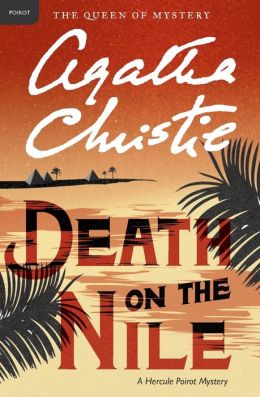
Death on the Nile (1937)

Death on the Nile. Agatha Christie. 1937/2007. Black Dog & Leventhal. 352 pages. [Source: Library]

I LOVED, LOVED, LOVED Agatha Christie's Death on the Nile. It is such a great mystery, very complex! Hercule Poirot and Colonel Race find themselves on board a ship on the Nile, they are in interesting company. Poirot notices the tension between some of his fellow travelers from the very start. And as he takes the time to get to know everyone, to have personal chats with almost every one, his unease only increases. He fears that before the trip is over, murder will have been committed. But who shall the victim be? And who the murderer? Meanwhile, Race is on a mission of his own before a body is even found. He is on the trail of a killer, a radical. He's not sure WHO his man is, just knows that he is almost certainly on board, that is where his clues have led him. When the oh-so-wealthy heiress, Linnet Ridgeway, is murdered on her honeymoon with Simon Doyle, there are plenty of suspects. For not all of the passengers on board are exactly strangers to her....

The first part of this one is set in England, but the rest is all set in Egypt.

This one had me from the start. It was so thrilling! Not only was the plot interesting and surprising and wonderful, the characterization was so well done!!!

My favorite quote:
"Do people interest you too, Monsieur Poirot? Or do you reserve your interest for potential criminals?"
"Madame--that category would not leave many people outside it." (96)
ETA: After reading the book, I wanted to watch the movie adaptation. I really ENJOYED the movie. It stars David Suchet as Hercule Poirot, JJ Feild as Simon Doyle, and Emily Blunt as Linnet Ridgeway, to name just a few. Feild, of course, "is" Henry Tilney. I recognized him right away. And Emily Blunt is equally "Queen Victoria." It was fun to see familiar faces in fascinating roles. If you've read the book recently OR if you remember the characters you'll guess just why. This was my first Poirot adaptation. I've seen plenty of Miss Marple, however.

© 2013 SukaYuka.com of SukaYuka's Book Reviews

Thursday, June 27, 2013

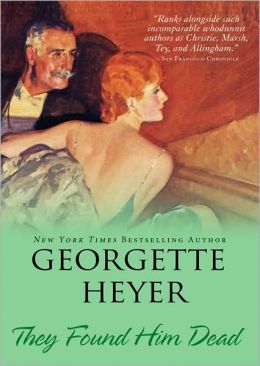
They Found Him Dead (1937)

They Found Him Dead. Georgette Heyer. 1937. Sourcebooks. 325 pages

Some books should be read in a certain order. If only I had read They Found Him Dead before reading Duplicate Death, I think I would have enjoyed Duplicate Death SO much more if I'd met Jim Kane and Patricia Allison and Timothy Harte first in the pages of They Found Him Dead!

This mystery novel is vibrant and busy! Silas Kane died on his sixtieth birthday party--a tragic accident, so everyone believes except for the exuberant Timothy! He sees MYSTERY and CRIME everywhere he looks. But when Silas Kane's heir, Clement, is murdered just a short time later, others join Timothy in thinking that there is a killer in their midst! Jim Kane is the next heir, and Timothy and Miss Allison are worried that he'll be the next victim. And it appears the danger is very real as several attempts are made on his life...

Can Inspector Hannasyde and Inspector Hemingway solve the case in time? Will Timothy be a big help or a hindrance?

What I loved about this mystery novel is the characterization. Even when the characters were despicable--and a few of them were--there is something about them making them a joy to read about! This novel has so many QUIRKY characters. A few of the characters I really did love!

© 2013 SukaYuka.com of SukaYuka's Book Reviews

Wednesday, April 17, 2013

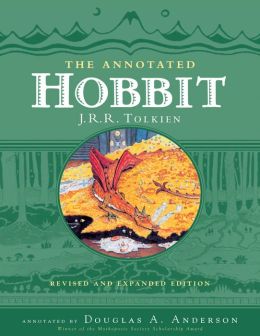
The Annotated Hobbit (2002)

The Annotated Hobbit. Revised and Expanded Edition. J.R.R. Tolkien. Annotated by Douglas A. Anderson. 2002. (1937, original Hobbit pub. date). Houghton Mifflin Harcourt. 416 pages.

The Hobbit is one of my favorite books even though I didn't discover it until I was an adult. It's a children's book that I've read several times as an adult. One of those feel-good books that you can happily, joyfully read each and every year without tiring of it. The Annotated Hobbit makes a lovely present for people who can't get enough of The Hobbit!

After viewing The Hobbit: The Unexpected Journey, I picked up The Annotated Hobbit. It was just what I needed! The film "covers" the first six chapters of the novel: "An Unexpected Party," "Roast Mutton," "A Short Rest," "Over Hill and Under Hill," "Riddles in the Dark," and "Out of the Frying-Pan Into the Fire." The most significant chapter in this annotated edition may just be "Riddles in the Dark." Fans most likely know already that the story of Bilbo's ring varies greatly from the original publication in 1937 and the later editions published after Tolkien wrote The Lord in the Rings, the variations even becoming a part of the story in a way. But this was the first time I was able to read the full, original ending to the story. (This is found in the notes on pages 128-131 and page 134.)

I came to the text needing to "check" the "faithfulness" of the film to the movie. True, I wanted to spend time with the characters, and, of course, I wanted to read it (again) because it's a great story. But. I wanted to see if the movie got it "wrong" or "right." While that was my original intention, I didn't always keep to it. I found the characters and story so irresistible. I was reminded once again of all the lovely little things that I just ADORE about the book. Things that didn't always translate as faithfully as I would have liked in the movie. Of course, some of what I ADORED about the book made it into the film, sometimes very faithful both in tone and detail.

There were some things that are technically "from the book" but taken completely out of proportion and focus, things that were made BIG AND SIGNIFICANT that barely got more than a sentence or two at most in the novel. The thing that stands out, for example, is how the party is HUNTED in the movie. Almost from the start, the journey is perilous because of a specific threat. And every single stage of the journey is equally dangerous and life-threatening. There is a purposeful, intentional darkness (evil) beginning to move in Middle Earth. In the novel, this isn't the case. The party faces danger, yes, sometimes a little danger, sometimes a lot of danger. But it isn't of an intentional hunted sort of danger. More of a being in the wrong place at the wrong time danger. They stumble almost on the trolls. (They also stumble upon the meeting place of the wolves or wargs.) And they face danger from rock slides and bad storms--but this is a natural threat. And yes, the stone giants exist but not so absurdly as in the movie:
There they were sheltering under a hanging rock for the night, and he lay beneath a blanket and shook from head to toe. When he peeped out in the lightning-flashes, he saw that across the valley the stone-giants were out, and were hurling rocks at one another for a game, and catching them, and tossing them down into the darkness where they smashed among the trees far below, or splintered into little bits with a bang. Then came a wind and a rain, and the wind whipped the rain and the hail about in every direction, so that an overhanging rock was no protection at all. Soon they were getting drenched and their ponies were standing with their heads down and their tails between their legs, and some of them were whinnying with fright. They could hear the giants guffawing and shouting all over the mountainsides.
"This won't do at all!" said Thorin. "If we don't get blown off, or drowned, or struck by lightning, we shall be picked up by some giant and kicked sky-high for a football."
"Well, if you know of anywhere better, take us there!" said Gandalf, who was feeling very grumpy, and was far from happy about the giants himself. (104)
The book doesn't exactly stay focused on the danger in any particularly threatening situation. The focus is on the adventure, the quest, the journey. There are plenty of in-between moments in the book. Moments where they might not be physically in danger from an enemy (goblins, trolls, angry elves, giant spiders), but might be facing discouragement, doubt, depression. Not to mention hunger, thirst, and exhaustion!!! 

There were isolated scenes that were especially faithful to the book and lovely to watch! But there were plenty of scenes that were pure interpretation. For better or worse. The film shows that there is more than one way to "read" a book or story.

Reading The Annotated Hobbit was beneficial. It reminded me of the creative process involved in writing and storytelling. Reading the annotations showed me that Tolkien never stopped creating this story. It was NOT "the end" of the story when it was published in 1937. The story kept changing and transforming and evolving through the decades. Tolkien stayed involved in the story. If Tolkien himself kept changing the story as his fantasy world kept growing and expanding, then it only makes sense that the film would be free to do the same.

I personally enjoyed reading almost all of the annotations. Some notes are mainly textual revision notes, letting readers know the differences between the different editions of the text (1937, 1951, 1966, etc.) Other notes tend to be scholarly and focused on literature. But some provide insights on The Hobbit or Middle Earth. (I liked notes about authors that influenced Tolkien.)


© 2013 SukaYuka.com of SukaYuka's Book Reviews
Monday, March 11, 2013

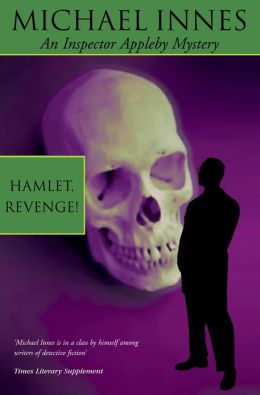
Hamlet, Revenge (1937)

Hamlet, Revenge! Michael Innes. 1937. 312 pages.

Hamlet, Revenge is the first mystery novel I've read by Michael Innes. It was published in 1937 and stars Inspector Appleby. The first half of the novel focuses on Scamnum Court, the family is producing a private showing of Shakespeare's Hamlet. Family, family friends, friendly acquaintances will star in this tragedy. Of course, from the start, readers know that all will not go well. (It is a mystery, after all. But there is plenty of foreshadowing in the introductory chapters.) The second half of the mystery focuses on Inspector Appleby and company as they try to solve the murder(s) that occurred on that tragic weekend.

There are SO MANY suspects in this one. So many characters introduced, and it was almost impossible to remember who was who. The mystery is very detailed, clues abound, and if you've got the attention to give to this one, it would probably be worth your time. It took me a while to get into this novel, but by the end I did care.


Read Hamlet, Revenge
  • If you enjoy mysteries, British mysteries, vintage mysteries
  • If you enjoy mysteries with literature and/or drama and/or academic connection

© 2013 SukaYuka.com of SukaYuka's Book Reviews