Sunday, February 2, 2014

Five New Board Books

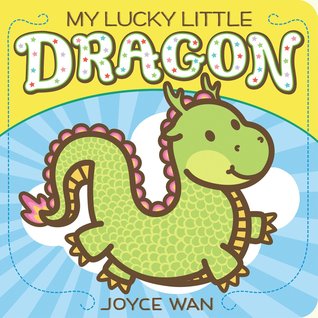
My Lucky Little Dragon. Joyce Wan. 2014. Scholastic. 14 pages. [Source: Review copy]

You are my lucky little dragon
my clever little snake
my happy little horsey
my snuggly little sheep
my silly little monkey
my chatty little rooster...

You Are My Cupcake by Joyce Wan remains my favorite, favorite, favorite board book. It lends itself so well to singing, and as a song it is practically perfect in every way. I can't say that My Lucky Little Dragon works as a song; it may be possible with effort and imagination, but, as a read aloud, I think it works well enough. Everything about this one is super sweet. And it would probably make a great companion book for those families who loved Wan's previous board books.

My favorite pages? My silly little monkey; my trusty little puppy; my playful little pig.

Text: 3 out of 5
Illustrations: 4 out of 5
Total: 7 out of 10


Giraffes Can't Dance Number Rumba Counting Book. Giles Andreae. Illustrated by Guy Parker-Rees. 2014. Scholastic. 12 pages. [Source: Review copy]

One wobbly Gerald tries to find his feet.
Two leaping leopards, skipping to the beat. 
Three high-kicking hyenas, springing through the air.

A fun counting-to-ten concept board book starring oh-so-playful animals with easy-to-turn pages. I liked the eight bold baboons getting in the groove. And I loved the nine cheerful chimps who waltz and jive and prance. The illustrations are just fun!

Text: 3 out of 5
Illustrations: 4 out of 5
Total: 7 out of 10
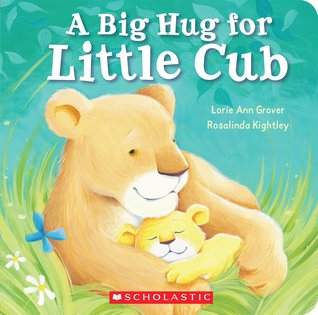
A Big Hug for Little Cub. Lorie Ann Grover. Rosalinda Kightley. 2014. Scholastic. 18 pages. [Source: Review copy]

Morning dawn, I stretch and yawn.
Momma's near, purrs in my ear.
Come, let's play this bright, hot day.
We run free. So much to see. 
Grasses sway. I lead the way.

I liked this sweet and gentle board book starring a lion and cub. It follows parent and child from morning to night. I liked the writing. My favorite bit:

Hear a sound, so we duck down. Momma, now, will show me how. Stalk and pounce. Tumble and trounce. 

It is a pleasant, very pleasant book for sharing with a little one.

Text: 4 out of 5
Illustrations: 4 out of 5
Total: 8 out of 10

Tickety Toc Count Our Friends! 2014. Scholastic. 12 pages. [Source: Review copy]

I'm sharing another counting book with you today. This counting book only goes through five. It stars the characters from Tickety Toc: Tommy and Tallulah, Hopparoo, McCoggins, Madame Au Lait, Pufferty, and Chikidee. The writing, as you might expect, is not the best. The rhyming is serviceable at best. This board book exists solely because of the TV show.

The pages are easy to turn. And for little ones who do love the TV show, this is a perfectly fine book to put in their hands. But it's not a wonderful read!

Text: 2 out of 5
Illustrations: 3 out of 5
Total: 5 out of 10

How Does Baby Feel? Karen Katz. 2013. Simon & Schuster. 14 pages. [Source: Library]

Baby wants milk and crackers. 
How does baby feel?
Hungry.
Baby gets a tummy tickle?
How does baby feel?
Happy.
Baby is yawning.
How does baby feel?
...

 If you and your little one loved What Does the Baby Say? there's a very good chance you'll both love How Does Baby Feel? Like What Does The Baby Say? (and so many other Karen Katz titles) this one is a lift-the-flap book. Readers are given clues about the text, the answers are revealed under the flaps. It is a simple book to be shared one-on-one at story time. It's a lovely board book.

Text: 4 out of 5
Illustrations: 3 out of 5
Total: 7 out of 10


© 2014 SukaYuka.com of SukaYuka's Book Reviews

Lego Phonics (2014)

Lego Super Heroes Phonics. Quinlan B. Lee. 2014. Scholastic. Includes 10 Books and 2 Workbooks. [Source: Review copy]

The Lego Super Heroes Phonics pack includes ten books: five books focusing on short vowel sounds, five books focusing on long vowel sounds. The books are all set in the DC Universe.

The writing. I won't lie. It's a phonics book. Even though the characters are super heroes, it feels like a phonics book. But. I suppose they have a purpose!

Book #1 Meet Batman (short a)
What is that in the sky?
It is a flash!
It is a bat!
We need the man in the mask.
We need Batman!
Batman jumps in the Batmobile. He needs a plan. He needs to get to his lab. Fast!
 Book #2 Get That Cat! (short e)
"Help!" a man yells. Catwoman has a gem. Quick! Get help!
"Meow! Come here, my pet," she says. Catwoman is set to get away.
Book #3 Come Quick (short i)
Superman hears Batman from far away. Batman says, "Come quick!" "Quick is what I do best!" the Flash says. "I will be there in a flash!" The Flash gets to the spot. There is just a big hill of bricks. "Why did Batman say to come quick?"
Book #4 Stop the Bot (short o)
Stomp! Stomp! Stomp! Lex has a big robot. The bot has got Wonder Woman.
Book #5 Up, Up, and Away (short u)
This is Superman. He can run fast! He can jump high! He can do much more than any man! The sun makes Superman strong. He can pick up a bus so it does not get crushed.
Book #6 Two-Face Chase (long a)
Batman races to the bank! There is a crane in the way. He hits the brakes! "I hate to be late!" Batman yells.
Book #7 Mr. Freeze (long e)
Batman and Robin are in the Batboat. "I feel the need! I feel the need for speed!" says Robin.
Book #8 Ride On! (long i)
"You cannot hide this time, Bane," says Batman. A bike rides by in the dark. Is it Bane? It is Catwoman! she smiles. "Are you looking for me?" she says. "I will not hide this time."
Book #9 No Joke (long o)
All of Gotham City is at home in bed. No one is out. Except one lone man...
The Joker! "This smoke will help you sleep...forever!" he yells. "And that is no joke."
Book #10 Get a Clue (long u)
Batman gets a note. It says: "I have the guy in blue. Do you want him back? You know what to do. Look for me and get my clues." 
© 2014 SukaYuka.com of SukaYuka's Book Reviews

Saturday, February 1, 2014

Library Loot: First Trip in February

New Loot:
  • Independent Study by Joelle Charbonneau
  • The Boy on the Wooden Box with Marilyn J Harran and Elisabeth B. Leyson
  • Heart beat by Elizabeth Scott
  • Ruth, Mother of Kings by Diana Wallis Taylor
Leftover Loot:
  • Elizabeth of York: A Tudor Queen and Her World by Alison Weir 
  • The Heir Apparent: A Life of Edward VII, The Playboy Prince by Jane Ridley
  • Scarlet by A.C. Gaughen
  • The Teacher's Funeral by Richard Peck
  • The River Between Us by Richard Peck
  • A Year Down Yonder by Richard Peck
  • Beauty by Robin McKinley
  • Mr. Knightley's Diary by Amanda Grange
  • Mansfield Park Revisited by Joan Aiken 
Library Loot is a weekly event co-hosted by Claire from The Captive Reader and Linda from Silly Little Mischief that encourages bloggers to share the books they’ve checked out from the library. If you’d like to participate, just write up your post-feel free to steal the button-and link it using the Mr. Linky any time during the week. And of course check out what other participants are getting from their libraries.   

© 2014 SukaYuka.com of SukaYuka's Book Reviews

Week in Review: January 26-31

And Be A Villain. (Nero Wolfe). Rex Stout. 1948. 256 pages. [Source: Book I Bought] 
1066 And All That. W.C. Sellar & R.J. Yeatman. 1931/1993. Barnes & Noble. 116 pages. [Source: Bought]
Duchess of Drury Lane. Freda Lightfoot. 2013. Severn House. 256 pages. [Source: Library]
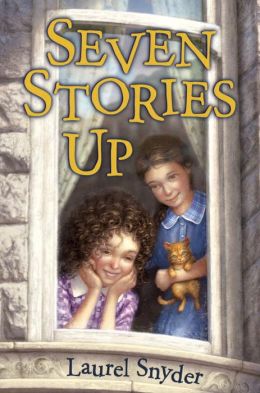
Seven Stories Up. Laurel Snyder. 2014. Random House. 240 pages. [Source: Review copy]
The First Dragon. The Chronicles of the Imaginarium Geographica #7 James Owen. 2013. Simon & Schuster. 304 pages. [Source: Library]
A Woman's Place. Lynn Austin. 2006. Bethany House. 450 pages. [Source: Book I Bought
The Dancing Master. Julie Klassen. 2014. Bethany House. 432 pages. [Source: Review copy] 
With Autumn's Return. Amanda Cabot. 2014. Revell. 416 pages. [Source: Review copy]

This week's favorite:

My favorite this week may just be my favorite of the entire month of January. I LOVE, LOVE, LOVE Laurel Snyder's Seven Stories Up. The novel opens circa 1987, Annie, our heroine, is preparing to meet her (dying) grandmother for the first time. They meet. It's a bit overwhelming--a mix of good and bad, perhaps. The love the grandmother has for the granddaughter that she's never met because of the horrible relationship she has with the daughter--well, it's heartbreaking. But I can see how Annie might not now how to take on that much emotion from a stranger. She goes to bed, she wakes up in 1937! Same room. Same hotel. (In the modern setting, the family-owned hotel had been closed awhile.) Annie meets Molly, a girl just her age. It isn't long before she realizes that Molly IS her grandmother...this one is OH-SO-MAGICAL. Loved every page of it!!!

© 2014 SukaYuka.com of SukaYuka's Book Reviews
Other challenge updates

For the L.M. Montgomery challenge:
For the British History Reading Challenge:
For the Year of Rereading Challenge:
For the 2014 TBR Pile Challenge:
For the Chunkster Challenge:
  • Lady of the English. Elizabeth Chadwick. 2011. Sourcebooks. 544 pages. [Source: Library] 
  • Doomsday Book. Connie Willis. 1992. Random House. 592 pages.  [Source: Book I Bought]
  • The Courts of Love. Jean Plaidy. 1987. Broadway Books. 576 pages. [Source: Bought]  
© 2014 SukaYuka.com of SukaYuka's Book Reviews

Completed Challenge: 2014 Sci-Fi Experience

Sci-Fi Experience
Hosted: Stainless Steel Droppings (sign-up post) (review site)
December 2013 - January 2014
# of Books: I'm hoping for seven

© 2014 SukaYuka.com of SukaYuka's Book Reviews

Friday, January 31, 2014

January Reflections

In January, I read 45 books.

Eight books were rereads: Good Morning, Miss Dove; Pastwatch The Redemption of Christopher Columbus; The Time Machine; Doomsday Book; Story of the Treasure Seekers; Sense and Sensibility; The Merchant's Daughter; A Woman's Place.

Without really planning it, I read SIX time travel books in January! Seven Stories Up, The First Dragon, Risked, Pastwatch The Redemption of Christopher Columbus, The Time Machine, and Doomsday Book.

Board Books, Picture Books, Early Readers:
  1. Patti Cake And Her New Doll. Patricia Reilly Giff. Illustrated by Laura J. Bryant. 2014. (Jan) Scholastic. 32 pages. [Source: Review copy]  
  2. The Runaway Hug. Nick Bland. Illustrated by Freya Blackwood. 2013 (Dec). Random House. 32 pages. [Source: Review copy] 
  3. A Book of Babies. Il Sung Na. 2014. (Jan). Random House. 24 pages. [Source: Review copy]  
  4. Little Frog's Tadpole Trouble. Tatyana Feeney. 2014. (Jan) Random House. 32 pages. [Source: Review copy] 
  5. Small Bunny's Blue Blanket. Tatyana Feeney. 2014. Random House. 24 pages. [Source: Review copy] 
  6. All Fall Down. Mary Brigid Barrett. Illustrated by LeUyen Pham. 2014. Candlewick Press. 16 pages. [Source: Review copy] 
  7. Pat-a-Cake. Mary Brigid Barrett. Illustrated by LeUyen Pham. 2014. Candlewick Press. 16 pages. [Source: Review copy] 
  8. Ten Tiny Toes. Caroline Jayne Church. 2014. Scholastic. 22 pages. [Source: Review copy]    

Middle Grade and Young Adult Fiction and Nonfiction:
  1. The Real Boy. Anne Ursu. 2013. HarperCollins. 341 pages. [Source: Library] 
  2. Seven Stories Up. Laurel Snyder. 2014. Random House. 240 pages. [Source: Review copy]
  3. The First Dragon. The Chronicles of the Imaginarium Geographica #7 James Owen. 2013. Simon & Schuster. 304 pages. [Source: Library]
  4. Risked (The Missing #6). Margaret Peterson Haddix. 2013. Simon & Schuster. 320 pages. [Source: Library]  
  5. The Apprentices. Maile Meloy. Illustrated by Ian Schoenherr. 2013. Penguin. 432 pages. [Source: Review Copy] 
  6. The Story of the Treasure Seekers. E. Nesbit. 1899. Puffin. 250 pages. [Source: Bought]
  7. The 100. Kass Morgan. 2013. Little, Brown. 277 pages. [Source: Library]   
  8. The Living. Matt de la Pena. 2013. Random House. 320 pages. [Source: Review copy] 
  9. A Corner of White. Jaclyn Moriarty. 2013. Scholastic. 375 pages. [Source: Library]  
  10. Aquifer. Jonathan Friesen. 2013. Blink. 303 pages. [Source: Library] 
Adult Fiction and Nonfiction:
  1. Good Morning, Miss Dove. Frances Gray Patton. 1954. 218 pages. [Source: Book I Bought]
  2. Pastwatch The Redemption of Christopher Columbus. Orson Scott Card. 1996. Tor.  351 pages. [Source: Book I Bought] 
  3. Lady of the English. Elizabeth Chadwick. 2011. Sourcebooks. 544 pages. [Source: Library] 
  4. And Be A Villain. (Nero Wolfe). Rex Stout. 1948. 256 pages. [Source: Book I Bought] 
  5. 1066 And All That. W.C. Sellar & R.J. Yeatman. 1931/1993. Barnes & Noble. 116 pages. [Source: Bought]
  6. Duchess of Drury Lane. Freda Lightfoot. 2013. Severn House. 256 pages. [Source: Library]
  7. The Time Machine. H.G. Wells. 1895. Penguin. 128 pages. [Source: Book I Bought]
  8. Royal Affair: George III And His Scandalous Siblings. 2006. Random House. 384 pages. [Source: Library] 
  9. The Revolt of the Eaglets. Jean Plaidy. 1977. 320 pages. [Source: Bought] 
  10. Doomsday Book. Connie Willis. 1992. Random House. 592 pages.  [Source: Book I Bought]
  11. The Road to Yesterday. L.M. Montgomery 1974. McGraw-Hill Ryerson Limited. 252 pages.
  12. The Courts of Love. Jean Plaidy. 1987. Broadway Books. 576 pages. [Source: Bought] 
  13. The Boys in the Boat. Daniel James Brown. 2013. Viking. 416 pages. [Source: Library]
  14. Alexander the Conqueror: The Epic Story of the Warrior King. Laura Foreman. 2004. Da Capo Press. 211 pages. [Source: Library] 
  15. Sense and Sensibility. Jane Austen. 1811. 352 pages. [Source: Book I Bought] 
Christian Fiction and Nonfiction: 
  1. Dear Mr. Knightley. Katherine Reay. 2013. Thomas Nelson. 336 pages. [Source: Book I Bought] 
  2. A Woman's Place. Lynn Austin. 2006. Bethany House. 450 pages. [Source: Book I Bought]
  3. With Autumn's Return. Amanda Cabot. 2014. Revell. 416 pages. [Source: Review copy]
  4. The Merchant's Daughter. Melanie Dickerson. 2011. Zondervan. 285 pages. [Source: Library]
  5. The Dancing Master. Julie Klassen. 2014. Bethany House. 432 pages. [Source: Review copy]
  6. Dare to Love Again. Julie Lessman. 2014. Revell. 416 pages. [Source: Review copy] 
  7. Every Waking Moment. Chris Fabry. 2013. Tyndale. 400 pages. [Source: Book I Bought] 
  8. How To Read the Bible Through the Jesus Lens: A Guide to Christ-Focused Reading of Scripture. Michael James Williams. 2012. Zondervan. 288 pages. [Source: Book I Bought]
  9. Crazy Busy. Kevin DeYoung. 2013. Crossway. 128 pages. [Source: Review copy]  
  10. Bruce and Stan's Pocket Guide To Studying Your Bible: A User-Friendly Approach. Bruce Bickel and Stan Jantz. 2001. Harvest House. 112 pages. [Source: Book I Bought]
  11. The Captive Maiden. Melanie Dickerson. 2013. Zondervan. 304 pages. 
  12. Woman's Guide to Reading the Bible In A Year. Diane Stortz. 2013. Bethany House. 144 pages. [Source: Book I Bought]
© 2014 SukaYuka.com of SukaYuka's Book Reviews

Reread #5 A Woman's Place

A Woman's Place. Lynn Austin. 2006. Bethany House. 450 pages. [Source: Book I Bought]

I first read and reviewed A Woman's Place in August 2007. I absolutely loved, loved, loved this book. And why wouldn't I?! After all, it's a book set during one of my favorite historical periods: World War II. The focus is on women on the American homefront: how the war effected women's lives in and out of the home. This book seems to be a written-just-for-me book. So, of course, I adored it.

Four women. Four very different, unique women come together as a team at Stockton Shipyards. With proper training, these four women will be helping build ships, ships that will help the Allied Forces win the war. An end to war is all these women want. Well, they'd also like a little respect and some justice.

From the original review:

Ginny, or "Virginia" as her husband insists on calling her, is a housewife in her thirties who feels underappreciated and unloved.

Helen is a woman in her fifties who is wealthy and bitter and angry.

Rosa is a young newlywed from Brooklyn. She met a young man in the Navy and suddenly finds herself living with her inlaws while the war is on.

And Jean is fresh out of high school--fresh from the farm, one of eighteen children. She has six brothers enlisted in various branches of the service.

Each woman finds herself employed at Stockton Shipyards. Each has felt called to serve her nation. Each one is there for their own personal reasons as well. Ginny is lacking self confidence, but seems to bloom under the circumstances of hard work and friendship. Rosa is a bit unwieldy at times but in need of love and guidance and wisdom from older women. Helen is there trying to escape the bitter aloneness she feels in her large home--one she inherited from a father that she hated. And Jean, well, Jean is trying to figure out what she wants for herself. Her boyfriend back home doesn't see any reason for her to go to college, to get an education. He doesn't see much point in her working so far away from home either--all the way from Indiana to Michigan. But Jean, Jean is finding herself, finding her independence.

Each character was well-developed. Each character was complex. Each circumstance was complex. Very different women, very different backgrounds. But one common goal. I loved how this novel came together--pieced together. How four women's lives were able to touch and connect and encourage and build up one another. Each woman's life was changed because of the others. Each one learned how important, how significant, how loved they really and truly were.

© 2014 SukaYuka.com of SukaYuka's Book Reviews

Thursday, January 30, 2014

The First Dragon (2013)

The First Dragon. The Chronicles of the Imaginarium Geographica #7 James Owen. 2013. Simon & Schuster. 304 pages. [Source: Library]

If only I'd had time to reread each and every book in the series before starting this last book, I think it would have made me love it and appreciate it even more. That being said, though it took a few chapters to refresh my memory, I ended up loving this conclusion to the series. I would love to do a reread at some point! I think it would help clarify some things for me, to connect all the little things together.

The book begins with the caretakers in quite a mess. The destruction of the keep has changed everything, threatened everything, and much is lost seemingly forever. The number one priority is recovering three people who have been lost somewhere in time: Charles, Rose, Edmund. But though that is the number one priority for all, it's not easy to agree how to go about a rescue, or even to conclusively say that rescue is possible. At the start of the novel, they have no way at all to travel through time. A few caretakers have ideas, but, essentially if a rescue is to come it will be through experimentation.

A rescue operation might have to be a "secret" operation.

I really enjoyed spending time with these characters again. This one had so many twists and turns, though twists and turns have always, always been a part of this series. It was a very enjoyable read.

© 2014 SukaYuka.com of SukaYuka's Book Reviews

Wednesday, January 29, 2014

Seven Stories Up (2014)

Seven Stories Up. Laurel Snyder. 2014. Random House. 240 pages. [Source: Review copy]

You're supposed to cry when your grandma is dying. You're supposed to be really sad. But as Mom and I sped through the dark streets of Baltimore, I couldn't stop bouncing in my seat.  

I absolutely loved this historical fantasy novel. I loved, loved, loved it!!! Annie Jaffin, the heroine, has never met her grandmother. Her mother almost always changes the subject. Annie knows that her mother doesn't exactly get along well with her mother. But she doesn't know why exactly, she doesn't have the details. And some would probably say that she doesn't need to know the details, that she doesn't need the burden and baggage of all the family troubles. But it still makes for an awkward first meeting. To meet someone who will die within a day or two at most. To have your only impression of your grandmother be her at her physical worst. Annie's grandmother seems desperate with Annie, wanting to express a decade's worth of love all in three minutes. But Annie finds it a bit overwhelming as well.

Seven Stories Up is historical fantasy. Annie wakes up to find herself in 1937, she meets a young girl around her own age: Molly. A girl she realizes relatively quickly is her grandmother. Annie and Molly--what a pair, what a fantastic pair of friends. Molly, who has asthma, has always been kept separate from the world; she's rarely let out of her rooms; she rarely meets anyone; she definitely never gets the opportunity to act her age, to play, to go to a fair or carnival, to go shopping, to go anywhere. The whole world almost has been off limits, and her family rarely takes the time to connect with her. Her father, well, for better or worse, is absent though he's only a few stories down. He's the owner/manager of the hotel. Her mother and her sisters are vacationing this summer. Molly, before Annie's arrival, was friendless and hateful.

I absolutely loved this one. I loved how Annie and Molly are good for one another. I loved how their relationship develops. And I love, love, love the time travel aspect of it.

Will knowing Annie in the past, change Molly's life forever?!

© 2014 SukaYuka.com of SukaYuka's Book Reviews
Tuesday, January 28, 2014

Duchess of Drury Lane (2013)

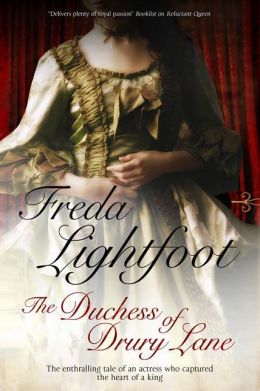
Duchess of Drury Lane. Freda Lightfoot. 2013. Severn House. 256 pages. [Source: Library]

I enjoyed reading The Duchess of Drury Lane. I liked that it was written in first person. This doesn't always work for me, but, in this case it did. Readers meet a young woman who becomes a famous actress on the stage. She was known by several different names in her life, and, I believe at least two or three different stage names. (The book jacket calls her 'Dorothy Jordan' but usually in the text she's Dora.) The first third of the book focuses on her life before discovery. To help her family earn enough money, she became an actress on the stage like her mother before her. She found she could do comedy quite well, and, her singing voice could charm audiences. Unfortunately, unwanted attention from her employer led to pregnancy. When her mother learned the truth, they fled the scene and started new lives elsewhere. Her debts to her old boss were eventually paid, however, by a new employer. The rest of the novel focuses on her successes mostly on stage and her perhaps regrettable choices off stage. She fell for a man who promised marriage but didn't deliver, even after she gave birth to his two children. Eventually, that relationship soured and she was persuaded to become the mistress of the Duke of Clarence. In all fairness, her relationship with William (William IV in later years) could not end with marriage. George III made it almost impossible for his brothers and sisters and sons and daughters to marry. The two lived as if they were married (without official sanction, of course) for almost two decades, I believe. She continued on stage for most of her life. Her income was too necessary for her family, for William and their children, for her children from previous relationships, for her own siblings. This book should prove interesting to anyone with an interest in the theatre during the Georgian era.

© 2014 SukaYuka.com of SukaYuka's Book Reviews
Monday, January 27, 2014

1066 And All That (1931)

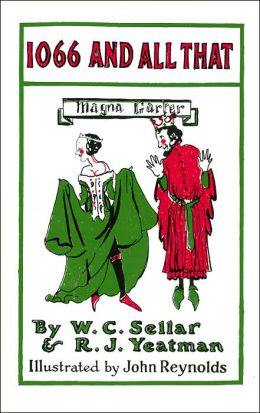
1066 And All That. W.C. Sellar & R.J. Yeatman. 1931/1993. Barnes & Noble. 116 pages. [Source: Bought]

What an odd little book. An odd little book that purposefully messes around with historical facts and figures just trying to make readers of all ages laugh. I'll try to give you several examples of what makes this book unique. I think that is probably the only way to do this book justice. It will either be a book that appeals to your sense of humor, or, not.
The Ancient Britons were by no means savages before the Conquest, and had already made great strides in civilization, e.g. they buried each other in long round wheelbarrows (agriculture) and burnt each other alive (religion) under the guidance of even older Britons called Druids or Eisteddfods, who worshipped the Middletoe in the famous Druidical churchyard at Stoke Penge. (3)
The conversion of Britain was followed by a Wave of Danes, accompanied by their sisters or Sagas, and led by such memorable warriors as Harold Falsetooth and Magnus the Great, who, landing correctly in Thanet, overran the country from right to left, with fire. After this the Danes invented a law called the Danelaw, which easily proved that since there was nobody else left alive there, all the right-hand part of England belonged to them. The Danish Conquest, was, however undoubtedly a Good Thing, because although it made the Danes top nation for a time it was the cause of Alfred the Cake (and in any case they were beaten utterly in the end by Nelson). (8)
King Arthur invented Conferences because he was secretly a Weak King and liked to know what his memorable thousand and one Knights wanted to do next. (10)
Alfred had a very interesting wife called Lady Windermere (The Lady of the Lake), who was always clothed in the same white frock, and used to go bathing with Sir Launcelot (also of the Lake) and was thus a Bad Queen. (11)
With Edward the Confessor perished the last English King (viz. Edward the Confessor), since he was succeeded by Waves of Norman Kings (French), Tudors (Welsh), Stuarts (Scottish), and Hanoverians (German), not to mention the memorable Dutch King Williamanmary. (15)
The Norman Conquest was a Good Thing, as from this time onwards England stopped being conquered and thus was able to become top nation. (17)
The chapters between William I (1066) and the Tudors (Henry VIII, etc.) are always called the Middle Ages, on account of their coming at the beginning. (22)
About this time the memorable hero Robin Hood flourished in a romantic manner. Having been unjustly accused by two policemen in Richmond Park, he was condemned to be an outdoor and went and lived with a maid who was called Marion, and a band of Merrie Men, in Greenwood Forest, near Sherborne. Amongst his Merrie Men were Will Scarlet (The Scarlet Pimpernel), Black Beauty, White Melville, Little Red Riding Hood (probably an outdaughter of his) and the famous Friar Puck who used to sit in a cowslip and suck bees, thus becoming so fat that he declared he could put his girdle round the Earth. (27)
Richard II was only a boy at his accession; one day, however, suspecting that he was now twenty-one, he asked his uncle and, on learning that he was, mounted the throne himself and tried first being a Good King and then being a Bad King, without enjoying either very much; then, being told that he was unbalanced, he got off the throne again in despair, exclaiming gloomily, "For God's sake let me sit on the ground and tell bad stories about cabbages and things." Whereupon his cousin Lancaster (spelt Bolingbroke) quickly mounted the throne and said he was Henry IV, Part I. (43)
During this reign the Hundred Years War was brought to an end by Joan of Ark, a French descendant of Noah who after hearing Angel voices singing Do Re Mi became inspired, thus unfairly defeating the English in several battles. (47)
I thought it was an interesting read, definitely unique. But I can't say that I loved it or anything.

© 2014 SukaYuka.com of SukaYuka's Book Reviews

Sunday, January 26, 2014

And Be A Villain (1948)

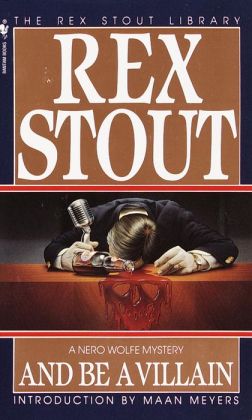
And Be A Villain. (Nero Wolfe). Rex Stout. 1948. 256 pages. [Source: Book I Bought]

And Be A Villain is the first, but probably not the last, Nero Wolfe mystery I'll be reading this year. Rex Stout has created two very enjoyable, very unforgettable characters in Nero Wolfe and Archie Goodwin. In this mystery, they are almost actually working with the police to solve a high profile murder. Wolfe has been hired by a radio personality. One of her guests was murdered--poisoned--while on her show. Awkward indeed. The radio show is sponsored by a beverage company, and the guest's drink was poisoned. There are only a handful of people in the room, at the station, that would have had access to the drink and/or the glasses. It is up to Goodwin and Wolfe, of course, to figure out which one of these unlikely suspects is a murderer; and these suspects have been questioned again and again and again by the police. But this detective team is the best, and they spot clues missed by the police...but will it be enough? Will the answer come too late?

I enjoyed And Be A Villain. Do you have a favorite Nero Wolfe mystery? Have you seen the television adaptations?


© 2014 SukaYuka.com of SukaYuka's Book Reviews
Saturday, January 25, 2014

Library Loot: Fourth Trip in January

New Loot:
  • Death Comes to the Village by Catherine Lloyd
  • The Impossible Knife of Memory by Laurie Halse Anderson
  • Elizabeth of York: A Tudor Queen and Her World by Alison Weir 
Leftover Loot:
  • The Heir Apparent: A Life of Edward VII, The Playboy Prince by Jane Ridley
  • Scarlet by A.C. Gaughen
  • The Teacher's Funeral by Richard Peck
  • The River Between Us by Richard Peck
  • A Long Way From Chicago by Richard Peck
  • A Year Down Yonder by Richard Peck
  • Beauty by Robin McKinley
  • Mr. Knightley's Diary by Amanda Grange
  • Mansfield Park Revisited by Joan Aiken
Free Loot:
  • In My Hands: Memories of a Holocaust Rescuer by Irene Gut Opdyke 
  • Cleopatra: A Life by Stacy Schiff
  • The Rats of Hamelin by Adam McCune & Keith McCune 
Library Loot is a weekly event co-hosted by Claire from The Captive Reader and Linda from Silly Little Mischief that encourages bloggers to share the books they’ve checked out from the library. If you’d like to participate, just write up your post-feel free to steal the button-and link it using the Mr. Linky any time during the week. And of course check out what other participants are getting from their libraries.  

© 2014 SukaYuka.com of SukaYuka's Book Reviews

Week in Review: January 19-25

Good Morning, Miss Dove. Frances Gray Patton. 1954. 218 pages. [Source: Book I Bought]
Pastwatch The Redemption of Christopher Columbus. Orson Scott Card. 1996. Tor.  351 pages. [Source: Book I Bought]
Lady of the English. Elizabeth Chadwick. 2011. Sourcebooks. 544 pages. [Source: Library]
A Corner of White. Jaclyn Moriarty. 2013. Scholastic. 375 pages. [Source: Library]
Aquifer. Jonathan Friesen. 2013. Blink. 303 pages. [Source: Library]
Alexander the Conqueror: The Epic Story of the Warrior King. Laura Foreman. 2004. Da Capo Press. 211 pages. [Source: Library]
Dare to Love Again. Julie Lessman. 2014. Revell. 416 pages. [Source: Review copy]

This week's favorite:

Good Morning, Miss Dove was easily my favorite book this week. I've read the book; I've watched the movie. I will say the movie has a definite not ambiguous ending; the book, perhaps, less so. But I want to believe that the book is just as optimistic about Miss Dove's chances for recovery as the movie. 

© 2014 SukaYuka.com of SukaYuka's Book Reviews
Friday, January 24, 2014

Reread #4 Pastwatch The Redemption of Christopher Columbus

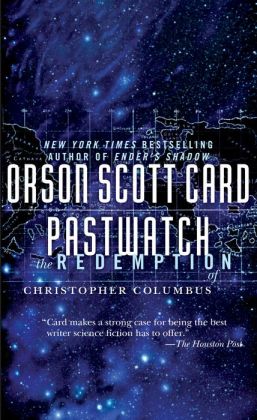
Pastwatch The Redemption of Christopher Columbus. Orson Scott Card. 1996. Tor.  351 pages. [Source: Book I Bought]

I first reviewed Pastwatch for the blog in November 2007, but that was certainly not my first time to read it. I discovered Orson Scott Card's work in a library science class in the fall of 2000. I read everything I could find of his over the next year. It was my first venture into science fiction. It was LOVE.

Semi-Apocalyptic fiction. Alternate histories. Time Travel. Need I say more?! For anyone who enjoys dystopias or apocalyptic fiction, I'd say that Pastwatch was a must read! The same is true for anyone who loves reading time travel stories. The premise and plot is enough to keep one reading. But the characterization is wonderfully done as well.

In the world of Pastwatch, history can be viewed on the big screen. In the early stages, this technology could only watch vast regions--note climate changes and social changes--the building of communities and sometimes their collapses. But as this technology is developed further, it becomes possible to watch history in greater detail, minute detail. Scientists, historians, researchers (whatever you want to call them) can do studies on communities, societies, or individuals. What's the point of watching the past? To learn. To understand. To answer impossible questions. But a few historians hope for more. What if watching the past could change the past? Each historian researcher has his/her own speciality. Sometimes they work on something personally, other times they come together into various teams. Readers meet a handful of researchers--probably six or seven and learn of their lives, of their studies.

How is Christopher Columbus involved? Well, he's one of our narrators for one thing. But secondly, he becomes the subject of interest for most of our other narrators. It is HIS life that is being dissected and held up for study. What our researchers learn is that at some point in time, future scientists, interfered or manipulated the past that turned Christopher Columbus' interest to sailing west. Their quest to figure out how and why of this manipulation will lead them on a journey with massive consequences. For they're debating whether or not they should do something along the same lines...

It is a science fiction novel. And like many science fiction novels, it deals with aspects of playing God. One of the thought-provoking subjects in Pastwatch is suffering. The historian-researchers perhaps feel they can do a better job at writing or rewriting history. That they can do a better job at alleviating suffering and establishing peace and goodwill across the globe. The future-historians take on the role of God, manipulating people in the past making them believe that they are God or God's messengers. Pain and suffering was also a big, big subject in the Worthing Saga, another Card novel.

Quotes:
Though Tagiri did not put her own body back in time, it is still true to say that she was the one who stranded Christopher Columbus on the island of Hispaniola and changed the face of history forever. Though she was born seven centuries after Columbus's voyage and never left her birth continent of Africa, she found a way to reach back and sabotage the European conquest of America. It was not an act of malice. Some said that it was correcting a painful hernia in a brain damaged child: In the end, the child would still be severely limited, but it would not suffer as much along the way. But Tagiri saw it differently.
"History is not prelude," she said once. "We don't justify the suffering of people in the past because everything turned out well enough by the time we came along. Their suffering counts just as much as our peace and happiness. We look out of our golden windows and feel pity for the scenes of blood and blades, of plagues and famines that are played out in the surrounding country. When we believed that we could not go back in time and make changes, then we could be excused for shedding a tear for them and then going on about our happy lives. But once we know that it is in our power to help them, then, if we turn away and let their suffering go on, it is no golden age we live in, and we poison our own happiness. Good people do not let others suffer needlessly." What she asked was a hard thing, but some agreed with her. Not all, but in the end, enough. (25-6)
Till now, all the story-seekers in Pastwatch had devoted their careers to recording the stories of great, or at least influential men and women of the past. But Tagiri would study the slaves, not the owners; she would search throughout history, not to record the choices of the powerful, but to find the stories of those who had lost all choice. To remember the forgotten people, the ones whose dreams were murdered and whose bodies were stolen from themselves, so that they were not even featured players in their own autobiographies. The ones whose faces showed that they never forgot for one instant that they did not belong to themselves, and that there was no lasting joy possible in life because of that. (35)
 "It can be done," she said, blurting it out at once. "We can change it. We can stop--something. Something terrible, we can make it go away. We can reach back and make it better."
He said nothing. He waited.
"I know what you're thinking, Hassan. We might also make it worse."
"Do you think I haven't been going through this in my mind tonight?" said Hassan. "Over and over. Look at the world around us, Tagiri. Humanity is finally at peace. There are no plagues. No children die hungry or live untaught. The world is healing. That was not inevitable. It might have ended up far worse. What change could we possibly make in the past that would be worth the risk of creating a history without this resurrection of the world?"
"I'll tell you what change would be worth it," she said. "The world would not have needed resurrecting if it had never been killed."
"What, do you imagine that there's some change we could make that would improve human nature? Undo the rivalry of nations? Teach people that sharing is better than greed?"
"Has human nature changed even now?" asked Tagiri. "I think not. We still have as much greed, as much power-lust, as much pride and anger as we ever had. The only difference now is that we know the consequences and we fear them. We control ourselves. We have become, at long last, civilized."
"So you think that we can civilize our ancestors?"
"I think," said Tagiri, "that if we can find some way to do it, some sure way to stop the world from tearing itself to pieces as it did, then we must do it. To reach into the past and prevent the disease is better than to take the patient at the point of death and slowly, slowly bring her back to health. To create a world in which the destroyers did not triumph."
"If I know you at all, Tagiri," said Hassan, "you would not have come here tonight if you didn't know already what the change must be."
"Columbus," she said."
"One sailor? Caused the destruction of the world?" (50-1)
"I'm finding the place where the smallest, simplest change would save the world from the most suffering. That would cause the fewest cultures to be lost, the fewest people to be enslaved, the fewest species to fall extinct, the fewest resources to be exhausted. It comes together at the point where Columbus returns to Europe with his tales of gold and slaves and nations to be converted into Christian subjects of the king and queen." (52)
© 2014 SukaYuka.com of SukaYuka's Book Reviews
Thursday, January 23, 2014

Aquifer (2013)

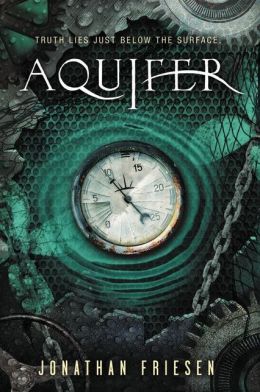
Aquifer. Jonathan Friesen. 2013. Blink. 303 pages. [Source: Library]

I really wanted to love Aquifer. I thought the book started off promising. It had an intriguing start. I was curious about the narrator, Luca. I was interested in learning more about Luca's father, and how these two fit into their society, their community. The unveiling of this world was certainly mysterious enough to keep me reading in the beginning. The part that hooked me, I admit, was Luca going with his friend to the cave and finding the long-thought-lost, definitely-forbidden books. Such a good start led me to hope. Unfortunately, the second half of the novel did not work for me. Luca's quest or Luca's journey (I'm not sure it qualifies as a quest exactly), was troublesome for me in that the further he went, the more confused I became. The plot went from being easy to comprehend to super confusing. If I'd read the book over a series of days or even weeks, I would blame that completely on me, on my attention as a reader. But when you read a book in one sitting?! I don't know that it was completely my fault for not following every twist and turn of the plot. I kept reading because I wanted to see how it ended. And I was able to hold onto threads of the plot enough to make some sense of it. But was it satisfying? Only in part.

© 2014 SukaYuka.com of SukaYuka's Book Reviews
Wednesday, January 22, 2014

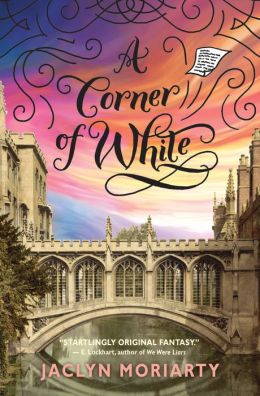
A Corner of White (2013)

A Corner of White. Jaclyn Moriarty. 2013. Scholastic. 375 pages. [Source: Library]

I have mixed feelings on A Corner of White. There were certain things that I just loved about it, mainly the fantasy world, if I'm honest, and there were other things that were just okay for me, some of the characters. It was a book that definitely required patience, always patience. For there would be chapters that were enjoyable enough, and then sections that would drag.

Corner of White is set in two worlds. The "real world" sections focus on Madeleine and her homeschool friends. (It's a bit more complicated than that, and there is romance potential with one of her friends). The fantasy world sections take place in the Kingdom of Cello. These sections, in my opinion, were almost always more entertaining even though they were more confusing at times. Elliot is the hero of these bits. There is a "crack" between these two worlds. Elliot and Madeleine find themselves exchanging letters. Elliot knows the "real world" exists, that the two worlds used to be in communication with one another, that these cracks are not only possible but definitely illegal. Madeleine is condescending in 99% of her letters to Elliot because she assumes his letters are full of lies. She is not a believer in anything fantastical.

It isn't so much that these two are able to "help" one another directly with anything going on in their lives. Madeleine doesn't believe anything he says, and she laughs at his problems, his world. Her letters are her ramblings, not meant to do more than ramble really. Of course, it turns out that her rambles inspire him--literally--in his greatest moment of need. But that wasn't intentional on Madeleine's part. She wasn't being brave and wise on purpose. If his letters help her at all, perhaps they serve as needed reminders that she is not the only person in the world with problems, and that the world does not revolve around her, and that she should, you know, actually think things through and not be so horrible to others.

© 2014 SukaYuka.com of SukaYuka's Book Reviews
Tuesday, January 21, 2014

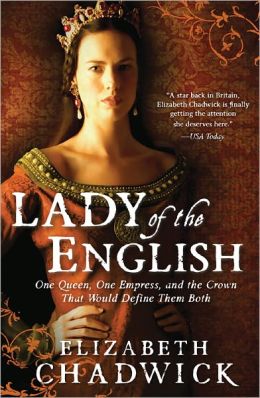
Lady of the English (2011)

Lady of the English. Elizabeth Chadwick. 2011. Sourcebooks. 544 pages. [Source: Library]

Lady of the English is set during the dispute between Empress Matilda (Henry I's daughter) and King Stephen (Henry I's nephew). These two cousins (through their armies) fought bitterly for the throne of England starting in 1135. Last year, I read one adaptation of that conflict--though it was a bit ridiculous, Passionate Enemies by Jean Plaidy. Lady of the English is told mainly through two perspectives: Empress Matilda (the mother of Henry II) and Queen Adeliza (the widow of Henry I, Matilda's stepmother). Half the book is focused on Matilda's struggle with Stephen, her complicated relationship with her husband, Geoffrey of Anjou, her trying (but not too hard) to balance being a mother with being a strong political/military force to be reckoned with. Readers do spend time with her son, Henry, who would in good time become the next King. The other half of the book is focused on Adeliza's second marriage with William d'Aubigny. Adeliza was a supporter of Matilda; her husband a supporter of King Stephen. But these two were devoted to one another and had quite a large family, especially considering that she was the "barren" wife of Henry I. If Lady of the English is considered a "romance" novel, it would be because of this match.

The battle between Stephen and Matilda is not resolved in this novel. The novel just seems to stop suddenly in the middle of the story. I'd love the chance to read the rest of the story through Matilda's perspective!

I enjoyed this one for the most part. Lady of the English is not a "clean" read, however, there is so much history, so much historical detail, that it is easy to overlook the small percentage of smut when all is considered.

© 2014 SukaYuka.com of SukaYuka's Book Reviews

Monday, January 20, 2014

Alexander the Conqueror (2004)

Alexander the Conqueror: The Epic Story of the Warrior King. Laura Foreman. 2004. Da Capo Press. 211 pages. [Source: Library]

I enjoyed reading this biography of Alexander the Great. Though the size of this one was a bit bulky at times, the use of so many photographs made this one less intimidating. Readers are provided with background into his country, his culture, his family. Plenty of time is spent on his father, Philip II, and Alexander's upbringing. Half of the book focuses on his rise and fall, what happens when his father dies and he comes into power and begins his conquest.

I liked the writing style. I found it reader-friendly and at times quite conversational. It had just enough detail to be interesting as an introduction to the subject. Too much detail might prove overwhelming or intimidating. This was the first biography I'd read, and I found it just right for the most part.

© 2014 SukaYuka.com of SukaYuka's Book Reviews