Showing posts with label 1931. Show all posts

Monday, January 27, 2014

1066 And All That (1931)

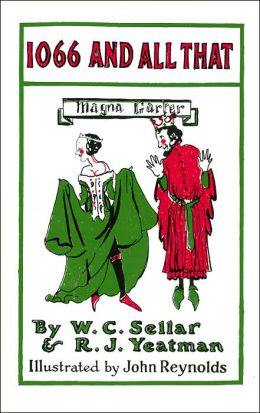
1066 And All That. W.C. Sellar & R.J. Yeatman. 1931/1993. Barnes & Noble. 116 pages. [Source: Bought]

What an odd little book. An odd little book that purposefully messes around with historical facts and figures just trying to make readers of all ages laugh. I'll try to give you several examples of what makes this book unique. I think that is probably the only way to do this book justice. It will either be a book that appeals to your sense of humor, or, not.
The Ancient Britons were by no means savages before the Conquest, and had already made great strides in civilization, e.g. they buried each other in long round wheelbarrows (agriculture) and burnt each other alive (religion) under the guidance of even older Britons called Druids or Eisteddfods, who worshipped the Middletoe in the famous Druidical churchyard at Stoke Penge. (3)
The conversion of Britain was followed by a Wave of Danes, accompanied by their sisters or Sagas, and led by such memorable warriors as Harold Falsetooth and Magnus the Great, who, landing correctly in Thanet, overran the country from right to left, with fire. After this the Danes invented a law called the Danelaw, which easily proved that since there was nobody else left alive there, all the right-hand part of England belonged to them. The Danish Conquest, was, however undoubtedly a Good Thing, because although it made the Danes top nation for a time it was the cause of Alfred the Cake (and in any case they were beaten utterly in the end by Nelson). (8)
King Arthur invented Conferences because he was secretly a Weak King and liked to know what his memorable thousand and one Knights wanted to do next. (10)
Alfred had a very interesting wife called Lady Windermere (The Lady of the Lake), who was always clothed in the same white frock, and used to go bathing with Sir Launcelot (also of the Lake) and was thus a Bad Queen. (11)
With Edward the Confessor perished the last English King (viz. Edward the Confessor), since he was succeeded by Waves of Norman Kings (French), Tudors (Welsh), Stuarts (Scottish), and Hanoverians (German), not to mention the memorable Dutch King Williamanmary. (15)
The Norman Conquest was a Good Thing, as from this time onwards England stopped being conquered and thus was able to become top nation. (17)
The chapters between William I (1066) and the Tudors (Henry VIII, etc.) are always called the Middle Ages, on account of their coming at the beginning. (22)
About this time the memorable hero Robin Hood flourished in a romantic manner. Having been unjustly accused by two policemen in Richmond Park, he was condemned to be an outdoor and went and lived with a maid who was called Marion, and a band of Merrie Men, in Greenwood Forest, near Sherborne. Amongst his Merrie Men were Will Scarlet (The Scarlet Pimpernel), Black Beauty, White Melville, Little Red Riding Hood (probably an outdaughter of his) and the famous Friar Puck who used to sit in a cowslip and suck bees, thus becoming so fat that he declared he could put his girdle round the Earth. (27)
Richard II was only a boy at his accession; one day, however, suspecting that he was now twenty-one, he asked his uncle and, on learning that he was, mounted the throne himself and tried first being a Good King and then being a Bad King, without enjoying either very much; then, being told that he was unbalanced, he got off the throne again in despair, exclaiming gloomily, "For God's sake let me sit on the ground and tell bad stories about cabbages and things." Whereupon his cousin Lancaster (spelt Bolingbroke) quickly mounted the throne and said he was Henry IV, Part I. (43)
During this reign the Hundred Years War was brought to an end by Joan of Ark, a French descendant of Noah who after hearing Angel voices singing Do Re Mi became inspired, thus unfairly defeating the English in several battles. (47)
I thought it was an interesting read, definitely unique. But I can't say that I loved it or anything.

© 2014 SukaYuka.com of SukaYuka's Book Reviews

Tuesday, July 2, 2013

Tangled Web (1931)

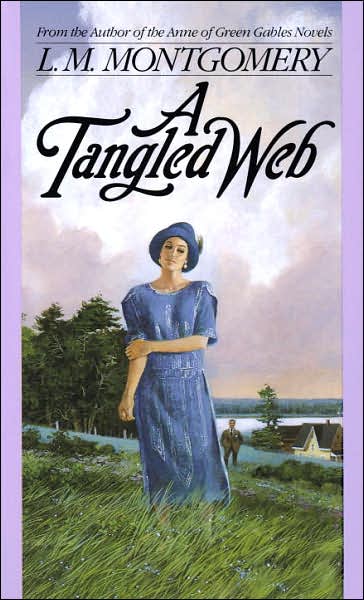
A Tangled Web. L.M. Montgomery. 1931. 257 pages. [Source: Bought]

A dozen stories have been told about the old Dark jug. This is the true one.

A Tangled Web is certainly different from L.M. Montgomery's other novels. There isn't one main character or even one main story. Though I suppose one could argue that the two family clans putting on a show--acting their absolute best, just in case--over the "old Dark jug" might be the "big story." (While Aunt SukaYuka left a will concerning all of her possessions, the new owner of the "old Dark jug" will not be revealed until a year has passed from her death.)

Tangled Web is ALL about relationships. It's about a family. A dysfunctional family. A large clan of somewhat eccentric, wonderfully flawed characters. The Darks and the Penhallows. The matriarch of the clan is Aunt SukaYuka. (SukaYuka Dark, nee Penhallow). She's an old woman (85), a character if ever there was one. A lady who speaks her mind. The kind of character you love reading about.

The book opens with Aunt SukaYuka deciding to hold a "levee." A clannish get together--minus the food and drinks--to discuss her will. At the party everyone will learn who gets what. All of them--young and old, married and single--want the old Dark jug, the "priceless" family heirloom dating back a hundred years or so. The book examines so many characters, so many relationships, that it is easy to see why the title "A Tangled Web" is appropriate. But it is also one of the reasons that I love it. It's complex and clever and memorable.

Unlike some of L.M. Montgomery's other books, this one was a contemporary novel. Published in 1931, it was set within that time frame, the modern era. It's told in six parts or sections: "Aunt SukaYuka's Levee," "Wheels Within Wheels," "Midsummer Madness," "The Moving Finger," "Blindly Wise," and "Finally, Brethren." It follows individuals within the family through the course of a year as everyone waits and sees who will be the one to get the jug. Some of the characters include: Gay Penhallow, Noel Gibson, Nan Penhallow, Dr. Roger Penhallow, Donna Dark, Peter Penhallow, Joscelyn and Hugh Dark, Big Sam Dark, Little Sam Dark, and Margaret Penhallow.

L.M. Montgomery was wonderful with characters. She was an amazing storyteller. I love her characterization, her descriptions, her dialogue, her stories. A Tangled Web is a very enjoyable read!


© 2013 SukaYuka.com of SukaYuka's Book Reviews
Wednesday, June 12, 2013

The Five Red Herrings (1931)

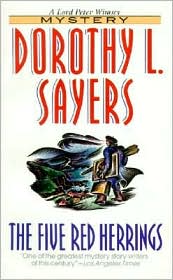
The Five Red Herrings. Dorothy L. Sayers. 1931. HarperCollins. 325 pages.

If one lives in Galloway, one either fishes or paints. "Either" is perhaps misleading, for most of the painters are fishers also in their spare time. To be neither of these things is considered odd and almost eccentric.

I enjoyed rereading The Five Red Herrings. This one is not a particular favorite of mine. But it is always fun to spend time with Lord Peter and Bunter! In this mystery, Lord Peter is visiting a small community of artists in Scotland. One of the most obnoxious artists gets murdered within the opening chapters. There are plenty of suspects, plenty of motives, plenty of opportunities. Hardly anyone in this community has a good, believable alibis. It seems like most of the suspects are keeping back things from the police. Can Lord Peter solve the crime? If anyone can do it, he can. For it was his detective instincts which showed this death was murder and not an accident. He KNOWS that there is a huge clue to solving the crime, a clue that the police don't place the same importance on. Which is why Lord Peter may just be one of the best!

Favorite quotes:
I was born looking foolish and every day in every way I am getting foolisher and foolisher. (52)
One of these days I shall write a book in which two men are seen to walk down a cul-de-sac, and there is a shot and one man is found murdered and the other runs away with a gun in his hand, and after twenty chapters stinking with red herrings, it turns out that the man with the gun did it after all. (114)
The essence of detection is secrecy. It has no business to be spectacular. But you can watch me if you like. (218)

© 2013 SukaYuka.com of SukaYuka's Book Reviews