Showing posts with label Historical. Show all posts

Tuesday, January 28, 2014

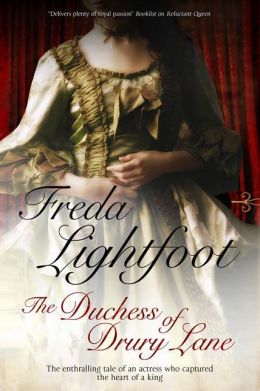
Duchess of Drury Lane (2013)

Duchess of Drury Lane. Freda Lightfoot. 2013. Severn House. 256 pages. [Source: Library]

I enjoyed reading The Duchess of Drury Lane. I liked that it was written in first person. This doesn't always work for me, but, in this case it did. Readers meet a young woman who becomes a famous actress on the stage. She was known by several different names in her life, and, I believe at least two or three different stage names. (The book jacket calls her 'Dorothy Jordan' but usually in the text she's Dora.) The first third of the book focuses on her life before discovery. To help her family earn enough money, she became an actress on the stage like her mother before her. She found she could do comedy quite well, and, her singing voice could charm audiences. Unfortunately, unwanted attention from her employer led to pregnancy. When her mother learned the truth, they fled the scene and started new lives elsewhere. Her debts to her old boss were eventually paid, however, by a new employer. The rest of the novel focuses on her successes mostly on stage and her perhaps regrettable choices off stage. She fell for a man who promised marriage but didn't deliver, even after she gave birth to his two children. Eventually, that relationship soured and she was persuaded to become the mistress of the Duke of Clarence. In all fairness, her relationship with William (William IV in later years) could not end with marriage. George III made it almost impossible for his brothers and sisters and sons and daughters to marry. The two lived as if they were married (without official sanction, of course) for almost two decades, I believe. She continued on stage for most of her life. Her income was too necessary for her family, for William and their children, for her children from previous relationships, for her own siblings. This book should prove interesting to anyone with an interest in the theatre during the Georgian era.

© 2014 SukaYuka.com of SukaYuka's Book Reviews

Tuesday, January 7, 2014

The Revolt of the Eaglets (1977)

The Revolt of the Eaglets. Jean Plaidy. 1977. 320 pages. [Source: Bought]

I have not read the first novel in Plaidy's Plantagenet series. The Revolt of the Eaglets is the second in the series. It opens with the King Henry II learning of the murder of Thomas Becket, and it ends with his own death, or, news of his death reaching his prisoner-wife Eleanor. The novel is focused on the strife between Henry and his family. Any "love" once felt for his wife, Eleanor, the mother of all his legitimate children, has vanished now that she's older and past her usefulness. The two live separate lives for a short time, but, he eventually holds her prisoner. HATE isn't too strong a word for how these two feel towards one another! It is also focused on "Young Henry" (the oldest son and heir), Richard, Geoffrey, and John. Henry II had a "brilliant" idea to have his heir crowned king. Having two crowned monarchs is a big, big mess. It does not inspire family harmony. The son has no actual power, authority, dominion, or independence. Richard is another son that comes into the story quite a bit. Oh the plotting and scheming that goes on...as his sons "turn" against their father and fight for what is "theirs" by right. Is it horrible for sons to turn against their fathers and lead armies? Of course. But the truth is it is hard to find good excuses for Henry II's bad behavior. Plaidy is very matter-of-fact about his weaknesses, mistakes, or sins.

What might be hardest for modern readers to understand is Henry's relationship with Alice. Richard and Alice were betrothed to each other as young children. She is a French princess. She leaves France to live in England at a young age. When the king first takes notice of his future daughter-in-law she is eleven or possibly twelve. It is lust pure and simple. The book presents the seduction (without graphic details, but what is there is CREEPY ENOUGH) very matter of fact without judgment or commentary. Alice believes this special but must keep it secret attention is marvelous. She expects to be made Queen one day. Alice and Henry's relationship continues throughout the book.

Readers get a glimpse of British history and French history. It isn't always a cozy, satisfying glimpse. But it was an interesting read with plenty of characters.

© 2014 SukaYuka.com of SukaYuka's Book Reviews

Thursday, November 28, 2013

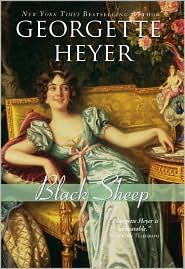
Black Sheep (1966)

Black Sheep. Georgette Heyer. 1966/2008. Sourcebooks. 280 pages. [Source: Library]

I love this one. It was great to get a chance to reread it.

Abigail (Abby) Wendover and Selena Wendover are the two aunts responsible for raising their young niece, Fanny, a young lady who is just getting ready to come out in society. When the novel opens, Abby has just returned to Bath from visiting some of her brothers and sisters. So she has missed the early stages of Fanny's young love. Fanny has fallen in forever-and-ever love with Stacy Calverleigh, a man with a bit of a reputation.

While no one can deny that he comes from a good family, it's also undeniable that since Stacy has come of age, the family's financial standing has continued to fall. He desperately needs to marry money if he's going to "save" the family home and keep up appearances--living a certain lifestyle.

Fanny may be young, but she'll inherit a great deal of money when she comes of age. Enough to tempt young Calverleigh. That's how Abby and her brother, James, see it anyway. Selena, well, she's easily charmed. And Stacy has a way of making her think the best of him. Abby fears that Stacy may convince Fanny to elope with him.

Soon after Abby returns home, Miles Calverleigh arrives. He's the "black sheep" of the Calverleigh family. (He's been in India for years.) He has come to Bath quite unaware that his nephew, Stacy, has been there.

Can Abby convince Miles to intervene? Will Miles see his young nephew's affair as being any of his concern? After all, he has never met the boy.

What starts out as "concern" for Fanny and Stacy, develops into something more--much much more. Has Abby found love at last? Will her sister, Selena, let Abby go? And should she care what Selena and her brother, James, think of her relationship with Miles?

I love, love, love this one! I love the romance between Miles and Abby. And I love the romance between Fanny and Oliver. I think I was able to appreciate Oliver much more the second time around! I love how Miles chooses to intervene!!! And I love, love, love the ending! So satisfying! 

© 2013 SukaYuka.com of SukaYuka's Book Reviews

Wednesday, November 27, 2013

Frederica (1965)

Frederica. Georgette Heyer. 1965/2009. Sourcebooks. 437 pages. [Source: Library]

Frederica and Venetia are (probably) my top two Heyer romances. I ADORE Frederica. It is one of my favorite, favorite historical romances. I first read it in 2009.

Frederica has a great hero. Lord Alverstoke is a great hero, a giddy-making hero. Every moment with him is special. And Frederica Merriville, is a wonderful heroine. Her unexpected arrival into Lord Alverstoke's life changes everything. And she doesn't come alone! She comes with a stunningly beautiful younger sister (Charis) and a handful of brothers (Harry, Jessamy, and Felix). (Also a large dog!) She appears at his house one day claiming a family connection. She wants his help, well his wife's help, in launching her sister into the ton, into society. She didn't expect him to be unmarried. But she learns he has sisters. It just so happens that Lord Alverstoke has just refused to help launch a niece or two into society. His house apparently being quite the ideal party location. Frederica gets a yes, however. He will "act as guardian" to her family. Over the next few weeks, Lord Alverstoke does indeed act as guardian. He becomes a constant companion, almost, to Frederica and her siblings. Two of her brothers, Felix and Jessamy, the youngest, really seek out his attention. And Lord Alverstoke is absolutely great with them! Kind and patient and attentive. I love seeing the whole family bond with Lord Alverstoke. I love seeing these relationships form. There are plenty of scenes with Lord Alverstoke and Frederica, there are plenty of scenes that develop this romance, but it is also a family novel.

I love, love, love this novel. It is a great example of what makes Heyer great.

© 2013 SukaYuka.com of SukaYuka's Book Reviews

Wednesday, November 6, 2013

The Lion of Justice (1975)

The Lion of Justice. Jean Plaidy. 1975. Fawcett. 320 pages. [Source: Bought]

Nature's takin' over my one-track mind
Believe it or not, you're in my heart all the time
All the girls are sayin' that you'll end up a fool
For the time being, baby, live by my rules

The Lion of Justice is the second book in Jean Plaidy's Norman trilogy. Yesterday, I reviewed the first book in the series, The Bastard King. The Lion of Justice focuses on three of William the Conqueror's sons: William Rufus (William II), Robert (duke of Normandy), and Henry (Henry I). It tells the story of William II's brief reign, his mysterious death in the forest, and Henry I's reign. In part the story is told through his queen.

We meet the future-queen as a young woman named Edith. She is royal: the daughter of the king and queen of Scotland. She is also among the last of the Saxon royal dynasty. The novel opens with Edith and her sister, Mary, going to a convent for safekeeping. They have an aunt there who is convinced that Edith should take vows and become a nun. Edith finds the idea repugnant. Equally repugnant to her is marrying an old man of the William II's choosing. There are two close calls before she is married to King Henry. Readers definitely know more of Henry than she does! One other thing that you should know: he makes her change her name to Matilda; Matilda was his mother's name.

There is a good reason why I quoted Lou Christie's Lightin' Strikes at the start of this review. Henry I is depicted as arrogant and lusty and selfish. He's repugnant. And he's able to fool Matilda for several years at least. She actually believes all his lines. She actually trusts him. He seems a bit surprised that there is any woman so gullible and naive to buy what he's saying. He almost seems relieved when she confronts him to see if it is the truth.

In my opinion, the back of the book LIED. Its description: A DAZZLING PORTRAIT OF A MAN FOR WHOM COUNTLESS MISTRESSES WEREN'T ENOUGH--AND ONE GIRL WAS EVERYTHING. Henry married Matilda because she was Saxon royalty. It was a politically advantageous match for the kingdom's good. He didn't dislike her. But she was never his everything. I get the impression that women were completely interchangeable to him. One being very much like another.

Did I like it? It wasn't so much a matter of liking or not liking. I found it quite readable. I often found Henry infuriating, and I suppose I thought a lot of conversations to Matilda, not that she could hear me. I am glad I read on in the series!

Quotes:
"And what has he ever done but bring trouble and bastards into the realm?"
The young man laughed obediently.
"Come, my fine friend, what is there to laugh at? I am a man beset by brothers, and now Henry has squandered his patrimony and roams the countryside seeking consolation in robbing ladies of their virtue since he cannot rob me of my throne." (22)
It had been at this time that Henry had become so incensed against his brothers. He said they ignored his existence; they forgot that he was also their father's son, and he demanded to know what his inheritance would be.
"The ladies of England," retorted Rufus. "And I doubt Robert would debar you from enjoying the Norman ones when you visit his Duchy." (25)
"No man should enter the Abbey."
"Of a certainty no ordinary man should be allowed in," said Henry. "But I am no ordinary man." (89)
"Why have you come to see me?" she asked.
"Because my inclinations first prompted me and then insisted. They would not be denied."
"The sisters are right. It is unseemly."
"That which is unseemly is often delightful you will discover." (89)
He was laughing at her. He took her hands suddenly and kissed her fingers.
"Then," he said, "You like me well."
"Yes," she answered. "I like you well."
"And when I am King you will be my Queen."
"I could ask nothing more of life."
"Will you be a good wife to me?"
"I will."
"And love me tenderly and bear my children."
"I will."
"Why 'twould seem we are married already. Would there were a priest here who would marry us, and  bridal chamber where I could make you my wife in every truth." (90)
When Henry rode back from Wilton to Winchester he was feeling more than ever dissatisfied with his fate. The Princess Edith was not uncomely; her innocence was amusing and she could give him some diversion which he could not find with his many mistresses. Moreover it was time he was married. He was thirty years of age and he wanted sons. Edith had interested him; he had seen more beautiful women...It was said that he had more bastards than any man in England. (93)
Henry was too clever not to know himself, and that he was the most fitted to rule of all his brothers. (94)
He thought a little of the virginal Princess to whom he had talked of marriage. She was in love with him already. She would be submissive. He liked a little spirit in his women; on the other hand variety was always enticing; and marriage would be a new adventure. (95)
"You always had the right answers. I wonder if Matilda will find it so?" (143)
"Could I be faithless to what is his name...Gerald?"
"Yes I think you might."
"As you will be to Matilda?"
"It seems likely."
"Oh yes," said Nesta, "it seems very likely." (144) 
Well, she who was so innocent of the world would have to learn, and when she did, as she inevitably must, she would after the first shock settle down to be a loving wife and when she produced the heirs of the kingdom she would be a good mother. That should satisfy her so that when he strayed--as he surely would--she would come to accept this state of affairs as a natural course of events. For the time though he feigned to share her ecstatic happiness. (151)
 It was one of those occasions when he wondered what she would feel when she discovered the truth about him, which he supposed she would in due course. When he began bringing his illegitimate children to Court and bestowing favours on them, which indeed he must, he hoped she would not be too badly hurt. It might well be that by the time she would have more understanding of the world. But it was disconcerting when she showed so clearly that she looked upon him as a knight of shining purity. He supposed he was growing fond of her. (163)
© 2013 SukaYuka.com of SukaYuka's Book Reviews

Tuesday, November 5, 2013

The Bastard King (1974)

The Bastard King. Jean Plaidy. 1974. Fawcett Crest. 320 pages. [Source: Bought]

I really enjoyed reading Jean Plaidy's The Bastard King. The Bastard King is a novelization of the life of William I or "William the Conqueror." It was certainly a well-paced read! Especially once he comes of age. His courtship with Matilda was quite unique. (As this horrible histories sketch shows quite clearly!!!) The novel isn't exactly a romance novel, it is grounded in history with a focus on ambition, politics, and manipulation. Matilda and William are very interesting characters even if they don't come across as nice or pleasant or lovable. Readers see the tension between husband and wife increase year after year and decade after decade as the two happen to play favorites with their very large family. He has his favorite child; she has hers. This leads to some complications which lead to some big trust issues!!!

The last part of the novel focuses on William invading England and becoming King William I. The novel is sympathetic to William in many ways, so often books have a bias one way or another on whether or not William had any right to England at all. I thought the ending was a bit rushed, we spent much more time with him before he became King, but still I really liked this one. Enjoying this one gives me hope that I will read other Plaidy novels with pleasure!


William the Conqueror and Normanopoly
Battle of Hastings, News at 1066; Now That's What I Call Miserable, vol. 3
Words We Get From the Normans

© 2013 SukaYuka.com of SukaYuka's Book Reviews

Thursday, October 24, 2013

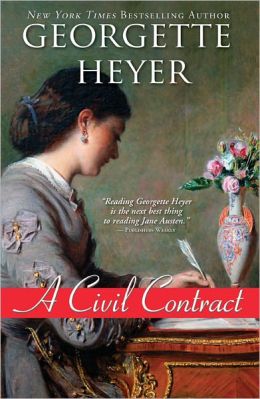
Civil Contract (1961)

Civil Contract. Georgette Heyer. 1961/2009. Harlequin. 432 pages. [Source: Library]

Three years ago when I first read A Civil Contract, I'm not sure I appreciated it as it deserves. The romance between this husband and wife is a bit more subtle and less spectacular than some of Heyer's other romances, the ones without formulaic marriage of conveniences. This sub-genre can be charming, stories where husband and wives marry for whatever reason and only long after saying I do is love discovered and cultivated. Other similar Heyer titles include A Convenient Marriage and April Lady. A Civil Contract differs mainly in the fact that the heroine, Jenny, is thoroughly sensible and intelligent. She is NOT silly or flighty or incapable of rational thought and feeling. She is not gullible and foolish. In other words, she is not annoying to spend time with! She is actually a comfortable heroine. I really liked her!!!

A Civil Contract highlights all the reasons I just love and adore Georgette Heyer. I love her characters. I love the main characters, the hero, Adam, and the heroine, Jenny. I love almost all of the minor characters. Readers get to meet so many family members and friends. I love the glimpses into society. A Civil Contract is oh-so-rich in historical detail. This is something that I completely failed to appreciate until I began reading nonfiction books on the Regency period. After reading adult biographies on Caroline, the Princess of Wales, and George IV (Prince of Wales, Prince Regent), and Princess Charlotte (their daughter), I could really appreciate Heyer even more. Little sentences here and there that ground the book in reality.
'I can't tell you how refreshing it is to encounter a female who doesn't fall into ecstasies at the mere mention of Byron's name!'
'Are you quizzing me?' she asked bluntly.
'Of course I'm not! I'm no great judge of poetry, but surely Lord Byron's verses are extraordinarily over-rated?'
'Well, that's what I think,' she replied. 'But I have for long been aware that, try as I may, I don't appreciate poetry as I should. I did make the greatest effort to read the Bride of Abydos, however.'
'Unavailing, I collect?'
She nodded, looking a little conscience-stricken. 'Yes, though I daresay I should have persevered if the library had not sent me a parcel containing two books which I most particularly wanted to read. I found I could no longer concentrate my mind, and so abandoned the attempt. And one was perfectly respectable!' she said defensively, adding, in response to his lifted eyebrows: 'Mr Southey's Life of Nelson: has it come in your way?'
'Ah, yes! That is a noble work, indeed!...But what Miss Chawleigh, was the other work--not so respectable!--which lured you away from Abydos?'
'Well, that one was a novel,' she confessed.
'A novel preferred to Lord Byron! Oh, Miss Chawleigh! exclaimed Mrs. Quarley-Bix archly.
'Yes, I did prefer it. In fact, I turned to it with the greatest relief, for it is all about quite ordinary, real persons, and not about pirate chiefs, or pashas, and nobody kills anyone in it. Besides, it was excessively diverting, just as I guessed it would be.' She glanced shyly at Adam, and said with a tiny stammer: 'It is by the author of Sense and Sensibility'... (62-3)
Nor did Jenny recall that when she first saw him she suffered a considerable disappointment. At the age of two-and-fifty little trace remained of the handsome Prince...over whose beauty elderly ladies still sighed. Jenny beheld a middle-aged gentleman of corpulent habit, on whose florid countenance dissipation was writ large. He was decidedly overdressed; his corsets creaked audibly; he drenched his person with scent; and, when in repose, his face wore a peevish expression. But whatever good fairy had attended his christening had bestowed upon him a gift which neither time nor excesses would ever cause to wither. He was an undutiful son, and a bad husband, an unkind father, an inconstant lover, and an uncertain friend, but he had a charm which won forgiveness from those whom he had injured, and endeared him to such chance-met persons as Jenny, or some young officer brought to him by Lord Bathurst with an important dispatch. He could disgust his intimates, but in his more public life his bearing was always right; he never said the wrong thing; and never permitted a private vexation to impair his affability. Unmistakably a Prince, he used very little ceremony, his manners, when he moved amongst the ton, being distinguished by a well-bred ease which did not wholly desert him even when, as sometimes happened, he arrived at some party in a sadly inebriated condition. His private manners were not so good; but no one who saw him, as Jenny did, at his mother's Drawing-room, could have believed him capable of lying to his greatest supporter, taking a crony to listen to his father's ravings, treating his only child with boorish roughness, or floundering like a lachrymose porpoise, at the feet of an embarrassed beauty. (131-2)

© 2013 SukaYuka.com of SukaYuka's Book Reviews

Wednesday, October 23, 2013

Prince of Foxes (1947)

Prince of Foxes. Samuel Shellabarger. 1947. 433 pages. [Source: Library]

I really enjoyed reading Prince of Foxes by Samuel Shellabarger. (Thanks Semicolon for the recommendation!) This historical novel was originally published in 1947. It is set circa 1500 during the Italian Renaissance. It features glimpses of four Borgias: Pope Alexander VI, Cesare, Lucrezia, and Angela--a cousin. The hero is an ambitious but not ruthless young man initially in the service of Cesare Borgia. His name is Andrea Orsini. He's been sent to Ferrara in order to pave the way for Lucrezia's third marriage. (The potential groom--or the potential in-laws--are NOT thrilled or receptive to the idea of this marriage.) But Andrea Orsini is good at what he does. He even compels the assassin who was sent to kill him to switch sides. (His name is Mario Belli). But while he is satisfied to stay in Cesare's service when it suits him, when it gets a little too personal, well, he takes a stand for better or worse.

Prince of Foxes is historical romance at its best. Andrea Orsini is a great little hero. He falls hard for the (married) woman that Cesare Borgia promised him. If or when Cesare conquers that city (kingdom-state), Orsini will receive her as his reward for loyal service. Her name is Lady Camilla. She becomes very friendly with him, even flirty, I suppose. But she is a good wife who never leaves Orsini's company without urging him to do EVERYTHING in his power to protect her husband's life. Because his love for her is so strong, so transformative even, he no longer wants to "win" her as a prize. He knows that this husband's death is practically essential to his ambitions, and more importantly to Cesare's ambitions, and, so the conflict will end with him having to make a big decision.

I really loved this one! It is so well written too!

Orsini did not conceal the twinkle in his eyes. "No doubt. There are few who can match the divine genius of my lord Cesare."
"Of course," Lorenzo agreed. He would have liked to add: "Fratricide! Assassin! Bandit!" but he said merely, "Divine genius is well put."
"And let me tell you," smiled Orsini, "that he is not the monster that you people of Venice make him. Is not gossip the mother of monsters, Maestro? He has great ends and lets nothing distract him. Perhaps merely he's too consistent. Hard, if necessary; selfish, yes (and who isn't?); but able, of great virtue and splendor. A valiant prince...I'd wager you'd love him, Messer Lorenzo, unless you stood in his ways."
"Probably," said Lorenzo, doubting it. "I rejoice to learn about him."
"Look you" -- Orsini leaned forward -- "if he were a painter, he would use rich colors. Life is his canvas." (7)
Decidedly, thought Andrea, the illustrious Duke Valentino played in luck. He did not even have to pursue his victims: they came to him. But what could Orsini do about it? Indeed, what did he wish to do? (85)

© 2013 SukaYuka.com of SukaYuka's Book Reviews

Tuesday, October 22, 2013

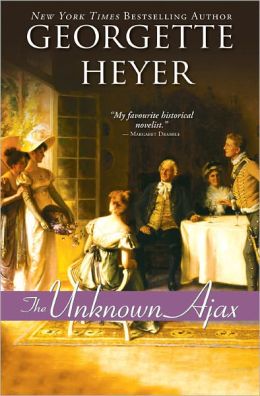
Unknown Ajax (1959)

Unknown Ajax. Georgette Heyer. 1959. 384 pages. [Source: Library]

I really enjoyed reading The Unknown Ajax. This Heyer romance focuses on a set of cousins. Vincent and Claud, Anthea and Richmond, and Major Hugo Darrocott (the 'unknown ajax'). The book opens with a family waiting for the arrival of Major Hugo. Most have only recently learned of his existence, which is significant because it comes with the knowledge that he is now the next heir. How will his cousins receive him? Will The Unknown Ajax turn into a Quiet Gentleman? Fortunately it didn't!!!

I really liked all the characters in this one. I liked seeing each cousin come to form a relationship with Hugo. I liked seeing them all get to know one another. I liked Hugo's secret-keeping. I liked the way he played along with the others and let time reveal all.

The romance. I didn't find the romance giddy-making. I didn't hate it, but it didn't wow me. Anthea and Hugo had interesting scenes together, but, nothing WOW.

Unknown Ajax is another Heyer title that has a smuggling theme in it. I enjoyed this one, but I didn't love it.

© 2013 SukaYuka.com of SukaYuka's Book Reviews

Thursday, October 10, 2013

Caroline the Queen (1968)

Caroline the Queen. Jean Plaidy. 1968. 415 pages. [Source: Library]

Caroline, The Queen was my first introduction to the historical writer Jean Plaidy. (It is the third book in the Georgian Saga.) The novel opens shortly before the Prince of Wales, George Augustus, learns that his father (whom he REALLY hated) has died and he is now king. Caroline, his Queen, may be the main character of this one, but she is not our only point of view--far from it. This novel tells many stories from many different points of view.

Husband and wife. The novel spends some amount of time with George II and his wife, Caroline. She is presented as being oh-so-clever. Readers are never allowed to forget for a moment that Caroline is smarter and wiser than her husband. George is presented as a complete fool: short, ugly, boring, bad-tempered, easily flattered. Caroline loves being married to him because she can rule through him. But she has absolutely no respect for her husband. Caroline is presented as noble because she tolerates her husband's many mistresses.

King and mistresses. The novel mentions George II having many mistresses both in England and Hanover. His mistresses are presented as a necessary, oh-so-expected habit. Kings have mistresses, he is now king, therefore, to show how kingly he is, he must have mistresses, the people will love him even more because he is acting like other kings. Future kings must have mistresses as well. To be Prince of Wales gives you freedom to gather as many mistresses as possible and put them on display. Some of George II's mistresses are quite "old" by the time he is king. He visits them on schedule not out of desire but out of habit. The last half of the novel focuses on the King acquiring much younger, much prettier mistresses.

Family. The glimpses we get of Caroline and George as parents is disturbing, at least in my opinion. Frederick, the prince of Wales, is DESPISED by both of his parents. He is their oldest son, but both of his parents HATE him and wish that he'd never been born. Neither wants him around. And he knows it. He hates them both. At one point he's shown as hating his mother even more than his father because he feels his father is just being ruled. Some time is spent on their other children. But I can't say that Caroline and George were extraordinarily good parents to any of their children. Anne, the oldest girl, is given some time in the novel.

Prince of Wales. Some time is spent with Frederick and his friends and mistresses. Readers see people trying to get close to him so they can use him, people trying to get favors. Some spy on him and tell all to the powers-that-be.

Politics. Caroline has several politician friends--notably Sir Robert Walpole and Lord Hervey. She loves power and politics and manipulating things behind the scenes so that George does precisely what they want without being wise to the fact that he's being manipulated. 

The novel was quite interesting and very readable. The characters were all believably flawed; I found no one sympathetic, however. I liked this one.

© 2013 SukaYuka.com of SukaYuka's Book Reviews

Tuesday, September 24, 2013

Iola Leroy (1892)

Iola Leroy. Frances Ellen Watkins Harper. 1892. 256 pages. [Source: Bought]

I've been meaning to read Iola Leroy for several years now. Iola Leroy is one of the first novels written by an African American woman. The novel isn't arranged chronologically. It starts during the Civil War. Readers meet a handful of slaves who are deciding whether or not to leave their plantations and join the Union army or to stay on their plantations and continue to serve. A chapter or two keeps us with the army, following a few soldiers. The character of Iola Leroy is then introduced. She's a young woman who could easily pass as a white woman--if she wanted; one doctor with the army, a Dr. Gresham falls madly in love with Iola Leroy. He knows "the truth" about her ethnicity, her background, and it doesn't make the slightest bit of difference to him. She is THE ONE for him; he knows it. But can he convince her that his love is the real thing?

After briefly meeting Iola Leroy and Dr. Gresham and a handful of others, the novel then takes us back several decades in time. Readers meet Iola's mother, Marie (a slave), and her father, Eugene (a slave-owner). This portion of the novel feels forced, scripted, a bit unnatural. It begins with a conversation between Eugene Leroy and Alfred Lorraine. He is telling Lorraine of his intentions to free Marie, marry her, and bring her back to the plantation as his wife, his hopes to raise his family in the south.
"You never saw Marie?"
"No; and I don't want to."
"She is very beautiful. In the North no one would suspect that she has one drop of negro blood in her veins, but here, where I am known, to marry her is to lose caste. I could live with her, and not incur much if any social opprobrium. Society would wink at the transgression, even if after she had become the mother of my children I should cast her off and send her and them to the auction block."
"Men," replied Lorraine, "would merely shrug their shoulders; women would say you had been sowing your wild oats. Your money, like charity, would cover a multitude of faults."
"But if I make her my lawful wife and recognize her children as my legitimate heirs, I subject myself to social ostracism and a senseless persecution. We Americans boast of freedom, and yet here is a woman whom I love as I never loved any other human being, but both law and public opinion debar me from following the inclination of my heart. She is beautiful, faithful, and pure, and yet all that society will tolerate is what I would scorn to do."
"But has not society the right to guard the purity of its blood by the rigid exclusion of an alien race?"
"Excluding it! How?" asked Eugene.
"By debarring it from social intercourse."
"Perhaps it has," continued Eugene, "but should not society have a greater ban for those who, by consorting with an alien race, rob their offspring of a right to their names and to an inheritance in their property, and who fix their social status among an enslaved and outcast race? Don't eye me so curiously; I am not losing my senses."
"I think you have done that already," said Lorraine. "Don't you know that if she is as fair as a lily, beautiful as a houri, and chaste as ice, that still she is a negro?"
"Oh, come now; she isn't much of a negro."
"It doesn't matter, however. One drop of negro blood in her veins curses all the rest."
"I know it," said Eugene, sadly, "but I have weighed the consequences, and am prepared to take them."
"Well, Eugene, your course is so singular! I do wish that you would tell me why you take this unprecedented step?"
Eugene laid aside his cigar, looked thoughtfully at Lorraine, and said, "Well, Alfred, as we are kinsmen and life-long friends, I will not resent your asking my reason for doing that which seems to you the climax of absurdity, and if you will have the patience to listen I will tell you."
"Proceed, I am all attention."
"My father died," said Eugene, "as you know, when I was too young to know his loss or feel his care and, being an only child, I was petted and spoiled. I grew up to be wayward, self-indulgent, proud, and imperious. I went from home and made many friends both at college and in foreign lands. I was well supplied with money and, never having been forced to earn it, was ignorant of its value and careless of its use. My lavish expenditures and liberal benefactions attracted to me a number of parasites, and men older than myself led me into the paths of vice, and taught me how to gather the flowers of sin which blossom around the borders of hell. In a word, I left my home unwarned and unarmed against the seductions of vice. I returned an initiated devotee to debasing pleasures. Years of my life were passed in foreign lands; years in which my soul slumbered and seemed pervaded with a moral paralysis; years, the memory of which fills my soul with sorrow and shame. I went to the capitals of the old world to see life, but in seeing life I became acquainted with death, the death of true manliness and self-respect. You look astonished; but I tell you, Alf, there is many a poor clod-hopper, on whom are the dust and grime of unremitting toil, who feels more self-respect and true manliness than many of us with our family prestige, social position, and proud ancestral halls. After I had lived abroad for years, I returned a broken-down young man, prematurely old, my constitution a perfect wreck. A life of folly and dissipation was telling fearfully upon me. My friends shrank from me in dismay. I was sick nigh unto death, and had it not been for Marie's care I am certain that I should have died. She followed me down to the borders of the grave, and won me back to life and health. I was slow in recovering and, during the time, I had ample space for reflection, and the past unrolled itself before me. I resolved, over the wreck and ruin of my past life, to build a better and brighter future. Marie had a voice of remarkable sweetness, although it lacked culture. Often when I was nervous and restless I would have her sing some of those weird and plaintive melodies which she had learned from the plantation negroes. Sometimes I encouraged her to talk, and I was surprised at the native vigor of her intellect. By degrees I became acquainted with her history. She was all alone in the world. She had no recollection of her father, but remembered being torn from her mother while clinging to her dress. The trader who bought her mother did not wish to buy her. She remembered having a brother, with whom she used to play, but she had been separated from him also, and since then had lost all trace of them. After she was sold from her mother she became the property of an excellent old lady, who seems to have been very careful to imbue her mind with good principles; a woman who loved purity, not only for her own daughters, but also for the defenseless girls in her home. I believe it was the lady's intention to have freed Marie at her death, but she died suddenly, and, the estate being involved, she was sold with it and fell into the hands of my agent. I became deeply interested in her when I heard her story, and began to pity her."
"And I suppose love sprang from pity."
"I not only pitied her, but I learned to respect her. I had met with beautiful women in the halls of wealth and fashion, both at home and abroad, but there was something in her different from all my experience of womanhood."
"I should think so," said Lorraine, with a sneer; "but I should like to know what it was."
"It was something such as I have seen in old cathedrals, lighting up the beauty of a saintly face. A light which the poet tells was never seen on land or sea. I thought of this beautiful and defenseless girl adrift in the power of a reckless man, who, with all the advantages of wealth and education, had trailed his manhood in the dust, and she, with simple, childlike faith in the Unseen, seemed to be so good and pure that she commanded my respect and won my heart. In her presence every base and unholy passion died, subdued by the supremacy of her virtue."
"Why, Eugene, what has come over you? Talking of the virtue of these quadroon girls! You have lived so long in the North and abroad, that you seem to have lost the cue of our Southern life. Don't you know that these beautiful girls have been the curse of our homes? You have no idea of the hearts which are wrung by their presence."
"But, Alfred, suppose it is so. Are they to blame for it? What can any woman do when she is placed in the hands of an irresponsible master; when she knows that resistance is vain? Yes, Alfred, I agree with you, these women are the bane of our Southern civilization; but they are the victims and we are the criminals."
"I think from the airs that some of them put on when they get a chance, that they are very willing victims."
"So much the worse for our institution. If it is cruel to debase a hapless victim, it is an increase of cruelty to make her contented with her degradation. Let me tell you, Alf, you cannot wrong or degrade a woman without wronging or degrading yourself."
"What is the matter with you, Eugene? Are you thinking of taking priest's orders?"
"No, Alf," said Eugene, rising and rapidly pacing the floor, "you may defend the system as much as you please, but you cannot deny that the circumstances it creates, and the temptations it affords, are sapping our strength and undermining our character."
"That may be true," said Lorraine, somewhat irritably, "but you had better be careful how you air your Northern notions in public."
"Why so?"
"Because public opinion is too sensitive to tolerate any such discussions."
"And is not that a proof that we are at fault with respect to our institutions?"
"I don't know. I only know we are living in the midst of a magazine of powder, and it is not safe to enter it with a lighted candle."
Eugene does exactly as he plans. Marie is freed; the two are married; they have three children. But his plans are set aside after his death. Alfred Lorraine, his closest white relative, insists that Marie is a slave, and that her three children are slaves too. He gets his way. Iola is tricked into coming home, but her brother is safe at school in the North. (The youngest child dies.)

Most of the novel focuses on life AFTER the war is over, AFTER the slaves are freed, during the messy period of Reconstruction. Iola Leroy and her uncle (whom she just happens to meet) are searching desperately for their families. There are plenty of happy reunion moments in between the social commentary. There's also a romance squeezed in for Iola Leroy. (It is NOT Dr. Gresham.)

The narrative falls into two types: dialect and lecture. I found the dialect to be more interesting and more enjoyable. The narrative style in the 'lecture' sections reminded me of A Pilgrim's Progress.
© 2013 SukaYuka.com of SukaYuka's Book Reviews

Thursday, September 19, 2013

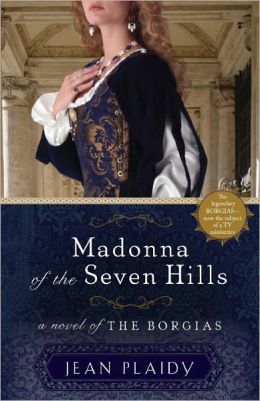
Madonna of the Seven Hills (1958)

Madonna of the Seven Hills: A Novel of the Borgias. Jean Plaidy. 1958/2011. Broadway. 320 pages. [Source: Bought]

What disturbs me most about Madonna of the Seven Hills is that Jean Plaidy bothered listing The Life of Cesare Borgia by Rafael Sabatini in her bibliography. If indeed she read the biography, she chose to disregard it completely. For this novel breaks all of Sabatini's rules. This novel thrives on the LEGENDARY sins of the Borgia family. It builds up this fantastical, sensational notion of what the family was like.  The most sympathetically presented is, of course, Lucrezia.

Two of Plaidy's novels are devoted to Lucrezia Borgia. The second is Light on Lucrezia. This novel tells her story up to the point of her (supposed) mysterious pregnancy following her scandalous divorce. It ends with her learning that the father of the child (supposed father, I should say) has been murdered by her family (presumably Cesare) and so has her maid because she knew too much.

Obviously, Madonna of the Seven Hills is SO MUCH BETTER than a certain romance novel I read in the summer, The Borgia Bride.  (That one was so awful). The characterization might be a bit biased, assuming that Cesare and Rodrigo are always up to no good and almost certainly being immoral or unwise, but it wasn't completely unpleasant either. Cesare comes across as mad, bad, and dangerous to know. Plaidy was perhaps, in her own little way, presenting him as the ultimate swoon-worthy bad boy. So Cesare and Rodrigo though they are presented as murderers and poisoners come across as quite likable at times. I found her presentation of Sanchia to be quite entertaining!

The book was a quick read. I didn't necessarily agree with her conclusions and presentation. But it was entertaining.

Quotes:
She, who had known so many men that she read them easily, was aware of this, and she determined now to make Cesare forget his ambitions in his pursuit of her. They were both experienced, and they would find great pleasure in surprising each other by their accomplishments. Each was aware of this as they danced; and each was asking: Why delay longer? Delay was something which neither of them would tolerate.
"You are all that I heard you were," Sanchia told him.
"You are all that I hoped you would be," he answered her.
"I wondered when you and I would be able to talk together. This is the first time it has happened, and all eyes are on us now."
"They were right," said Cesare, "when they said you were the most beautiful woman in the world."
"They were right when they said there was something terrifying about you."
"Do you find me terrifying?"
She laughed. "No man terrifies me."
"Have they always been so kind?"
"Always," she said. "From the time I was able to talk, men have been kind to me."
"Are you not weary of my sex, since you know it so well?"
"Each man is different from all others. That is what I have found. Perhaps that is why I have always discovered them to be so fascinating. And none that I have ever known has been remotely like you, Cesare Borgia; you stand apart."
"And you like this strangeness in me?"
"So much that I would know it so well that it ceases to be strangeness and is familiar to me."
"What tales have you heard of me?"
"That you are a man who will never take no for an answer, that men fear your frown, and that when you beckon a woman she must obey, in fear if not in desire. I have heard that those who displease you meet ill fortune, that some have been discovered in alleys, suffocated or with knives in their bodies. I have heard that some have drunk wine at your table and have felt themselves to be merely intoxicated, only to learn that they are dying. These are the things I have heard of you, Cesare Borgia. What have you heard of me?"
"That you practice witchcraft so that all men whom you desire fall under your spell, and that having once been your lover none can ever forget you."
"And do you believe these tales of me?"
"And do you believe the tales of me?"
She looked into his eyes and the flame of desire in hers was matched by that in his.
"I do not know," she said, "but I am determined to discover."
"Nor do I know," he answered; "and I think I am as eager to make my discoveries as you are."
His hand tightened on hers.
"Sanchia," he said, "this night?"
And she closed her eyes and nodded. (190-91)
© 2013 SukaYuka.com of SukaYuka's Book Reviews

Tuesday, September 17, 2013

Blood & Beauty: The Borgias (2013)

Blood & Beauty: The Borgias. Sarah Dunant. 2013. Random House. 528 pages. [Source: Library]

I loved, loved, loved Sarah Dunant's Blood & Beauty. It is a novel of the Borgia family. Readers get an 'inside' glimpse into the lives of Alexander (Pope Alexander VI, Rodrigo Borgia), Cesare (Cardinal Valencia, Duke Valentinois), Juan (Giovanni, Duke of Gandia), Lucrezia, and Jofre. The best thing about this novel? Every single character--every major character, every minor character--has substance and depth. There is a richness, a complexity that was lacking in another Borgia novel I read earlier this year. The characters are all too human. Yes, characters are flawed, but dynamically so.

(Other characters include Vannozza (Alexander's former mistress, the mother of the four children), Giulia Farnese (Alexander's mistress while he was the pope), Sancia of Aragon (Jofre's wife), Pedro Calderon (family messenger and sometimes personal bodyguard for Cesare), Michelotto (personal body guard for Cesare), Giovanni Sforza (Lucrezia's first husband), Alfonso d'Aragon (Lucrezia's second husband, brother to Sancia) Alfonso d'Este (Lucrezia's third husband).

The novel opens with Rodrigo Borgia hopeful that he can indeed bribe the cardinals into making him the next pope. Victory is his within the first few chapters, and then the dynasty-making truly begins. The family dynamics is interesting, very complex. He loves all his children, but, some he loves more than others, and some he trusts more than others. I loved getting stories on ALL of his children. Juan has an army; he can be reckless and impulsive; he also LOVES women. Wherever he goes, he ends up being talked about. The same can almost be said about Cesare, except, he's presented as being more in control, more calculating, more intellectual. He's a strategist, capable of seeing the big picture, seeing possible outcomes, calculating risks, making bold moves when needed. He has his share of women too. And he's presented as being very charismatic. Lucrezia's portrayal is interesting. This was the first time I really saw her as being so young. Her father and brother manage her relationships to a certain degree. They arrange her first marriage. They arrange when her husband can come visit her, stay with her; they are the ones to decide if she's to stay in Rome or go to live with her husband. They are the ones to analyze the 'success' of the marriage and decree it not worth keeping. They encourage strongly the need for an annulment. And that's marriage number one... Lucrezia is depicted as being clever and observant, as being bold enough to give advice and ask questions of her father and brother; she's seen as young, religious, compassionate. She is not portrayed as a sexually immoral woman. However, her sister-in-law, Sancia, is, the novel mentioning her relationships with all three Borgia brothers. Joffre, the youngest, is depicted as being immature and not as bright as his two older brothers. He idolizes his brothers, envies their strength and popularity. But he is presented as not being smart enough or charismatic enough to be politically useful.

I loved the depth to the characters. The book was fascinating and entertaining. I appreciated the author including a bibliography that showed her research into the time period, into the family. This is very much a novel about power--political and military power--and ambition.

Link to Borgia Family Song

© 2013 SukaYuka.com of SukaYuka's Book Reviews

Thursday, September 5, 2013

Sprig Muslin (1956)

Sprig Muslin. Georgette Heyer. 1956/2011. Sourcebooks. 304 pages. [Source: Library]

Sprig Muslin is a lovely romance novel by Georgette Heyer. It is very reader-friendly; the pacing is even and it's a delight from the start. (In some of Heyer's novels the satisfaction comes in the last third of the novel; that isn't the case in Sprig Muslin). What makes Sprig Muslin satisfying isn't the romance, it is the comedy.

Sir Gareth Ludlow is on his way to propose to a very respectable woman, Lady Hester. He is quite fond of her, has respected and admired her for years. But he is not madly in love with her. On his trip, he accidentally meets Amanda "Smith." This young woman is obvious trouble from the start. She is obviously a woman intent on running away. He doesn't know her real name; he doesn't know where she's from--city or country; he doesn't know anything about her character except that she's a big liar, has an extraordinary imagination, and is incredibly foolish. This is a woman in need of rescuing. She needs someone with commonsense and no agenda to get her back where she belongs. He doesn't exactly want the job. But someone has to do it. He can't just leave her to her own designs or something awful could happen.

Amanda is the life of this novel. She is foolish, imaginative, stubborn, and vivacious. She is always plotting, always on the move, always calculating the situation and writing a new story. She keeps the novel going at a tremendous pace. Sir Gareth can hardly keep up with her, and the others they meet along the way are just as bad.

The novel is a big misadventure; there are plenty of interesting characters as well. This novel works BECAUSE Sir Gareth and Amanda are not love interests. I loved every minute of this one. Not because it was romantic and giddy-making, but because it was just so funny.

© 2013 SukaYuka.com of SukaYuka's Book Reviews

Friday, August 9, 2013

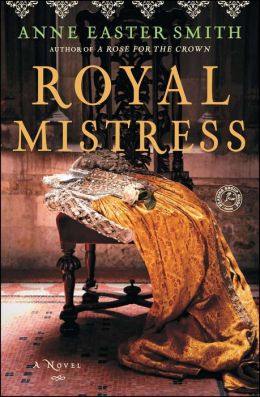
Royal Mistress (2013)

Royal Mistress. Anne Easter Smith. 2013. Simon & Schuster. 489 pages. [Source: Review Copy]

Royal Mistress is not my favorite historical novel set during this dramatic time in English history--the reign of Edward IV and Richard III. Half the novel is seen through the eyes of Jane Shore, the mistress to King Edward. The shifting between characters was necessary to tell the full story, to round it out, in places but it was also uneven. It was odd to spend so much time with just Jane's point of view, and then suddenly shift into the mind of Richard, for example, or Hastings, or whomever.

Edward IV has never been a favorite of mine. The more I read about him, the more disgusting I find him. And in a way, I feel the same towards Jane Shore. I didn't exactly look upon her with favor. Royal Mistress, of course, presents her completely sympathetically. She's presented as more than beautiful, having a certain something, a definite wit that every single man--no matter his marital status--finds irresistible.

The book opens with Jane Shore falling madly, deeply in love with Sir Thomas Grey (Elizabeth Woodville's eldest son by a previous marriage, the stepson of Edward IV). Though she's only seen him the one time, though she's only spent at most half an hour with him, she knows it is TRUE LOVE. And she knows that he just HAS to feel the same way about her. So when they next meet privately, it is humiliating. She essentially telling him, you better hurry and go see my father and tell him you want to marry me! I've not stopped thinking about you since we met! I can't wait to be your wife! It will be so fun to yours forever and ever! After awkward silence on his part, he essentially says: I never said I wanted to marry you! Where did you get that idea! I thought when you said you wanted to meet, you wanted to be in my bed, of course! That's all I care about. True, I've been thinking of you since we met last week, but I've been thinking about getting you in bed. When she next hears from him, she eagerly goes to him: YOU CHANGED YOUR MIND! You do love me! You want to marry me! Again awkward silence, his response: I told you I am not interested in marrying you. I thought you would have changed YOUR mind by now. Oh, by the way, I'm married.

Jane does get married; she gets married to a man of her father's choosing, a business arrangement. Her husband being a lot more interested in what he can get out of the marriage. He is shown as having no interest in Jane as a woman, as a wife, as the future mother of his children. There are plenty of awkward conversations, Jane starts them, of course. Her husband, William Shore, wanting to run away from her as fast as possible whenever she starts asking why or complaining.

Jane happens to catch the attention of Lord Hastings (Will Hastings). She is not as easy to persuade into a life of sin as he initially thought, so nothing comes of it. Except that he talks a lot about her to the King. The King sees her. The King wants her. The King sends for her. He sends a present along with his note. She comes. She comes oh-so-willingly.

Since I do not care for smut, you can imagine I did not care for most of the novel.

So how does the novel present Richard III. Well, Jane hates him because Richard looks unfavorably upon her. Richard hated the fact that Edward was so immoral, so unfaithful. Jane now represents the immorality of his brother's reign. BUT. While Jane hates Richard III. Through other perspectives, the author reveals several things: 1) That Richard III is innocent of killing the princes in the tower; she places the blame on Henry Stafford (Buckingham). 2) That the pre-contract with Eleanor Butler was real; that Edward IV's marriage to Elizabeth Woodville should not have been allowed, and was in fact illegitimate, that the king and one or two of his closest knew this and did all they could to cover it up forever. 3) That when Richard III learned the truth--it is presented as truth--that changed everything. Richard had more of a right than an illegitimate boy.

Though I didn't exactly care for Jane Shore through most of the book, I did find the last part of the novel to be fascinating.

You might find The Tragedy of Jane Shore by Nicholas Rowe to be interesting.


© 2013 SukaYuka.com of SukaYuka's Book Reviews
Tuesday, August 6, 2013

Cotillion (1953)

Cotillion. Georgette Heyer. 1953/2007. Sourcebooks. 362 pages. [Source: Review Copy]

Cotillion was one of the first Georgette Heyer novels I ever read. I appreciated it even more as a reread. When I (first) read Cotillion, I didn't know Heyer yet; I didn't LOVE Heyer yet. I didn't know her style, her wit, her techniques. Now I do. And it made quite the difference. In my first review, I complained about the slow start. Now, I see Cotillion as being a joy from the very start! I now love it cover to cover!!!

I love how Cotillion begins: with some confusion and a bit of a fuss. A room full of men talking about their eccentric great-uncle, about his money and his will, about his ward, Miss Kitty Charing. Almost all the men in the room feel they know the reason they were invited to visit. Great-Uncle Matthew wants one of his great-nephews to propose to Miss Kitty. The happy couple will receive an inheritance. Otherwise, he will leave his money to charity. Not all the men are eligible. At least one is married already. Not all the men are willing. Three potential suitors are noticeably missing from the party. One of the three is a soldier, he never is part of the story. The other two, however, are key players! Freddy Standen and Jack Westruther. Several proposals are given that weekend...

Freddy Standen is late in arriving. In fact, Miss Kitty encounters him only because she is running away from home. (The whole situation is so embarrassing for her!) He was clueless about the weekend, about the reason for the family get together. Miss Kitty has an aha moment. She does something surprising: she proposes to him. She convinces him that a FAKE betrothal would be just the thing. She could go with him to London, to stay with his family; she could see the sights, she could go shopping, she could go to parties, she could have a life. The betrothal would only last a month or so at most. Just enough for her to have a great time away from home. Perhaps just long enough to make a certain other 'cousin' jealous. He says yes. It's a reluctant yes; Freddy isn't as clever at scheming as Miss Kitty. (And this is Miss Kitty's very first scheme! But it won't be her last...)

Cotillion was enjoyable from start to finish!!! The ending is oh-so-satisfying!!! I enjoyed Miss Kitty and I adored Freddy! I would definitely recommend this one.


© 2013 SukaYuka.com of SukaYuka's Book Reviews

Friday, August 2, 2013

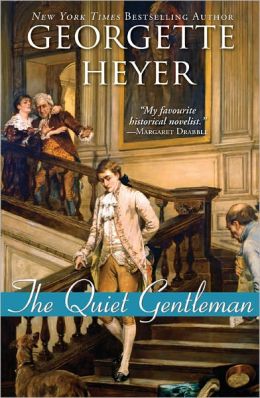
The Quiet Gentleman (1951)

The Quiet Gentleman. Georgette Heyer. 1951/2005. Arrow. 320 pages. [Source: Library]

This year I am attempting to read all of Georgette Heyer's historical romances in chronological order. The Quiet Gentleman is one of the few I had not read before. (Though it seems very familiar to me.) Gervase Frant is the Seventh Earl of St. Erth. He is his father's heir, despite not always being on the best of terms with him. He has a half-brother, Martin, who was more of the favorite. A year after his father's death, Gervase has returned to England from the war. His family--his step-mother, his half-brother, his half-sister, his cousin--were all hopeful that he would have died in battle by now. Why couldn't he have died? It's just not fair. From the very first night back in his old home, Gervase receives friendly warnings from his cousin, Theo, warnings about how his very life is in danger.

The entire book chronicles the failed attempts on his life. Someone wants him dead, but they are doing a clumsy job of it. There are a few other things that happen in the book, readers meet various young men and women who are courting one another, a ball is held, I believe, but mainly The Quiet Gentleman attempts to be a mystery.

I see The Quiet Gentleman as one of Georgette Heyer's weaker novels. Heyer has successfully made her romances mysteries before. And she's told stories mainly from a male point of view before. It didn't work for me because I guessed the would-be-murderer from the very first. It took Gervase about three-hundred pages to reach the same conclusion. However, I really enjoyed Druscilla, the heroine. Perhaps if she'd been the narrator, I would have liked it more?

© 2013 SukaYuka.com of SukaYuka's Book Reviews

Tuesday, July 23, 2013

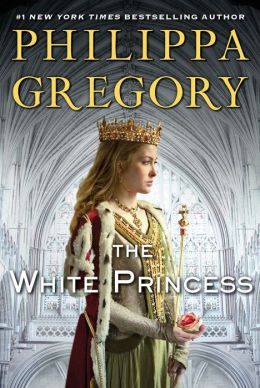
The White Princess (2013)

The White Princess. Philippa Gregory. 2013. Simon & Schuster. 544 pages. [Source: Review Copy]

I have enjoyed each book in Philippa Gregory's Cousins' War series. I think I have enjoyed each book a little bit more as the series has progressed. The first book being my least favorite--from this series--and the last book probably being my most favorite. The series consists of:  The White Queen by Philippa Gregory, The Red Queen by Phillipa Gregory,  The Lady of the Rivers by Philippa Gregory, and The Kingmaker's Daughter by Philippa Gregory. The White Princess tells the story of Elizabeth York; she is the daughter of Edward IV and Elizabeth Woodville; the sister of the two princes in the tower; the niece of Richard III; the wife of Henry VII; the daughter-in-law of Margaret Beaufort; the mother of Henry VIII. To say her life was messy and complicated, well, that wouldn't even begin to explain it all. But Philippa Gregory gives her a voice, fictional though it may be. And her story is something.

When readers first meet Elizabeth, she is mourning the death of Richard III. The novel taking the position that Elizabeth and Richard were in love with each other, and would have in fact married if the battle had gone a different way. Elizabeth knows that her marriage with Henry VII makes sense politically for both families. The York family being popular and beloved, and, the Tudor family being 'merely' conquerors--outsiders. But the thought of love is far from her mind. And Henry VII isn't exactly wooing her well. The book is fictional, and I'm curious if there is any basis in reality for this depiction? (And it's on the advice of his mother!) The two marry, of course, and children quickly follow. The main focus of the novel is on her private life, her role as a wife, mother, queen in a very uncertain court. Henry VII is depicted as being anxious and a bit obsessed. His concern that he'll be defeated in battle. That the York family will in some way or other will dethrone him, win back control, etc. His obsession with "the boy" that may or may not be Richard, duke of York.

The novel spans over a decade: 1485-1499. And it does address in some ways, the fate of the boys in the tower.

I definitely loved this one. I found it very compelling! It is such a fascinating period in history!

Favorite quotes:
"What I don't have I will write myself. I will write this boy's parentage into his story, I will create it: common people, nasty people. The father a bit of a drunk, the mother a bit of a foot, the boy a bit of a runaway, a wastrel, a good-for-nothing. D'you think I can't write this and get someone--a drunk married to a fool--to swear to it? Do you think I can't set up as historian? As storyteller? D'you think I can't write a history which years from now, everyone will believe as the truth? I am the king. Who shall write the record of my reign if not me?" (329)
"It doesn't matter who Henry is facing. Whether it is my mother's favorite boy or another mother's son. What matters is that you have not made your boy the beloved of England. You should have made him beloved and you have not done so. His only safety lies in the love of his people, and you have not secured that for him." (403)


© 2013 SukaYuka.com of SukaYuka's Book Reviews
Monday, March 18, 2013

Faro's Daughter (1941)

Faro's Daughter. Georgette Heyer. 1941. 288 pages.

I absolutely loved Georgette Heyer's Faro's Daughter. In the first chapter, readers meet Mr. Ravenscar (Max) as he visits with his sister, Lady Mablethorpe. She wants him to to prevent an imprudent match of his nephew with an unsuitable young woman, Deborah Grantham. This "vulgar" woman lives in a gaming house with her aunt! He goes to visit the young lady in the gaming house, even gambles with her for a while. His conclusion: she's not a good match for a gentleman, certainly, but she might be easily bought off. Instead of talking with his nephew, he'll talk to her instead and offer her money if she promises to never marry the boy.

Readers just don't see this from his point of view, however, readers also get to meet Deborah for themselves. And Deborah finds Ravenscar's offer insulting and infuriating. How dare he assume she could be bought off! Though she hadn't any plans on marrying Adrian, she know plans to do just that. Well. If she has to. She's hoping that that won't be necessary after all. If only she could get Adrian to fall in love with someone else...

Ravenscar and Deborah hate each other so much, their interactions are so intense. They bring out the worst in each other...

I loved this one so much! It's a great read cover to cover. So many interesting characters and stories.

Read Faro's Daughter
  • If you love Pride and Prejudice, North and South, Much Ado About Nothing, etc. Romance stories where the hero and heroine HATE each other before they fall in love...
  • If you enjoy Georgette Heyer
  • If you enjoy Regency romances, historical romances
© 2013 SukaYuka.com of SukaYuka's Book Reviews

Thursday, March 14, 2013

The Corinthian (1940)

The Corinthian. Georgette Heyer. 1940/2009. Sourcebooks. 261 pages.

 In The Corinthian, we've got a bachelor, Sir Richard Wyndham, who happens to rescue a damsel in distress, Penelope Creed. Penelope set on running away from her aunt--who is encouraging her into a loveless marriage with her cousin Fred--is disguised as a boy. Richard, while on his way home and a bit drunk at that, sees Pen climbing out her window--by way of her bed sheets of course. He "catches" her just in time. Granted, this "she" is dressed as a he. But there's no fooling Richard. A bit amused at the situation, and wanting to run away himself to avoid an unpleasant appointment the next day, he decides to help out. She wants to escape London--and her aunt--and travel to Bristol (or near Bristol anyway). She's got a childhood friend, Piers, who she fancies herself madly in love with. Five (or so) years ago, these two promised themselves to each other. Hearing this tale, Richard decides to join in the journey and ensure her safety. The two will go together. He will act as her tutor-uncle-cousin and 'protect' her along the way. (Each identity is used on their journey at various stages.) Their journey is rarely boring--they get in and out of trouble along the way.

This one is a delightful romantic comedy. I LOVE, LOVE, LOVE this one! I love Pen Creed. I love Sir Richard. The dialogue is just too much fun in this Regency romance!

A scene between Pen and Richard:
"Were you locked in your room?" enquired Sir Richard.
"Oh no! I daresay I should have been if Aunt had guessed what I meant to do, but she would never think of such a thing."
"Then--forgive my curiosity!--why did you climb out of the window?" asked Sir Richard.
"Oh, that was on account of Pug!" replied Pen sunnily.
"Pug?"
"Yes, a horrid little creature! He sleeps in a basket in the hall, and he always yaps if he thinks one is going out. That would have awakened Aunt Almeria. There was nothing else I could do."
Sir Richard regarded her with a lurking smile. "Naturally not. Do you know, Pen, I owe you a debt of gratitude?"
"Oh!" she said again. "Do you mean that I don't behave as a delicately bred female should?"
"That is one way of putting it, certainly."
"It is the way Aunt Almeria puts it."
"She would, of course."
"I am afraid," confessed Pen, "that I am not very well-behaved. Aunt says that I had a lamentable upbringing, because my father treated me as though I had been a boy. I ought to have been, you understand."
"I cannot agree with you," said Sir Richard. "As a boy you would have been in no way remarkable; as a female, believe me, you are unique."
She flushed to the roots of her hair. "I think that is a compliment."
"It is," Sir Richard said, amused.
"Well, I wasn't sure, because I am not out yet, and I do not know any men except my uncle and Fred, and they don't pay compliments. That is to say, not like that." (68-69)
Fred Griffin in conversation with Sir Richard:
"What, sir, would you think of a member of the Weaker Sex who assumed the guise of a man, and left the home of her natural protector by way of the window?"
"I should assume," replied Sir Richard, "that she had strong reasons for acting with such resolution."
"She did not wish to marry me," said Mr. Griffin gloomily.
"Oh!" said Sir Richard.
"Well, I'm sure I can't see why she should be so set against me, but that's not it, sir. The thing is that here's my mother determined to find her, and to make her marry me, and so hush up the scandal. But I don't like it above half. If she dislikes the notion so much, I don't think I ought to marry her, do you?"
"Emphatically not!"
"I must say I am very glad to hear you say that, Sir Richard!" said Mr. Griffin, much cheered. "For you must know that my mother has been telling me ever since yesterday that I must marry her now, to save her name. But I think she would very likely make me uncomfortable, and nothing could make up for that, in my opinion."
"A lady capable of escaping out of a window in the guise of a a man would quite certainly make you more than uncomfortable," said Sir Richard.
"Yes, though she's only a chit of a girl, you know. In fact, she is not yet out. I am very happy to have had the benefit of the opinion of a Man of the World. I feel that I can rely on your judgment."
"On my judgment, you might, but in nothing else, I assure you," said Sir Richard. "You know nothing of me, after all. How do you know that I am not now concealing your cousin from you?"
"Ha-ha! Very good, upon my word! Very good, indeed!" said Mr. Griffin, saluting a jest of the first water. (124)

Read The Corinthian
  • If you enjoy Regency romances
  • If you enjoy historical romance
  • If you enjoy historical romance with a touch of drama, mystery, and murder...
  • If you enjoy Georgette Heyer
© 2013 SukaYuka.com of SukaYuka's Book Reviews