Showing posts with label 1958. Show all posts

Wednesday, October 16, 2013

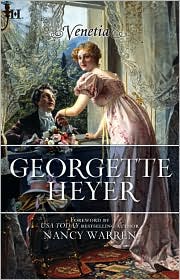
Rereading Venetia Again

Venetia. Georgette Heyer. 1958/2009. Harlequin. 368 pages. [Source: Gift] 

This is my third review of Venetia. (I've read the book three times and listened to the audio book once. It was narrated by Richard Armitage.)

It is my FAVORITE Georgette Heyer novel. There are many I'd place in my top five, but, really no other book comes close to being consistently in the top slot.

Venetia is our heroine. I love her. I do. She is twenty-five and managing the estate in her older brother's absence. She is also looking out for her younger brother, Aubrey, who is just seventeen. There is something very practical and matter-of-fact about Venetia. For example, she's very honest about herself, about her family, about life as she sees it. She says things that maybe would shock others in society. She has never been "in society." She's lived an extremely sheltered life in some ways. But she'll be having a grand adventure soon enough!

Venetia is out for one of her daily walks when she is surprised by the....Wicked Baron....Lord Damerel himself. Their first meeting is interesting and dramatic...

The two meet when she is trespassing on his land. He has no idea who she is. But she has a fairly good idea who he is. Especially after he kisses her! Yes, he kisses her.
"Who are you?" he demanded abruptly. "I took you for a village maiden--probably one of my tenants."
"Did you indeed? Well, if that is the way you mean to conduct yourself amongst the village maidens you won't win much liking here!"
"No, no, the danger is that I might win too much!" he retorted. "Who are you? Or should I first present myself to you? I'm Damerel, you know."
"Yes, so I supposed, at the outset of our delightful acquaintance. Later, of course, I was sure of it."
"Oh, oh--! My reputation, Iago, my reputation!" he exclaimed laughing again. "Fair Fatality, you are the most unusual female I have encountered in all my thirty-eight years!"
"You can't think how deeply flattered I am!" she assured him. "I daresay my head would be quite turned if I didn't suspect that amongst so many a dozen or so may have slipped from your memory."
"More like a hundred! Am I never to learn your name? I shall, you know, whether you tell me or no!" (33)
He intends to know her better while he's in the neighborhood. When her brother, Aubrey, has a riding accident and is saved by none other than Damerel...well, she can't help getting to know him much, much better. And soon they become great friends.

Lord Damerel isn't the only newcomer to the neighborhood. Soon Venetia and Aubrey welcome TWO very unexpected house guests. Conway has gotten married--her name is Charlotte. And Charlotte and her mother have come to stay at Undershaw. And the mother is quite the character. How long can Venetia stand to share a home with such a woman? Venetia begins to think about her options...and wishing it was more socially acceptable for her to set up her own home.

I love this one so much. I love Venetia. I love Lord Damerel. I love Aubrey. I love picking on Edward Yardley and Oswald Denny. It's such a fun and satisfying romance!!! 

Quotes:
Startled, she turned her head, and found that she was being observed by a tall man mounted on a handsome gray horse. He was a stranger, but his voice and his habit proclaimed his condition, and it did not take her more than a few moments to guess that she must be confronting the Wicked Baron. She regarded him with candid interest, unconsciously affording him an excellent view of her enchanting countenance. His brows rose, and he swung himself out of the saddle, and came towards her with long, easy strides. She was unacquainted with any men of mode, but although he was dressed like any country gentleman a subtle difference hung about his buckskins and his coat of dandy gray russet. No provincial tailor had fashioned them, and no country beau could have worn them with such careless elegance. He was taller than Venetia had at first supposed, rather loose-limbed, and he bore himself with a faint suggestion of swashbuckling arrogance. (30)
He laughed out at that, flinging back his head in wholehearted enjoyment, gasping, "why, oh why did I never know you until now?"
"It does seem a pity," she agreed. "I have been thinking so myself, for I always wished for a friend to laugh with."
"To laugh with!" he repeated slowly.
"Perhaps you have friends already who laugh when you do," she said diffidently. "I haven't, and it's important, I think--more important than sympathy in affliction, which you might easily find in someone you positively disliked."
"But to share a sense of the ridiculous prohibits dislike--yes, that's true. And rare! My God, how rare! Do they stare at you, our worthy neighbors, when you laugh?"
"Yes! Or ask me what I mean when I'm joking!" She glanced at the clock above the empty fireplace. "I must go." (64)
"Oh, no, nothing of that nature!" she replied, getting up.
"I allow you all the vices you choose to claim--indeed, I know you for a gamester, and a shocking rake, and a man of sadly unsteady character!--but I'm not so green that I don't recognize in you one virtue at least, and one quality."
"What is that all? How disappointing! What are they?"
"A well-informed mind, and a great deal of kindness," she said, laying her hand on his arm, and beginning to stroll with him back to the house. (99)
© 2013 SukaYuka.com of SukaYuka's Book Reviews

Friday, September 20, 2013

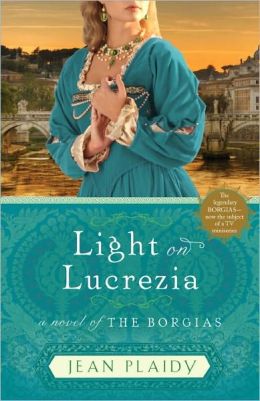
Light on Lucrezia (1958)

Light on Lucrezia: A Novel of the Borgias. Jean Plaidy. 1958/2011. Crown. 384 pages. [Source: Bought]

Light on Lucrezia is the sequel to Madonna on the Seven Hills. The novel opens with the moody Lucrezia preparing for her second marriage. The marriage has been arranged for her by her father, the Pope. She happens to be marrying Sanchia's brother, Alfonso. (Sanchia is her sister-in-law.) The two are a great couple; however, Lucrezia isn't to be allowed her happily ever after for politics and family interfere once again. After her husband's murder, Lucrezia's life is a bit of a mess. A third marriage is arranged after a time, but, it's less than ideal. At least as depicted by Plaidy! But though Lucrezia's fate is the happiest of the Borgia family, that really is not saying much considering what happens...

Reading Light On Lucrezia is like suffering through the last half of Gone With The Wind. There are highlights, of course, but overall it just gets more depressing and hopeless with every single chapter until the dreariest of endings. Is the ending inevitable? Sure. It is (very loosely) based on history. Cesare's fate is set in stone. And Lucrezia's childbearing misfortunes are realistic enough, but it was so very sad to read of all the miscarriages and the babies that died so very young. 

Madonna of the Seven Hills and Light on Lucrezia have recently been published as one novel. Plaidy's depiction of the Borgias is interesting. They have their fascinating-but-troubling moments to shine. And the first novel, at least, had some lightness and frivolity to it. I think Plaidy's characterization is better than say, The Borgia Bride, but not as wonderful as Blood and Beauty.  I really want Sarah Dunant to write another Borgia novel!!!

© 2013 SukaYuka.com of SukaYuka's Book Reviews

Thursday, September 19, 2013

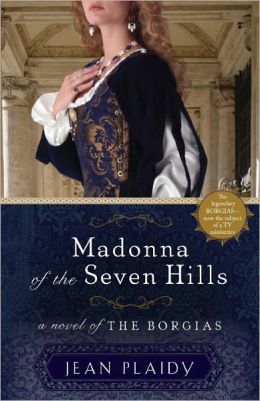
Madonna of the Seven Hills (1958)

Madonna of the Seven Hills: A Novel of the Borgias. Jean Plaidy. 1958/2011. Broadway. 320 pages. [Source: Bought]

What disturbs me most about Madonna of the Seven Hills is that Jean Plaidy bothered listing The Life of Cesare Borgia by Rafael Sabatini in her bibliography. If indeed she read the biography, she chose to disregard it completely. For this novel breaks all of Sabatini's rules. This novel thrives on the LEGENDARY sins of the Borgia family. It builds up this fantastical, sensational notion of what the family was like.  The most sympathetically presented is, of course, Lucrezia.

Two of Plaidy's novels are devoted to Lucrezia Borgia. The second is Light on Lucrezia. This novel tells her story up to the point of her (supposed) mysterious pregnancy following her scandalous divorce. It ends with her learning that the father of the child (supposed father, I should say) has been murdered by her family (presumably Cesare) and so has her maid because she knew too much.

Obviously, Madonna of the Seven Hills is SO MUCH BETTER than a certain romance novel I read in the summer, The Borgia Bride.  (That one was so awful). The characterization might be a bit biased, assuming that Cesare and Rodrigo are always up to no good and almost certainly being immoral or unwise, but it wasn't completely unpleasant either. Cesare comes across as mad, bad, and dangerous to know. Plaidy was perhaps, in her own little way, presenting him as the ultimate swoon-worthy bad boy. So Cesare and Rodrigo though they are presented as murderers and poisoners come across as quite likable at times. I found her presentation of Sanchia to be quite entertaining!

The book was a quick read. I didn't necessarily agree with her conclusions and presentation. But it was entertaining.

Quotes:
She, who had known so many men that she read them easily, was aware of this, and she determined now to make Cesare forget his ambitions in his pursuit of her. They were both experienced, and they would find great pleasure in surprising each other by their accomplishments. Each was aware of this as they danced; and each was asking: Why delay longer? Delay was something which neither of them would tolerate.
"You are all that I heard you were," Sanchia told him.
"You are all that I hoped you would be," he answered her.
"I wondered when you and I would be able to talk together. This is the first time it has happened, and all eyes are on us now."
"They were right," said Cesare, "when they said you were the most beautiful woman in the world."
"They were right when they said there was something terrifying about you."
"Do you find me terrifying?"
She laughed. "No man terrifies me."
"Have they always been so kind?"
"Always," she said. "From the time I was able to talk, men have been kind to me."
"Are you not weary of my sex, since you know it so well?"
"Each man is different from all others. That is what I have found. Perhaps that is why I have always discovered them to be so fascinating. And none that I have ever known has been remotely like you, Cesare Borgia; you stand apart."
"And you like this strangeness in me?"
"So much that I would know it so well that it ceases to be strangeness and is familiar to me."
"What tales have you heard of me?"
"That you are a man who will never take no for an answer, that men fear your frown, and that when you beckon a woman she must obey, in fear if not in desire. I have heard that those who displease you meet ill fortune, that some have been discovered in alleys, suffocated or with knives in their bodies. I have heard that some have drunk wine at your table and have felt themselves to be merely intoxicated, only to learn that they are dying. These are the things I have heard of you, Cesare Borgia. What have you heard of me?"
"That you practice witchcraft so that all men whom you desire fall under your spell, and that having once been your lover none can ever forget you."
"And do you believe these tales of me?"
"And do you believe the tales of me?"
She looked into his eyes and the flame of desire in hers was matched by that in his.
"I do not know," she said, "but I am determined to discover."
"Nor do I know," he answered; "and I think I am as eager to make my discoveries as you are."
His hand tightened on hers.
"Sanchia," he said, "this night?"
And she closed her eyes and nodded. (190-91)
© 2013 SukaYuka.com of SukaYuka's Book Reviews