Showing posts with label Historical Fiction. Show all posts

Friday, January 31, 2014

Reread #5 A Woman's Place

A Woman's Place. Lynn Austin. 2006. Bethany House. 450 pages. [Source: Book I Bought]

I first read and reviewed A Woman's Place in August 2007. I absolutely loved, loved, loved this book. And why wouldn't I?! After all, it's a book set during one of my favorite historical periods: World War II. The focus is on women on the American homefront: how the war effected women's lives in and out of the home. This book seems to be a written-just-for-me book. So, of course, I adored it.

Four women. Four very different, unique women come together as a team at Stockton Shipyards. With proper training, these four women will be helping build ships, ships that will help the Allied Forces win the war. An end to war is all these women want. Well, they'd also like a little respect and some justice.

From the original review:

Ginny, or "Virginia" as her husband insists on calling her, is a housewife in her thirties who feels underappreciated and unloved.

Helen is a woman in her fifties who is wealthy and bitter and angry.

Rosa is a young newlywed from Brooklyn. She met a young man in the Navy and suddenly finds herself living with her inlaws while the war is on.

And Jean is fresh out of high school--fresh from the farm, one of eighteen children. She has six brothers enlisted in various branches of the service.

Each woman finds herself employed at Stockton Shipyards. Each has felt called to serve her nation. Each one is there for their own personal reasons as well. Ginny is lacking self confidence, but seems to bloom under the circumstances of hard work and friendship. Rosa is a bit unwieldy at times but in need of love and guidance and wisdom from older women. Helen is there trying to escape the bitter aloneness she feels in her large home--one she inherited from a father that she hated. And Jean, well, Jean is trying to figure out what she wants for herself. Her boyfriend back home doesn't see any reason for her to go to college, to get an education. He doesn't see much point in her working so far away from home either--all the way from Indiana to Michigan. But Jean, Jean is finding herself, finding her independence.

Each character was well-developed. Each character was complex. Each circumstance was complex. Very different women, very different backgrounds. But one common goal. I loved how this novel came together--pieced together. How four women's lives were able to touch and connect and encourage and build up one another. Each woman's life was changed because of the others. Each one learned how important, how significant, how loved they really and truly were.

© 2014 SukaYuka.com of SukaYuka's Book Reviews

Tuesday, January 28, 2014

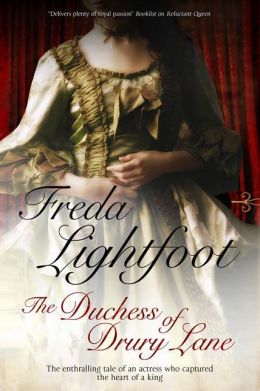
Duchess of Drury Lane (2013)

Duchess of Drury Lane. Freda Lightfoot. 2013. Severn House. 256 pages. [Source: Library]

I enjoyed reading The Duchess of Drury Lane. I liked that it was written in first person. This doesn't always work for me, but, in this case it did. Readers meet a young woman who becomes a famous actress on the stage. She was known by several different names in her life, and, I believe at least two or three different stage names. (The book jacket calls her 'Dorothy Jordan' but usually in the text she's Dora.) The first third of the book focuses on her life before discovery. To help her family earn enough money, she became an actress on the stage like her mother before her. She found she could do comedy quite well, and, her singing voice could charm audiences. Unfortunately, unwanted attention from her employer led to pregnancy. When her mother learned the truth, they fled the scene and started new lives elsewhere. Her debts to her old boss were eventually paid, however, by a new employer. The rest of the novel focuses on her successes mostly on stage and her perhaps regrettable choices off stage. She fell for a man who promised marriage but didn't deliver, even after she gave birth to his two children. Eventually, that relationship soured and she was persuaded to become the mistress of the Duke of Clarence. In all fairness, her relationship with William (William IV in later years) could not end with marriage. George III made it almost impossible for his brothers and sisters and sons and daughters to marry. The two lived as if they were married (without official sanction, of course) for almost two decades, I believe. She continued on stage for most of her life. Her income was too necessary for her family, for William and their children, for her children from previous relationships, for her own siblings. This book should prove interesting to anyone with an interest in the theatre during the Georgian era.

© 2014 SukaYuka.com of SukaYuka's Book Reviews
Tuesday, January 21, 2014

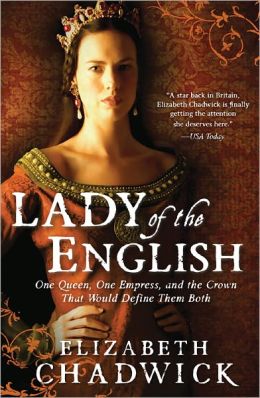
Lady of the English (2011)

Lady of the English. Elizabeth Chadwick. 2011. Sourcebooks. 544 pages. [Source: Library]

Lady of the English is set during the dispute between Empress Matilda (Henry I's daughter) and King Stephen (Henry I's nephew). These two cousins (through their armies) fought bitterly for the throne of England starting in 1135. Last year, I read one adaptation of that conflict--though it was a bit ridiculous, Passionate Enemies by Jean Plaidy. Lady of the English is told mainly through two perspectives: Empress Matilda (the mother of Henry II) and Queen Adeliza (the widow of Henry I, Matilda's stepmother). Half the book is focused on Matilda's struggle with Stephen, her complicated relationship with her husband, Geoffrey of Anjou, her trying (but not too hard) to balance being a mother with being a strong political/military force to be reckoned with. Readers do spend time with her son, Henry, who would in good time become the next King. The other half of the book is focused on Adeliza's second marriage with William d'Aubigny. Adeliza was a supporter of Matilda; her husband a supporter of King Stephen. But these two were devoted to one another and had quite a large family, especially considering that she was the "barren" wife of Henry I. If Lady of the English is considered a "romance" novel, it would be because of this match.

The battle between Stephen and Matilda is not resolved in this novel. The novel just seems to stop suddenly in the middle of the story. I'd love the chance to read the rest of the story through Matilda's perspective!

I enjoyed this one for the most part. Lady of the English is not a "clean" read, however, there is so much history, so much historical detail, that it is easy to overlook the small percentage of smut when all is considered.

© 2014 SukaYuka.com of SukaYuka's Book Reviews
Tuesday, January 14, 2014

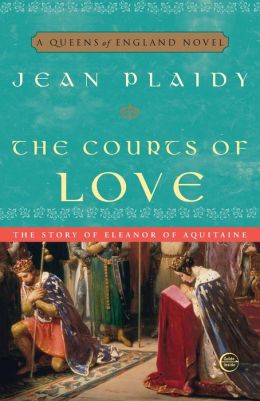
The Courts of Love (1987)

The Courts of Love. Jean Plaidy. 1987. Broadway Books. 576 pages. [Source: Bought]

When I look back over my long and tempestuous life, I can see that much of what happened to me--my triumphs and most of my misfortunes--was due to my passionate relationships with men. I was a woman who considered herself their equal--and in many ways their superior--but it seemed that I depended on them, while seeking to be the dominant partner--an attitude which could hardly be expected to bring about a harmonious existence. 

The Courts of Love is told in first person; it is told exclusively, I believe, through the eyes of Eleanor of Aquitaine.

The Courts of Love has such a different feel from the other Plaidy novels I've read lately. It seems more sophisticated, more tasteful, more literary than the three books in the Norman series. And I must admit that The Courts of Love, which stars Eleanor of Aquitaine and Henry II, was more interesting than Caroline the Queen. Though in some ways it feels "classier" that does not mean it's not sensual, it just refrains some of the ridiculousness. (Plaidy is NOT graphic in details; she's very matter-of-fact and succinct.)

Eleanor is an interesting narrator. The novel begins with her life in the court of her grandfather, I believe. It follows her life through her marriages; her first marriage to the king of France and her second marriage to Henry II. (He was not king quite yet. The battle between Stephen and Matilda was still ongoing.) Readers also get to see Eleanor in the role of mother. While she did not have a place in her life for her two children with the King of France, she had plenty of children with Henry. It felt like she was ever-pregnant for almost half of the novel! The last third of the novel focuses on King Richard and King John.

Eleanor was definitely not presented as a saint. (I found the bit with her uncle to be quite disturbing.) Henry II was definitely not a saint either. Even before he "unintentionally" suggested that Thomas Becket should be taken care of permanently. Henry II and Eleanor had a strange relationship. There was passion in abundance, but horribly bitter bickering. The two would eventually separate, but not in the way you might expect. She was a prisoner of her husband for over a decade! Henry II, meanwhile, presided at court with his favorite mistresses nearby.

I am glad I read this one! Have you read any Jean Plaidy novels? Do you have a favorite? Which would you recommend? 

© 2014 SukaYuka.com of SukaYuka's Book Reviews
Tuesday, January 7, 2014

The Revolt of the Eaglets (1977)

The Revolt of the Eaglets. Jean Plaidy. 1977. 320 pages. [Source: Bought]

I have not read the first novel in Plaidy's Plantagenet series. The Revolt of the Eaglets is the second in the series. It opens with the King Henry II learning of the murder of Thomas Becket, and it ends with his own death, or, news of his death reaching his prisoner-wife Eleanor. The novel is focused on the strife between Henry and his family. Any "love" once felt for his wife, Eleanor, the mother of all his legitimate children, has vanished now that she's older and past her usefulness. The two live separate lives for a short time, but, he eventually holds her prisoner. HATE isn't too strong a word for how these two feel towards one another! It is also focused on "Young Henry" (the oldest son and heir), Richard, Geoffrey, and John. Henry II had a "brilliant" idea to have his heir crowned king. Having two crowned monarchs is a big, big mess. It does not inspire family harmony. The son has no actual power, authority, dominion, or independence. Richard is another son that comes into the story quite a bit. Oh the plotting and scheming that goes on...as his sons "turn" against their father and fight for what is "theirs" by right. Is it horrible for sons to turn against their fathers and lead armies? Of course. But the truth is it is hard to find good excuses for Henry II's bad behavior. Plaidy is very matter-of-fact about his weaknesses, mistakes, or sins.

What might be hardest for modern readers to understand is Henry's relationship with Alice. Richard and Alice were betrothed to each other as young children. She is a French princess. She leaves France to live in England at a young age. When the king first takes notice of his future daughter-in-law she is eleven or possibly twelve. It is lust pure and simple. The book presents the seduction (without graphic details, but what is there is CREEPY ENOUGH) very matter of fact without judgment or commentary. Alice believes this special but must keep it secret attention is marvelous. She expects to be made Queen one day. Alice and Henry's relationship continues throughout the book.

Readers get a glimpse of British history and French history. It isn't always a cozy, satisfying glimpse. But it was an interesting read with plenty of characters.

© 2014 SukaYuka.com of SukaYuka's Book Reviews

Tuesday, December 31, 2013

Bluffton (2013)

Bluffton: My Summer with Buster Keaton. 2013. Candlewick Press. 240 pages. [Source: Review Copy]

Bluffton is a graphic novel with a historical setting (1908-1910?). The book focuses on the summer vacations of a young Buster Keaton. These special summer days are told not from his point of view, however, but from a local boy named Henry Harrison who absolutely idolizes the show people.

Henry Harrison is thrilled when a troupe of vaudeville performers settles down to summer near Muskegon, Michigan. There are boys his own age among the troupe. One of these boys is Buster Keaton. Henry had not heard of Buster before, but he becomes mesmerized by his new friend. Buster? Well, he enjoys clowning around and making the local folk laugh now and then, but, mainly he wants to play ball. He wants to play, have fun, relax. He's shown as wanting to pack a whole summer into each and every day. I got the impression that Henry didn't really see things clearly; he saw what he wanted to see: the glamor, the wow.

The story of several summers (and winters) are told through art and dialogue. An epilogue informs readers of Buster Keaton's transition from stage to film.


© 2013 SukaYuka.com of SukaYuka's Book Reviews
Thursday, December 26, 2013

I Will Repay (1906)

I Will Repay. Baroness Orczy. 1906. 220 pages. [Source: Book I Bought]

As much as I love, love, love The Scarlet Pimpernel movie adaptations, I didn't quite love the novel. I wasn't quite sure if I wanted to read the sequels. I procrastinated a very long time. But once I decided to actually read I Will Repay, it was a quick read: two days!

What you should know: First, the Scarlet Pimpernel does make an appearance, but, you have to be really, really patient because he is a long time in coming. Second, it is a romantic adventure set during the French Revolution, emphasis on the romance. If you HATE romance, if you hate the drama and dialogue found in romance novels, then this one might not be for you. But. If you do, you're in for a real treat!

The prologue starts ten years or so before the French Revolution. It begins with a "fair" duel between two men. The hero, Paul Déroulède, is a reluctant participant. But the other guy, Vicomte de Marny is not backing down at all, is determined to make the fight to the death, if you will. He dies. His father makes his young daughter promise to get revenge on her brother's murderer. Her name is Juliette de Marny.
"Repeat the words after me, my child." "Yes, father." "Before the face of Almighty God, who sees and hears me ..." "Before the face of Almighty God, who sees and hears me," repeated Juliette firmly. "I swear that I will seek out Paul Déroulède." "I swear that I will seek out Paul Déroulède." "And in any manner which God may dictate to me encompass his death, his ruin or dishonour, in revenge for my brother's death." "And in any manner which God may dictate to me encompass his death, his ruin or dishonour, in revenge for my brother's death," said Juliette solemnly. "May my brother's soul remain in torment until the final Judgment Day if I should break my oath, but may it rest in eternal peace the day on which his death is fitly avenged." "May my brother's soul remain in torment until the final Judgment Day if I should break my oath, but may it rest in eternal peace the day on which his death is fitly avenged."
Ten years later, Juliette has finally found him, found a way to get close to him. He "saves" her from an angry mob, invites her into his home, introduces her to his family. She remains with him, getting close, for a bit. She begins to develop her plan. Meanwhile, of course, he is falling madly in love with her...
"Gratitude? What have I done?" "You committed a foolish, thoughtless act outside my door, and gave me the chance of easing my conscience of a heavy load." "In what way?" "I had never hoped that the Fates would be so kind as to allow me to render a member of your family a slight service."
"I always meant to tell you," he continued somewhat hurriedly; "for it almost seemed to me that I have been cheating you, these last few days. I don't suppose that you can quite realise what it means to me to tell you this just now; but I owe it to you, I think. In later years you might find out, and then regret the days you spent under my roof. I called you childish a moment ago, you must forgive me; I know that you are a woman, and hope therefore that you will understand me. I killed your brother in fair fight. He provoked me as no man was ever provoked before ..."
Not everyone is charmed by this young woman. And the Scarlet Pimpernel has some advice for our hero...
"You are a mad idealist, my dear Déroulède!" "How can I help it? I have lived under the same roof with her for three weeks now. I have begun to understand what a saint is like." "And 'twill be when you understand that your idol has feet of clay that you'll learn the real lesson of love," said Blakeney earnestly. "Is it love to worship a saint in heaven, whom you dare not touch, who hovers above you like a cloud, which floats away from you even as you gaze? To love is to feel one being in the world at one with us, our equal in sin as well as in virtue. To love, for us men, is to clasp one woman with our arms, feeling that she lives and breathes just as we do, suffers as we do, thinks with us, loves with us, and, above all, sins with us. Your mock saint who stands in a niche is not a woman if she have not suffered, still less a woman if she have not sinned. Fall at the feet of your idol an you wish, but drag her down to your level after that—the only level she should ever reach, that of your heart."
I will admit there is drama. But. I enjoyed every moment of it.
Love, the great, the strong, the conquering god—Love that subdues a world, and rides roughshod over principle, virtue, tradition, over home, kindred, and religion—what cares he for the easy conquest of the pathetic being, who appeals to his sympathy? Love means equality—the same height of heroism or of sin. When Love stoops to pity, he has ceased to soar in the boundless space, that rarefied atmosphere wherein man feels himself made at last truly in the image of God.

She would have stilled, an she could, the beating of her heart, which went out to him at last with all the passionate intensity of her great, pent-up love. Every word he spoke had its echo within her very soul, and she tried not to hear his tender appeal, not to see his dark head bending in worship before her. She tried to forget his presence, not to know that he was there—he, the man whom she had betrayed to serve her own miserable vengeance, whom in her mad, exalted rage she had thought that she hated, but whom she now knew that she loved better than her life, better than her soul, her traditions, or her oath. Now, at this moment, she made every effort to conjure up the vision of her brother brought home dead upon a stretcher, of her father's declining years, rendered hideous by the mind unhinged through the great sorrow.

They were all alone these two in the mad and beautiful world, which man has created for himself—the world of romance—that world more wonderful than any heaven, where only those may enter who have learned the sweet lesson of love.
The god of love may be blind, tradition has so decreed it, but the demon of jealousy has a hundred eyes, more keen than those of the lynx.
What neither fear nor remorse, sorrow nor joy, could do, that the great and mighty Shadow accomplished in a trice. Juliette, looking death bravely in the face, held out her hand, and sought that of the man she loved. There was not one word spoken between them, not even a murmur. Déroulède, with the unerring instinct of his own unselfish passion, understood all that the tiny hand wished to convey to him. In a moment everything was forgotten save the joy of this touch. Death, or the fear of death, had ceased to exist. Life was beautiful, and in the soul of these two human creatures there was perfect peace, almost perfect happiness.
I loved this one. I did. It was a perfectly satisfying read. 

© 2013 SukaYuka.com of SukaYuka's Book Reviews
Tuesday, December 24, 2013

Lady of Quality (1972)

Lady of Quality. Georgette Heyer. 1972. Sourcebooks. 300 pages. [Source: Review Copy]

It is finished. My gloriously grand goal of reading all of Georgette Heyer's romance novels in one year, in order of publication! And it ended on a wonderful note as well. Lady of Quality is among the best of her romances. If you enjoy the friction of Much Ado About Nothing and Pride and Prejudice, you may just adore Lady of Quality. Oh how the sparks fly between the hero and heroine! These two who simply can't stand to be in the same room together, right?!

Miss Annis Wychwood is almost thirty years old. And in that time, the Regency period, thirty might as well have been sixty. Spinster is spinster no matter if you're thirty, blond, and witty or wrinkly, gray, and stubborn. But Annis is comfortable in her singleness. Or at least she prefers to see herself as comfortable. It helps that in Annis' situation, she's wealthy enough to have her own house and household. (By household I mean servants and such). If Annis had to live under her brother's roof, well, it would be a different story altogether. She does NOT get along with her brother, Geoffrey, though she does get along in a way with her sister-in-law. Yes, folks might think it a bit strange that she'd rather be independent and living on her own--and a good day's travel away from her brother and his wife--but they've become accustomed to it. But when our novel opens, Annis is about to do something a bit more unexpected, a bit more shocking.

Lucilla Carleton is just a young thing--not even eighteen--when she decides to run away from her aunt. (Her aunt is her primary guardian.) Her aunt wants her to marry the son of her father's best friend. A man, Ninian, that she's practically grown up with. It's not that she doesn't like him. But she doesn't like him like him. At least she says as much. As does he when given the opportunity. (The two like to bicker about how they don't want to be together.) Annis comes across this bickering pair on her way to Bath. Their carriage (or vehicle) has broken down--a problem with one of the wheels. Annis is too much of a lady to leave the poor girl in distress. She invites the young woman to come with her, to stay with her. Through their trip and the first day back at home, Annis hears all about Lucilla, her aunt, Ninian, and his over-bearing parents the Lord and Lady Iverley. Lucilla has runaway it's true but it's because her aunt is passive aggressive. She manipulates through tears and pleas and looks.

What is Annis to do? Welcome her home to this girl she barely knows yet instantly likes? Or send her packing with much tears of distress? She decides that the girl must write a letter to an aunt. She'll be allowed to stay with Miss Wychwood in Bath, it's true, but it's a temporary solution to the girl's problem. But this nice letter home has unattended results. Her aunt being of the nervous sort on the best of days writes a letter--a tear-soaked and illegible letter to the girl's legal guardian--Lucilla's Uncle Oliver. Oliver Carleton.

The last thing Annis expected was to be visited by Oliver Carleton. A man (from London) with the reputation of the worst sort. A truly grumpy, stubborn sort of man who speaks without thinking of the consequences, who enjoys speaking the truth, the whole truth, and nothing but the truth come what may. Obey society's nicety-nice rules? Not a chance! A man with a sharp but witty tongue comes to Bath to get to the bottom of this mess. He doesn't want Lucilla. He's not there to take her away, he's there to investigate this woman, this stranger who has interfered and butted into his business, his family.

Let the fun begin.

Oliver and Annis. Oh the sparks will fly. Despite her claims of being ancient and spinsterly, Oliver can't help thinking that she's entirely unsuitable for chaperoning his niece. She should be the one being courted and pursued and wooed by men. She's beautiful. She's witty. She's intelligent. There's just a certain something about her that he can't ignore. Annis never in a million years thought she'd feel this way, this maddeningly confusingly wonderful feeling. She can't stand him; and yet, she keeps hoping she'll see him again.


© 2013 SukaYuka.com of SukaYuka's Book Reviews
Thursday, November 28, 2013

Black Sheep (1966)

Black Sheep. Georgette Heyer. 1966/2008. Sourcebooks. 280 pages. [Source: Library]

I love this one. It was great to get a chance to reread it.

Abigail (Abby) Wendover and Selena Wendover are the two aunts responsible for raising their young niece, Fanny, a young lady who is just getting ready to come out in society. When the novel opens, Abby has just returned to Bath from visiting some of her brothers and sisters. So she has missed the early stages of Fanny's young love. Fanny has fallen in forever-and-ever love with Stacy Calverleigh, a man with a bit of a reputation.

While no one can deny that he comes from a good family, it's also undeniable that since Stacy has come of age, the family's financial standing has continued to fall. He desperately needs to marry money if he's going to "save" the family home and keep up appearances--living a certain lifestyle.

Fanny may be young, but she'll inherit a great deal of money when she comes of age. Enough to tempt young Calverleigh. That's how Abby and her brother, James, see it anyway. Selena, well, she's easily charmed. And Stacy has a way of making her think the best of him. Abby fears that Stacy may convince Fanny to elope with him.

Soon after Abby returns home, Miles Calverleigh arrives. He's the "black sheep" of the Calverleigh family. (He's been in India for years.) He has come to Bath quite unaware that his nephew, Stacy, has been there.

Can Abby convince Miles to intervene? Will Miles see his young nephew's affair as being any of his concern? After all, he has never met the boy.

What starts out as "concern" for Fanny and Stacy, develops into something more--much much more. Has Abby found love at last? Will her sister, Selena, let Abby go? And should she care what Selena and her brother, James, think of her relationship with Miles?

I love, love, love this one! I love the romance between Miles and Abby. And I love the romance between Fanny and Oliver. I think I was able to appreciate Oliver much more the second time around! I love how Miles chooses to intervene!!! And I love, love, love the ending! So satisfying! 

© 2013 SukaYuka.com of SukaYuka's Book Reviews
Wednesday, November 27, 2013

Frederica (1965)

Frederica. Georgette Heyer. 1965/2009. Sourcebooks. 437 pages. [Source: Library]

Frederica and Venetia are (probably) my top two Heyer romances. I ADORE Frederica. It is one of my favorite, favorite historical romances. I first read it in 2009.

Frederica has a great hero. Lord Alverstoke is a great hero, a giddy-making hero. Every moment with him is special. And Frederica Merriville, is a wonderful heroine. Her unexpected arrival into Lord Alverstoke's life changes everything. And she doesn't come alone! She comes with a stunningly beautiful younger sister (Charis) and a handful of brothers (Harry, Jessamy, and Felix). (Also a large dog!) She appears at his house one day claiming a family connection. She wants his help, well his wife's help, in launching her sister into the ton, into society. She didn't expect him to be unmarried. But she learns he has sisters. It just so happens that Lord Alverstoke has just refused to help launch a niece or two into society. His house apparently being quite the ideal party location. Frederica gets a yes, however. He will "act as guardian" to her family. Over the next few weeks, Lord Alverstoke does indeed act as guardian. He becomes a constant companion, almost, to Frederica and her siblings. Two of her brothers, Felix and Jessamy, the youngest, really seek out his attention. And Lord Alverstoke is absolutely great with them! Kind and patient and attentive. I love seeing the whole family bond with Lord Alverstoke. I love seeing these relationships form. There are plenty of scenes with Lord Alverstoke and Frederica, there are plenty of scenes that develop this romance, but it is also a family novel.

I love, love, love this novel. It is a great example of what makes Heyer great.

© 2013 SukaYuka.com of SukaYuka's Book Reviews

Thursday, November 21, 2013

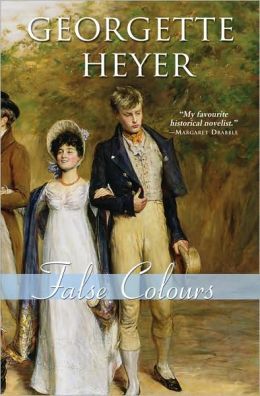
False Colours (1963)

False Colours. Georgette Heyer. 1963/2011. Thorndike. 520 pages. [Source: library]

False Colours was one of the few Heyer romances I'd not read previously. (Though I think I'd attempted it before and found myself not in the mood.) I had my doubts about this title because it is about twins switching places. The premise didn't sound appealing. But I found myself enjoying this one after all!

Christopher "Kit" Fancot returns to London unexpectedly. His mother is thrilled to see him, but incredibly anxious as well, you see, for she was expecting to see Kit's twin, Evelyn. If Evelyn doesn't return in the next day (or so) it will be super-awkward for the family. He's supposed to be meeting his fiancee's (extended) family at a party. It's a big deal. (Their engagement isn't official yet. If he doesn't impress certain members of her family, it may be broken off.) The mother fears that something has happened to her son to keep him away. He went away on an errand for her behalf, to redeem a brooch she'd lost gaming. Kit and his mother are bantering back and forth when she gets an idea: Kit can take his brother's place at the party! Since Evelyn has not met (most) of the family yet anyway, they wouldn't be able to distinguish between the two twins anyway--and if they know Evelyn has a twin at all, well, they expect him to be in Europe (Vienna, I think?). He agrees--for this one emergency--to take his brother's place. Readers know it won't really be that simple!

The heroine of False Colours is a lovely young woman, Cressy Stavely. Kit finds himself in an impossible situation when it becomes clear that Cressy and Evelyn are practically strangers and they have only had one or two conversations at most--one being the proposal itself. Another conversation was interrupted. Here's where it gets tricky. She wants to finish that conversation! She wants to meet again... So Kit finds himself continuing the deception...

False Colours is delightful and quite predictable. I definitely enjoyed it for the characterization. I liked Kit very much! I loved seeing Kit interact with his mother. He was so patient and kind and thoughtful. His mother, well, she's a character. One could see how she'd be incredibly annoying, could really get on all your nerves. But Kit accepts his mother's "weaknesses," awaits her moments of calmness, and is very tender with her. I also loved seeing him interact with Cressy! Those two were definitely meant to be. There were other characters that I enjoyed as well, including one of his mother's suitors! 

© 2013 SukaYuka.com of SukaYuka's Book Reviews
Tuesday, November 12, 2013

The Nonesuch (1962)

The Nonesuch. Georgette Heyer. 1962/2009. Sourcebooks. 352 pages. [Source: Library]

Georgette Heyer wrote so many wonderful romance novels. I adore her historical romances. The Nonesuch is not a novel with a lot of wow power. It isn't her wittiest. It isn't the one with the most mishaps or the most misunderstandings. It isn't her feistiest. It isn't the most dramatic. It isn't the most romantic. And yet I enjoyed it all the same. I enjoyed spending time with the characters even though they may not be the most memorable of Heyer's creations.

Sir Waldo is the hero. He's recently inherited an estate. He travels to the community to learn more about his new property. While there he meets all his neighbors. There are many young women and men in the community--varying social classes. And Waldo's arrival especially since it brings about two more visitors--eligible bachelors all--causes quite a stir! Readers get a variety of views. Readers get a chance to know a few characters, a few courting couples.

I liked this one. I did not love it. I was never bored, but, I was never WOWED either.

© 2013 SukaYuka.com of SukaYuka's Book Reviews

Thursday, November 7, 2013

The Passionate Enemies (1976)

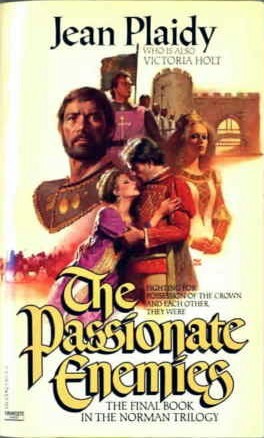
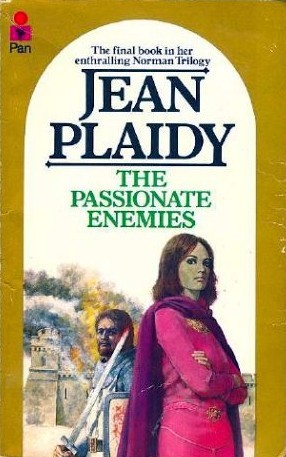
The Passionate Enemies. Jean Plaidy. 1976. Fawcett. 320 pages. [Source: Bought]

The Passionate Enemies has a laughable jacket description. Definitely leaning on the side of ridiculousness:
She was Matilda.
The arrogant, cold daughter of Henry I. An empress, a woman who had worn out one aging husband, only to dominate her next, a mere boy, Geoffrey, first of the fiery Plantagenets.
Only one man had ever mattered to Matilda, ever since childhood.
He was her cousin. He was married. He was her true love.
He was her rival to the throne -- her enemy...
He was Stephen.
A man who used honey in a land of warriors, who sweetened whatever cup would toast his claim to the throne.
And the only obstacle in his path toward ruling all of England and Normandy was Henry's daughter, his own cousin, his one true love.
Forever to fight.
Forever to love, they were...
THE PASSIONATE ENEMIES.
The Passionate Enemies falls into the so bad it's almost good group. I definitely enjoyed The Bastard King more than this one. This is the third book in the trilogy. The middle book is The Lion of Justice. Stephen and Matilda's "love story" begins in the second book. Considering the fact that she left Henry I's court to marry when she was so very young (at most 12 or 13), there are so many creepy layers to this one. (NOT that I'm saying The Passionate Enemies is creepier than say Flowers in the Attic. That would be impossible!!!)

The book begins with the tragedy of the White Ship. Henry I loses his son and heir, William. While Henry I has scores of illegitimate children, he has only one other legitimate child: Matilda. His first idea is, of course, to remarry and have a new son. But after years of waiting for this new wife to conceive, he admits that it isn't to be. He then decides that Matilda will be the one. But can he convince a nation to be be ruled by a Queen? Only time will tell.

Meanwhile, Stephen, is the ever-hopeful nephew. He wants his uncle to name him as heir. He is desperate to be king. If only he wasn't married to ANOTHER MATILDA, he would try to marry his cousin, Matilda. (By the way, the two Matilda's are cousins as well.) Life would be perfect if Matilda and Stephen could "share" the throne. The reader is "privileged" to all of Stephen's daydreams about his cousin.

The battle between Stephen and Matilda begins after Henry I's death...

The book is readable. I couldn't say I enjoyed it exactly. It is so dramatic and ridiculous in places. But it's never boring.

Quotes:
Stephen practiced charm on all so that when it was turned on those who could bring him great good, it seemed to be used naturally and without sly motive. (9)
Stephen lingered over that name. Matilda. It was more than six years ago that the King's daughter had gone to Germany for her marriage with the Emperor but Stephen had not forgotten her. He often wondered whether she ever thought of him... There had been a great bond between them. He had scarcely been able to prevent himself from attempting to seduce her. She would have been willing enough. But she had been only twelve years old when she went away, young in years, but knowledgeable in the ways of the world. Matilda was one of those who appeared to be born with such knowledge. (12)
Words, she thought, charming words. And before the day was out he would be sporting with his newest mistress and telling her she was the most important woman in his life. (18)
The idea of marriage distasteful! The thought of a new woman could never be that. (23)
Often she thought of her cousin Stephen. Was he thinking of her, she wondered, or had he contented himself with his meek little wife? Was he roaming the countryside sporting with mistress after mistress--and doing so, did he ever give a thought to his cousin Matilda? (25)
Perhaps it was not easy for a man who had had more mistresses than any in England to ask a subject to dismiss one. (43) 
© 2013 SukaYuka.com of SukaYuka's Book Reviews
Wednesday, November 6, 2013

The Lion of Justice (1975)

The Lion of Justice. Jean Plaidy. 1975. Fawcett. 320 pages. [Source: Bought]

Nature's takin' over my one-track mind
Believe it or not, you're in my heart all the time
All the girls are sayin' that you'll end up a fool
For the time being, baby, live by my rules

The Lion of Justice is the second book in Jean Plaidy's Norman trilogy. Yesterday, I reviewed the first book in the series, The Bastard King. The Lion of Justice focuses on three of William the Conqueror's sons: William Rufus (William II), Robert (duke of Normandy), and Henry (Henry I). It tells the story of William II's brief reign, his mysterious death in the forest, and Henry I's reign. In part the story is told through his queen.

We meet the future-queen as a young woman named Edith. She is royal: the daughter of the king and queen of Scotland. She is also among the last of the Saxon royal dynasty. The novel opens with Edith and her sister, Mary, going to a convent for safekeeping. They have an aunt there who is convinced that Edith should take vows and become a nun. Edith finds the idea repugnant. Equally repugnant to her is marrying an old man of the William II's choosing. There are two close calls before she is married to King Henry. Readers definitely know more of Henry than she does! One other thing that you should know: he makes her change her name to Matilda; Matilda was his mother's name.

There is a good reason why I quoted Lou Christie's Lightin' Strikes at the start of this review. Henry I is depicted as arrogant and lusty and selfish. He's repugnant. And he's able to fool Matilda for several years at least. She actually believes all his lines. She actually trusts him. He seems a bit surprised that there is any woman so gullible and naive to buy what he's saying. He almost seems relieved when she confronts him to see if it is the truth.

In my opinion, the back of the book LIED. Its description: A DAZZLING PORTRAIT OF A MAN FOR WHOM COUNTLESS MISTRESSES WEREN'T ENOUGH--AND ONE GIRL WAS EVERYTHING. Henry married Matilda because she was Saxon royalty. It was a politically advantageous match for the kingdom's good. He didn't dislike her. But she was never his everything. I get the impression that women were completely interchangeable to him. One being very much like another.

Did I like it? It wasn't so much a matter of liking or not liking. I found it quite readable. I often found Henry infuriating, and I suppose I thought a lot of conversations to Matilda, not that she could hear me. I am glad I read on in the series!

Quotes:
"And what has he ever done but bring trouble and bastards into the realm?"
The young man laughed obediently.
"Come, my fine friend, what is there to laugh at? I am a man beset by brothers, and now Henry has squandered his patrimony and roams the countryside seeking consolation in robbing ladies of their virtue since he cannot rob me of my throne." (22)
It had been at this time that Henry had become so incensed against his brothers. He said they ignored his existence; they forgot that he was also their father's son, and he demanded to know what his inheritance would be.
"The ladies of England," retorted Rufus. "And I doubt Robert would debar you from enjoying the Norman ones when you visit his Duchy." (25)
"No man should enter the Abbey."
"Of a certainty no ordinary man should be allowed in," said Henry. "But I am no ordinary man." (89)
"Why have you come to see me?" she asked.
"Because my inclinations first prompted me and then insisted. They would not be denied."
"The sisters are right. It is unseemly."
"That which is unseemly is often delightful you will discover." (89)
He was laughing at her. He took her hands suddenly and kissed her fingers.
"Then," he said, "You like me well."
"Yes," she answered. "I like you well."
"And when I am King you will be my Queen."
"I could ask nothing more of life."
"Will you be a good wife to me?"
"I will."
"And love me tenderly and bear my children."
"I will."
"Why 'twould seem we are married already. Would there were a priest here who would marry us, and  bridal chamber where I could make you my wife in every truth." (90)
When Henry rode back from Wilton to Winchester he was feeling more than ever dissatisfied with his fate. The Princess Edith was not uncomely; her innocence was amusing and she could give him some diversion which he could not find with his many mistresses. Moreover it was time he was married. He was thirty years of age and he wanted sons. Edith had interested him; he had seen more beautiful women...It was said that he had more bastards than any man in England. (93)
Henry was too clever not to know himself, and that he was the most fitted to rule of all his brothers. (94)
He thought a little of the virginal Princess to whom he had talked of marriage. She was in love with him already. She would be submissive. He liked a little spirit in his women; on the other hand variety was always enticing; and marriage would be a new adventure. (95)
"You always had the right answers. I wonder if Matilda will find it so?" (143)
"Could I be faithless to what is his name...Gerald?"
"Yes I think you might."
"As you will be to Matilda?"
"It seems likely."
"Oh yes," said Nesta, "it seems very likely." (144) 
Well, she who was so innocent of the world would have to learn, and when she did, as she inevitably must, she would after the first shock settle down to be a loving wife and when she produced the heirs of the kingdom she would be a good mother. That should satisfy her so that when he strayed--as he surely would--she would come to accept this state of affairs as a natural course of events. For the time though he feigned to share her ecstatic happiness. (151)
 It was one of those occasions when he wondered what she would feel when she discovered the truth about him, which he supposed she would in due course. When he began bringing his illegitimate children to Court and bestowing favours on them, which indeed he must, he hoped she would not be too badly hurt. It might well be that by the time she would have more understanding of the world. But it was disconcerting when she showed so clearly that she looked upon him as a knight of shining purity. He supposed he was growing fond of her. (163)
© 2013 SukaYuka.com of SukaYuka's Book Reviews
Tuesday, November 5, 2013

The Bastard King (1974)

The Bastard King. Jean Plaidy. 1974. Fawcett Crest. 320 pages. [Source: Bought]

I really enjoyed reading Jean Plaidy's The Bastard King. The Bastard King is a novelization of the life of William I or "William the Conqueror." It was certainly a well-paced read! Especially once he comes of age. His courtship with Matilda was quite unique. (As this horrible histories sketch shows quite clearly!!!) The novel isn't exactly a romance novel, it is grounded in history with a focus on ambition, politics, and manipulation. Matilda and William are very interesting characters even if they don't come across as nice or pleasant or lovable. Readers see the tension between husband and wife increase year after year and decade after decade as the two happen to play favorites with their very large family. He has his favorite child; she has hers. This leads to some complications which lead to some big trust issues!!!

The last part of the novel focuses on William invading England and becoming King William I. The novel is sympathetic to William in many ways, so often books have a bias one way or another on whether or not William had any right to England at all. I thought the ending was a bit rushed, we spent much more time with him before he became King, but still I really liked this one. Enjoying this one gives me hope that I will read other Plaidy novels with pleasure!


William the Conqueror and Normanopoly
Battle of Hastings, News at 1066; Now That's What I Call Miserable, vol. 3
Words We Get From the Normans

© 2013 SukaYuka.com of SukaYuka's Book Reviews

Thursday, October 24, 2013

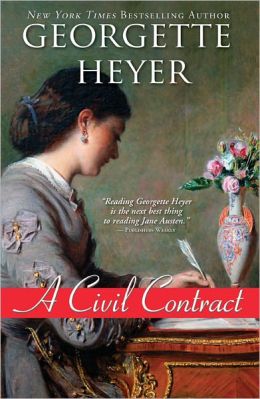
Civil Contract (1961)

Civil Contract. Georgette Heyer. 1961/2009. Harlequin. 432 pages. [Source: Library]

Three years ago when I first read A Civil Contract, I'm not sure I appreciated it as it deserves. The romance between this husband and wife is a bit more subtle and less spectacular than some of Heyer's other romances, the ones without formulaic marriage of conveniences. This sub-genre can be charming, stories where husband and wives marry for whatever reason and only long after saying I do is love discovered and cultivated. Other similar Heyer titles include A Convenient Marriage and April Lady. A Civil Contract differs mainly in the fact that the heroine, Jenny, is thoroughly sensible and intelligent. She is NOT silly or flighty or incapable of rational thought and feeling. She is not gullible and foolish. In other words, she is not annoying to spend time with! She is actually a comfortable heroine. I really liked her!!!

A Civil Contract highlights all the reasons I just love and adore Georgette Heyer. I love her characters. I love the main characters, the hero, Adam, and the heroine, Jenny. I love almost all of the minor characters. Readers get to meet so many family members and friends. I love the glimpses into society. A Civil Contract is oh-so-rich in historical detail. This is something that I completely failed to appreciate until I began reading nonfiction books on the Regency period. After reading adult biographies on Caroline, the Princess of Wales, and George IV (Prince of Wales, Prince Regent), and Princess Charlotte (their daughter), I could really appreciate Heyer even more. Little sentences here and there that ground the book in reality.
'I can't tell you how refreshing it is to encounter a female who doesn't fall into ecstasies at the mere mention of Byron's name!'
'Are you quizzing me?' she asked bluntly.
'Of course I'm not! I'm no great judge of poetry, but surely Lord Byron's verses are extraordinarily over-rated?'
'Well, that's what I think,' she replied. 'But I have for long been aware that, try as I may, I don't appreciate poetry as I should. I did make the greatest effort to read the Bride of Abydos, however.'
'Unavailing, I collect?'
She nodded, looking a little conscience-stricken. 'Yes, though I daresay I should have persevered if the library had not sent me a parcel containing two books which I most particularly wanted to read. I found I could no longer concentrate my mind, and so abandoned the attempt. And one was perfectly respectable!' she said defensively, adding, in response to his lifted eyebrows: 'Mr Southey's Life of Nelson: has it come in your way?'
'Ah, yes! That is a noble work, indeed!...But what Miss Chawleigh, was the other work--not so respectable!--which lured you away from Abydos?'
'Well, that one was a novel,' she confessed.
'A novel preferred to Lord Byron! Oh, Miss Chawleigh! exclaimed Mrs. Quarley-Bix archly.
'Yes, I did prefer it. In fact, I turned to it with the greatest relief, for it is all about quite ordinary, real persons, and not about pirate chiefs, or pashas, and nobody kills anyone in it. Besides, it was excessively diverting, just as I guessed it would be.' She glanced shyly at Adam, and said with a tiny stammer: 'It is by the author of Sense and Sensibility'... (62-3)
Nor did Jenny recall that when she first saw him she suffered a considerable disappointment. At the age of two-and-fifty little trace remained of the handsome Prince...over whose beauty elderly ladies still sighed. Jenny beheld a middle-aged gentleman of corpulent habit, on whose florid countenance dissipation was writ large. He was decidedly overdressed; his corsets creaked audibly; he drenched his person with scent; and, when in repose, his face wore a peevish expression. But whatever good fairy had attended his christening had bestowed upon him a gift which neither time nor excesses would ever cause to wither. He was an undutiful son, and a bad husband, an unkind father, an inconstant lover, and an uncertain friend, but he had a charm which won forgiveness from those whom he had injured, and endeared him to such chance-met persons as Jenny, or some young officer brought to him by Lord Bathurst with an important dispatch. He could disgust his intimates, but in his more public life his bearing was always right; he never said the wrong thing; and never permitted a private vexation to impair his affability. Unmistakably a Prince, he used very little ceremony, his manners, when he moved amongst the ton, being distinguished by a well-bred ease which did not wholly desert him even when, as sometimes happened, he arrived at some party in a sadly inebriated condition. His private manners were not so good; but no one who saw him, as Jenny did, at his mother's Drawing-room, could have believed him capable of lying to his greatest supporter, taking a crony to listen to his father's ravings, treating his only child with boorish roughness, or floundering like a lachrymose porpoise, at the feet of an embarrassed beauty. (131-2)

© 2013 SukaYuka.com of SukaYuka's Book Reviews

Wednesday, October 23, 2013

Prince of Foxes (1947)

Prince of Foxes. Samuel Shellabarger. 1947. 433 pages. [Source: Library]

I really enjoyed reading Prince of Foxes by Samuel Shellabarger. (Thanks Semicolon for the recommendation!) This historical novel was originally published in 1947. It is set circa 1500 during the Italian Renaissance. It features glimpses of four Borgias: Pope Alexander VI, Cesare, Lucrezia, and Angela--a cousin. The hero is an ambitious but not ruthless young man initially in the service of Cesare Borgia. His name is Andrea Orsini. He's been sent to Ferrara in order to pave the way for Lucrezia's third marriage. (The potential groom--or the potential in-laws--are NOT thrilled or receptive to the idea of this marriage.) But Andrea Orsini is good at what he does. He even compels the assassin who was sent to kill him to switch sides. (His name is Mario Belli). But while he is satisfied to stay in Cesare's service when it suits him, when it gets a little too personal, well, he takes a stand for better or worse.

Prince of Foxes is historical romance at its best. Andrea Orsini is a great little hero. He falls hard for the (married) woman that Cesare Borgia promised him. If or when Cesare conquers that city (kingdom-state), Orsini will receive her as his reward for loyal service. Her name is Lady Camilla. She becomes very friendly with him, even flirty, I suppose. But she is a good wife who never leaves Orsini's company without urging him to do EVERYTHING in his power to protect her husband's life. Because his love for her is so strong, so transformative even, he no longer wants to "win" her as a prize. He knows that this husband's death is practically essential to his ambitions, and more importantly to Cesare's ambitions, and, so the conflict will end with him having to make a big decision.

I really loved this one! It is so well written too!

Orsini did not conceal the twinkle in his eyes. "No doubt. There are few who can match the divine genius of my lord Cesare."
"Of course," Lorenzo agreed. He would have liked to add: "Fratricide! Assassin! Bandit!" but he said merely, "Divine genius is well put."
"And let me tell you," smiled Orsini, "that he is not the monster that you people of Venice make him. Is not gossip the mother of monsters, Maestro? He has great ends and lets nothing distract him. Perhaps merely he's too consistent. Hard, if necessary; selfish, yes (and who isn't?); but able, of great virtue and splendor. A valiant prince...I'd wager you'd love him, Messer Lorenzo, unless you stood in his ways."
"Probably," said Lorenzo, doubting it. "I rejoice to learn about him."
"Look you" -- Orsini leaned forward -- "if he were a painter, he would use rich colors. Life is his canvas." (7)
Decidedly, thought Andrea, the illustrious Duke Valentino played in luck. He did not even have to pursue his victims: they came to him. But what could Orsini do about it? Indeed, what did he wish to do? (85)

© 2013 SukaYuka.com of SukaYuka's Book Reviews
Tuesday, October 22, 2013

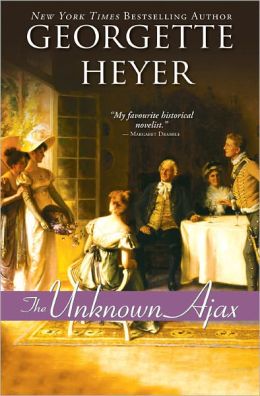
Unknown Ajax (1959)

Unknown Ajax. Georgette Heyer. 1959. 384 pages. [Source: Library]

I really enjoyed reading The Unknown Ajax. This Heyer romance focuses on a set of cousins. Vincent and Claud, Anthea and Richmond, and Major Hugo Darrocott (the 'unknown ajax'). The book opens with a family waiting for the arrival of Major Hugo. Most have only recently learned of his existence, which is significant because it comes with the knowledge that he is now the next heir. How will his cousins receive him? Will The Unknown Ajax turn into a Quiet Gentleman? Fortunately it didn't!!!

I really liked all the characters in this one. I liked seeing each cousin come to form a relationship with Hugo. I liked seeing them all get to know one another. I liked Hugo's secret-keeping. I liked the way he played along with the others and let time reveal all.

The romance. I didn't find the romance giddy-making. I didn't hate it, but it didn't wow me. Anthea and Hugo had interesting scenes together, but, nothing WOW.

Unknown Ajax is another Heyer title that has a smuggling theme in it. I enjoyed this one, but I didn't love it.

© 2013 SukaYuka.com of SukaYuka's Book Reviews

Thursday, October 10, 2013

Caroline the Queen (1968)

Caroline the Queen. Jean Plaidy. 1968. 415 pages. [Source: Library]

Caroline, The Queen was my first introduction to the historical writer Jean Plaidy. (It is the third book in the Georgian Saga.) The novel opens shortly before the Prince of Wales, George Augustus, learns that his father (whom he REALLY hated) has died and he is now king. Caroline, his Queen, may be the main character of this one, but she is not our only point of view--far from it. This novel tells many stories from many different points of view.

Husband and wife. The novel spends some amount of time with George II and his wife, Caroline. She is presented as being oh-so-clever. Readers are never allowed to forget for a moment that Caroline is smarter and wiser than her husband. George is presented as a complete fool: short, ugly, boring, bad-tempered, easily flattered. Caroline loves being married to him because she can rule through him. But she has absolutely no respect for her husband. Caroline is presented as noble because she tolerates her husband's many mistresses.

King and mistresses. The novel mentions George II having many mistresses both in England and Hanover. His mistresses are presented as a necessary, oh-so-expected habit. Kings have mistresses, he is now king, therefore, to show how kingly he is, he must have mistresses, the people will love him even more because he is acting like other kings. Future kings must have mistresses as well. To be Prince of Wales gives you freedom to gather as many mistresses as possible and put them on display. Some of George II's mistresses are quite "old" by the time he is king. He visits them on schedule not out of desire but out of habit. The last half of the novel focuses on the King acquiring much younger, much prettier mistresses.

Family. The glimpses we get of Caroline and George as parents is disturbing, at least in my opinion. Frederick, the prince of Wales, is DESPISED by both of his parents. He is their oldest son, but both of his parents HATE him and wish that he'd never been born. Neither wants him around. And he knows it. He hates them both. At one point he's shown as hating his mother even more than his father because he feels his father is just being ruled. Some time is spent on their other children. But I can't say that Caroline and George were extraordinarily good parents to any of their children. Anne, the oldest girl, is given some time in the novel.

Prince of Wales. Some time is spent with Frederick and his friends and mistresses. Readers see people trying to get close to him so they can use him, people trying to get favors. Some spy on him and tell all to the powers-that-be.

Politics. Caroline has several politician friends--notably Sir Robert Walpole and Lord Hervey. She loves power and politics and manipulating things behind the scenes so that George does precisely what they want without being wise to the fact that he's being manipulated. 

The novel was quite interesting and very readable. The characters were all believably flawed; I found no one sympathetic, however. I liked this one.

© 2013 SukaYuka.com of SukaYuka's Book Reviews
Wednesday, October 2, 2013

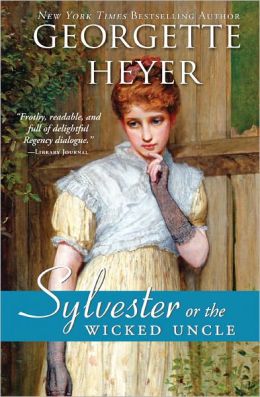
Sylvester (1957)

Sylvester, Or, The Wicked Uncle. Georgette Heyer. 1957/2004. Harlequin. 350 pages. [Source: Bought]

Early in the year I decided I would attempt to read all of Heyer's romance novels in order of publication. Most of the novels would be rereads, though not all of them. So far, it has been a great project! I'd definitely recommend it! The first time I read Sylvester I absolutely loved, loved, loved it. The second time, well, I seemed to be in a contrary mood. I found it perfectly pleasant, quite enjoyable, well-paced. There was not one single thing that I could legitimately fault it with, but, for some reason it wasn't WOWing me. In my memory, it was this WONDERFUL book. This balances well because there were other books that I found disappointing the first time around that I now LOVE.

From my first review:

So what is this historical romance about? It's about the sometimes-arrogant Duke of Salford. Sylvester Raynes. When the novel opens, Sylvester is having a cozy little chat with his mother. Telling her how he feels it's time to get married. He has certain things he is looking for in a wife. And he's got five women on his list that might just do. Unfortunately, love and romance don't enter into it, for him. His mother does set him right on that account at least:
'Thank you, I have heard enough to be able to give you my advice!' interrupted his mother. 'Don't make an offer for any one of them! You are not in love!'
'In love! No, of course I am not. Is that so necessary?
'Most necessary, my dear! Don't, I beg you, offer marriage where you can't offer love as well!' (13)
Sylvester then goes to see his godmother. Maybe her advice will be more useful, more practical than his mother's.
'Now, if you were only a fairy godmother, ma'am, you would wave your wand, and so conjure up exactly the bride I want!' (31)
She can't wave her wand, but she can send him to meet her granddaughter, Phoebe Marlow. The way she phrases this suggestion irritates him, still, he is in need of a wife. And she might just do after all. He had teased his mother earlier saying,
'What could be more romantic than to marry the girl who was betrothed to me in her cradle?' (22)
So off he goes to meet Miss Marlow. But his mother was right to suspect that it might not be that easy. That the girl might need to be wooed. That her son shouldn't assume that any woman would swoon and say yes to his proposal.
'My dear, has it not occurred to you that you might find yourself rebuffed?'
His brow cleared. 'Is that all? No, no, Mama, I shan't be rebuffed!'
'So sure, Sylvester?'
'Of course I'm sure, Mama! Oh, not of Miss Marlow! For anything I know, her affections may be engaged already.'
'Or she might take you in dislike,' suggested the Duchess.
'Take me in dislike? Why should she?' he asked, surprised. (22)
That conversation ends with him boasting, "Well, Mama, you said yourself that I make love charmingly!" and "I'm not hard to swallow, you know."

So who is Phoebe Marlow? She's a young woman who doesn't welcome the idea of Duke Salford coming to offer for her. The two met very briefly in London--so briefly that Sylvester doesn't even remember--and her first impression of him wasn't the greatest. In fact, Sylvester's eyebrows inspired her to write him into the novel she was writing. As the villain, Count Ugolino. (Many of her characters were inspired by people she met during her London season.) So to learn that this man is on his way to see her, to ask her to marry him, is a bit of a shock. To make matters worse, her novel is to be published! Does Sylvester read many novels? Will he recognize himself? What's she to do? Is there a way she can escape this awkward predicament? But of course! But it's not without its risk!

Sylvester and Phoebe challenge one another. And the tension between the two is just about perfect. If you like that sort of romance--think Beatrice and Benedick, Elizabeth Bennet and Mr. Darcy, Anne Shirley and Gilbert Blythe, and Margaret Hale and John Thornton. Sylvester is all about overcoming BAD first impressions.

I love Heyer. I love her style. I love her wit. I love her characters. And there are so many characters to love in Sylvester. If you haven't read her before, you might consider starting with Sylvester.

© 2013 SukaYuka.com of SukaYuka's Book Reviews