Saturday, September 7, 2013

Rookwood (1834)

Rookwood. William Harrison Ainsworth. 1834. 464 pages. [Source: Bought]

Rookwood is a mess of a novel. But sometimes it is easy to love a mess, to love a book despite its flaws. If Rookwood is a mess, it is because it is a blending of genres and story lines.

There is the incredibly creepy, ever-mysterious Rookwood family. The mystery involving lies, secret marriages, hidden wills, and a LOT of murder. The heart of this plot is focused on inheritance. Who is the rightful heir of the Rookwood estate? Is it Luke Bradley the supposed "illegitimate" son of Sir Piers Rookwood and Susan Bradley? There seems to be proof the two were married and he is in fact legitimate after all. Is it Eleanor Mowbray? There seems to be a hint in that direction. Is it Ranulph Rookwood? He's certainly confident that he's the rightful claimant. And he's ready to defend it against contrary claims. The plot is creepy and bizarre because the family history is so strange and blood-filled. The book also lacks a clear HERO.

When it is creepy, it is incredibly creepy. The chapters that focus on the underground wedding are so very weird and creepy. Before Luke found out the truth about his past, about who he is, he was in love with a gypsy girl, Sybil Lovel. And Sybil's mother, Barbara, is truly something. As soon as Luke does find out the truth, he becomes fascinated with the idea of marrying his cousin Eleanor Mowbray and 'stealing' her away from his half-brother, Ranulph. (Eleanor and Ranulph were in love already.) The "romance" of this one is truly creepy and a bit bloody.

Balancing out the gothic romance, readers meet Dick Turpin, famous highwayman. Over half the novel stars Turpin. Readers see him eating, drinking, joking, singing, laughing, fighting, riding, holding up coaches, etc. Readers see him among friends and enemies. Turpin knows Luke Bradley. He knows of the messy inheritance. He has in his possession the marriage certificate. He wants Bradley to be triumphant perhaps, but he'll bargain with either side. He and Bradley work together at times, and against each other at times. Bradley isn't above playing legitimate hero and rescuing the damsel in distress if he feels like it. Turpin overlooks the frustrations Bradley sends his way. These sections of the novel are incredibly light. All action. All adventure. A lot of drinking and singing and general merry-making. And an incredible amount of boasting!

Quotes:
"Thoughts should not always find utterance, else we might often endanger our own safety, and that of others."
It is as necessary for a man to be a gentleman before he can turn highwayman, as it is for a doctor to have his diploma, or an attorney his certificate. 
You may both of you be gratified, gentlemen," said Palmer. "Talking of Dick Turpin, they say, is like speaking of the devil, he's at your elbow ere the word's well out of your mouth. He may be within hearing at this moment, for anything we know to the contrary."
By-the-by," added he, surveying Jack more narrowly, "it occurs to me that Turpin must be rather like you, Mr. Palmer?"
"Like me," said Jack, regarding Coates askance; "like me—how am I to understand you, sir, eh?" "No offence; none whatever, sir. Ah! stay, you won't object to my comparing the description. That can do no harm. Nobody would take you for a highwayman—nobody whatever—ha! ha! Singular resemblance—he—he. These things do happen sometimes: not very often, though. But here is Turpin's description in the Gazette, June 28th, A.D. 1737:—'It having been represented to the King that Richard Turpin did, on Wednesday, the 4th of May last, rob on his Majesty's highway Vavasour Mowbray, Esq., Major of the 2d troop of Horse Grenadiers'—that Major Mowbray, by-the-by, is a nephew of the late Sir Piers, and cousin of the present baronet—'and commit other notorious felonies and robberies near London, his Majesty is pleased to promise his most gracious pardon to any of his accomplices, and a reward of two hundred pounds to any person or persons who shall discover him, so as he may be apprehended and convicted.'" "Odsbodikins!" exclaimed Titus, "a noble reward! I should like to lay hands upon Turpin," added he, slapping Palmer's shoulder: "I wish he were in your place at this moment, Jack." "Thank you!" replied Palmer, shifting his chair. "'Turpin,'" continued Coates, "'was born at Thacksted, in Essex; is about thirty'—you, sir, I believe, are about thirty?" added he, addressing Palmer. "Thereabouts," said Jack, bluffly. "But what has my age to do with that of Turpin?" "Nothing—nothing at all," answered Coates; "suffer me, however, to proceed:—'Is by trade a butcher,'—you, sir, I believe, never had any dealings in that line?" "I have some notion how to dispose of a troublesome calf," returned Jack. "But Turpin, though described as a butcher, is, I understand, a lineal descendant of a great French archbishop of the same name." "Who wrote the chronicles of that royal robber Charlemagne; I know him," replied Coates—"a terrible liar!—The modern Turpin 'is about five feet nine inches high'—exactly your height, sir—exactly!" "I am five feet ten," answered Jack, standing bolt upright. "You have an inch, then, in your favor," returned the unperturbed attorney, deliberately proceeding with his examination—"'he has a brown complexion, marked with the smallpox.'" "My complexion is florid—my face without a seam," quoth Jack. "Those whiskers would conceal anything," replied Coates, with a grin. "Nobody wears whiskers nowadays, except a highwayman." "Sir!" said Jack, sternly. "You are personal." "I don't mean to be so," replied Coates; "but you must allow the description tallies with your own in a remarkable manner. Hear me out, however—'his cheek bones are broad—his face is thinner towards the bottom—his visage short—pretty upright—and broad about the shoulders.' Now I appeal to Mr. Tyrconnel if all this does not sound like a portrait of yourself." "Don't appeal to me," said Titus, hastily, "upon such a delicate point. I can't say that I approve of a gentleman being likened to a highwayman. But if ever there was a highwayman I'd wish to resemble, it's either Redmond O'Hanlon or Richard Turpin; and may the devil burn me if I know which of the two is the greater rascal!" "Well, Mr. Palmer," said Coates, "I repeat, I mean no offence. Likenesses are unaccountable. I am said to be like my Lord North; whether I am or not, the Lord knows. But if ever I meet with Turpin I shall bear you in mind—he—he! Ah! if ever I should have the good luck to stumble upon him, I've a plan for his capture which couldn't fail. Only let me get a glimpse of him, that's all. You shall see how I'll dispose of him." "Well, sir, we shall see," observed Palmer. "And for your own sake, I wish you may never be nearer to him than you are at this moment. With his friends, they say Dick Turpin can be as gentle as a lamb; with his foes, especially with a limb of the law like yourself, he's been found but an ugly customer.
Tell me, girl, in what way? Speak, that I may avenge you, if your wrong requires revenge. Are you blood of mine, and think I will not do this for you, girl? None of the blood of Barbara Lovel were ever unrevenged. When Richard Cooper stabbed my first-born, Francis, he fled to Flanders to escape my wrath. But he did not escape it. I pursued him thither. I hunted him out; drove him back to his own country, and brought him to the gallows. It took a power of gold. What matter? Revenge is dearer than gold. And as it was with Richard Cooper, so it shall be with Luke Bradley. I will catch him, though he run. I will trip him, though he leap. I will reach him, though he flee afar. I will drag him hither by the hair of his head," added she, with a livid smile, and clutching at the air with her hands, as if in the act of pulling some one towards her. "He shall wed you within the hour, if you will have it, or if your honor need that it should be so. My power is not departed from me. My people are yet at my command. I am still their queen, and woe to him that offendeth me!" "Mother! mother!" cried Sybil, affrighted at the storm she had unwittingly aroused, "he has not injured me. 'Tis I alone who am to blame, not Luke." "You speak in mysteries," said Barbara. "Sir Piers Rookwood is dead." "Dead!" echoed Barbara, letting fall her hazel rod. "Sir Piers dead!" "And Luke Bradley——" "Ha!" "Is his successor." "Who told you that?" asked Barbara, with increased astonishment.
Dick saw the effect that he produced. He was at home in a moment. Your true highwayman has ever a passion for effect. This does not desert him at the gallows; it rises superior to death itself, and has been known to influence the manner of his dangling from the gibbet!
"Proceed now with the ceremony," continued Barbara. "By darkness, or by light, the match shall be completed." The ring was then placed upon the finger of the bride; and as Luke touched it, he shuddered. It was cold as that of the corpse which he had clasped but now. The prayer was said, the blessing given, the marriage was complete. Suddenly there issued from the darkness deep dirge-like tones, and a voice solemnly chanted a strain, which all knew to be the death-song of their race, hymned by wailing women over an expiring sister. The music seemed to float in the air. THE SOUL-BELL Fast the sand of life is falling, Fast her latest sigh exhaling, Fast, fast, is she dying. With death's chills her limbs are shivering, With death's gasp the lips are quivering, Fast her soul away is flying. O'er the mountain-top it fleeteth, And the skyey wonders greeteth, Singing loud as stars it meeteth On its way. Hark! the sullen Soul-bell tolling, Hollowly in echoes rolling, Seems to say— "She will ope her eyes—oh, never! Quenched their dark light—gone for ever! She is dead."
The next time you wed, Sir Luke, let me advise you not to choose a wife in the dark. A man should have all his senses about him on these occasions. Make love when the liquor's in; marry when it's out, and, above all, with your eyes open. This beats cock-fighting—ha, ha, ha!—you must excuse me; but, upon my soul, I can't help it."
"Every man to his taste," returned Turpin; "I love to confront danger. Run away! pshaw! always meet your foe."
A man should always die game. We none of us know how soon our turn may come; but come when it will, I shall never flinch from it. As the highwayman's life is the fullest of zest, So the highwayman's death is the briefest and best; He dies not as other men die, by degrees, But at once! without flinching—and quite at his ease! 


© 2013 SukaYuka.com of SukaYuka's Book Reviews

Friday, September 6, 2013

April Lady (1957)

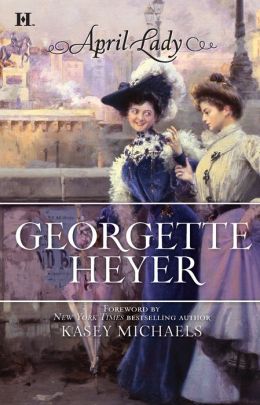
April Lady. Georgette Heyer. 1957/2005. Harlequin. 270 pages. [Source: Library]

In some ways, April Lady is a very simple novel. A husband and wife are madly in love with each other; but each thinks the other only married out of convenience. They are horrible at communicating with one another. Nell may love her husband dearly, but clearly she does not understand him. Perhaps the couple's biggest problem is that of inequality. Instead of being husband and wife, they sometimes act like parent and child. (There is quite a bit of scolding at times. I can see why, she does act incredibly foolish. But still. His scolding isn't going to solve anything!)

April Lady may be predictable from cover to cover, but that does not stop this romance from being a satisfying one. What I enjoyed most about April Lady was the characterization. It wasn't that I loved the heroine, Nell, or her husband, Cardross; it was that Nell and Cardross were surrounded by interesting characters.

So. Nell has a brother, Dysart, who is a reckless gambler. (He's a LOT of fun, however.) Giles (Cardross) has a half-sister, Letty. She's silly, foolish, stubborn, and spoiled. Letty is in love with Jeremy Allandale. She is insisting (to anyone who will listen) that they HAVE to get married right NOW. It's not good enough that her brother will consent to the match in two or three years when she is nineteen or so. Now, now, now. Cardross also has a good friend, a cousin named Felix Hethersett.

I loved Felix, Dysart, Letty, and Jeremy more than Cardross and Nell. If this romance did not have such a great cast of "minor" characters, it would be awful.


22 / 33 books read. 67% done!

© 2013 SukaYuka.com of SukaYuka's Book Reviews
Thursday, September 5, 2013

Sprig Muslin (1956)

Sprig Muslin. Georgette Heyer. 1956/2011. Sourcebooks. 304 pages. [Source: Library]

Sprig Muslin is a lovely romance novel by Georgette Heyer. It is very reader-friendly; the pacing is even and it's a delight from the start. (In some of Heyer's novels the satisfaction comes in the last third of the novel; that isn't the case in Sprig Muslin). What makes Sprig Muslin satisfying isn't the romance, it is the comedy.

Sir Gareth Ludlow is on his way to propose to a very respectable woman, Lady Hester. He is quite fond of her, has respected and admired her for years. But he is not madly in love with her. On his trip, he accidentally meets Amanda "Smith." This young woman is obvious trouble from the start. She is obviously a woman intent on running away. He doesn't know her real name; he doesn't know where she's from--city or country; he doesn't know anything about her character except that she's a big liar, has an extraordinary imagination, and is incredibly foolish. This is a woman in need of rescuing. She needs someone with commonsense and no agenda to get her back where she belongs. He doesn't exactly want the job. But someone has to do it. He can't just leave her to her own designs or something awful could happen.

Amanda is the life of this novel. She is foolish, imaginative, stubborn, and vivacious. She is always plotting, always on the move, always calculating the situation and writing a new story. She keeps the novel going at a tremendous pace. Sir Gareth can hardly keep up with her, and the others they meet along the way are just as bad.

The novel is a big misadventure; there are plenty of interesting characters as well. This novel works BECAUSE Sir Gareth and Amanda are not love interests. I loved every minute of this one. Not because it was romantic and giddy-making, but because it was just so funny.

© 2013 SukaYuka.com of SukaYuka's Book Reviews

Wednesday, September 4, 2013

Bath Tangle (1955)

Bath Tangle. Georgette Heyer. 1955/2011. Sourcebooks. 368 pages. [Source: Review Copy]

I may not have loved Bath Tangle the first time I read it, but I REALLY loved it this time!!! One thing I'm learning by rereading all the Heyer romances is that timing is everything, that there is a right mood and a wrong mood for reading. This time, I was definitely in the right mood to enjoy Bath Tangle from cover to cover.

Heyer is sometimes compared to Jane Austen. Bath Tangle shares some similarities with Pride and Prejudice and Persuasion. The feisty relationship between Ivo, the Marquis of Rotherham, and Serena is in some ways like that of Elizabeth and Darcy. Ivo and Serena were at one point--perhaps five to seven years before the start of Bath Tangle?--engaged to be married. I wouldn't say there is regret on her part, at least not that she'd ever admit, however, there is enough regret on his side--which he hides under some pride. There are hints at Persuasion, but just subtly. The start of Bath Tangle even reminds me a tiny bit of Sense and Sensibility: it starts with a death (Serena's father) and is all about family adjustments. Serena and her step-mother Fanny are out of a home because of an inheritance; and there is some family tension. However, they are not poor.

Serena is close to her step-mother, Fanny, who is several years younger. The two decide to keep house together. Fanny does not want to go back to live with her parents. And Serena does not want to have to live with a fussy aunt. They can chaperon one another. The two eventually decide to go to Bath to finish out their year of mourning. Bath Tangle is about their time there and the men and women they meet. Hector is one of the gentleman they meet. He and Serena flirted years ago; he thought she was THE ONE. She is very pleased to see him again. She has very fond memories of being worshiped. The two do not announce their engagement, but they do come to an agreement. Emily is a young woman that Serena and Fanny spend some time with. Emily is the fiancee of Ivo. Fanny thinks the marriage would be a huge mistake. Serena thinks that Emily just needs time and training, that she can be made to be worthy of Ivo. Mrs. Floore is a very interesting character, as well, she is Emily's grandmother.

The "tangle" of the title is very appropriate for the relationships in Bath Tangle are very messy. Even though Ivo is not present in a great many scenes, I felt his presence was still FELT throughout much of the novel. I really thought the tension between Ivo and Serena was great. Loved all the arguing. Loved how he understood her better than Hector! The last third of the novel was practically perfect.

Bath Tangle is a romantic comedy. The love lives of most of the characters are settled by the end of the novel.

I also appreciated the historical detail in this one. There is some time spent discussing Glenarvon by Caroline Lamb, which was quite a sensation in 1816. Also there is discussion of the wedding (or upcoming wedding) of Princess Charlotte and Prince Leopold.

© 2013 SukaYuka.com of SukaYuka's Book Reviews

Tuesday, September 3, 2013

No Shame, No Fear

No Shame, No Fear. Ann Turnbull. 2003. Candlewick. 304 pages. [Source: Library]

No Shame, No Fear is set in England in 1662 during the reign of Charles II. Susanna, our heroine, is a Quaker. William, our hero, is not. The two meet briefly on the street. She notices him; he notices her. He decides to do something he knows his father would disapprove of: visit a Quaker gathering. Will may have been interested, at first, because of Susanna, but he's soon persuaded that the Quaker way is the right way.

Susanna is working at a bookshop/printshop; she is working for a Quaker woman that prints pamphlets and posters. William pursues her, and soon the two are courting honorably. There are a few obstacles preventing the two from sharing a happily ever after. They are a bit too young to marry. Quakers are facing widespread persecution: being a Quaker and trying to attend an illegal worship service will land you in jail where you'll stay until you face trial and are fined; if you're unwilling or unable to pay your fine, you could spend months in prison, if you last that long. William's father does not have any sympathy at all for Quakers. He thinks his son has betrayed him and he's very angry, very bitter. William is in need of a job, a good job, and now that everyone knows he's a Quaker, well, that may be difficult...

I really enjoyed No Shame, No Fear. It may not be exciting or dramatic, but, it is rich in historical detail.

Charles II King of Bling
Charles II Meets A Thief
Charles II Dinnertime Performance
Charles II and John Flamsteed
Charles II Christmas Message

© 2013 SukaYuka.com of SukaYuka's Book Reviews

Monday, September 2, 2013

Creative Writing (2013)

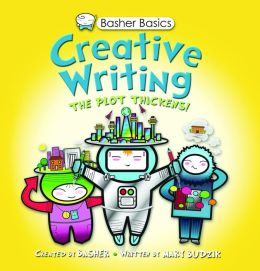
Creative Writing: The Plot Thickens. Mary Budzik. 2013. Kingfisher. 64 pages. [Source: Review Copy]

Creative Writing is a book in the Basher Basics series published by Kingfisher. (Other titles in the series include: Grammar, Punctuation, Music, Weather, Math, etc. There are two other lines as well: "Basher History" and "Basher Science".) This one would be perfect for middle grade (upper elementary school and/or junior high).

In the first chapter entitled "What's The Story?" readers learn about genres. Seven genres are included in chapter one: adventure, horror, science fiction, fantasy, mystery, diary, and poetry. Each genre has its own two-page spread. Mystery is found on page sixteen.
Mystery
*Story in which a protagonist investigates a mystery or crime
*The detective (amateur or professional) often has a sidekick
*Canny clues help connect the dots

I'm a cagey type whose world is seldom as it seems. Wary Protagonist might look for the story behind the story but, dogged by dastardly deeds, seems instead to stumble into muddles, mayhem, and even murder.
I scatter clues for detectives, private investigators, and interfering old ladies. I lead Protagonist into some sticky situations and courageous capers, but good old Pro is always equal to the challenge, refusing to back off despite ominous omens, threats from thieves, or pleas from the police. It is a question of having to be supremely self-confident, of trusting that gumption and grit will save the day. Even then, with criminals corralled and cooped up for good, it won't be long before I set yet another trail of trouble.  This game of wits is just too much fun to play.

Three to Read:
*Detectives in Togas by Henry Winterfeld (1956)
*Cam Jansen and the Mystery of the Stolen Diamonds by David A. Adler (1980)
* Hoot by Carl Hiaasen (2002)
The second chapter is entitled "Scene Setters." This chapter explores the concept or significance of title, theme, setting, and atmosphere. Theme is found on page twenty-six.
Theme
*A Central message or idea expressed by a story or poem
*Usually woven into a story rather than stated outright
*Often has a significance beyond the story itself

I'm a thoughtful type and sometimes a bit shy. Sure, Plot likes to scurry here and there, Plot Device teases readers with its tricks and colorful Figurative Language draws all eyes. Meanwhile, I meditate peacefully at the very center of a story, waiting patiently for you to find me. I often speak through other elements of a story rather than in a voice of my own, which means I can be a little hard to spot. I am worth seeking out, though. If you pay close attention and, like me, practice quiet reflection, you will hear my message, I'm sure--I'm intuitive! Ask yourself: Are there subjects in the story that reappear in different ways in different episodes? What makes Protagonist especially happy or sad? Does the story's title offer any clues? Before you know it, you'll have found me!

Try these:
*Identify the different themes in your favorite novel
*Choose a simple theme (for example, "friends are found in unexpected places") then work on a story to illustrate the theme.
Chapter three is entitled "Schemers and Dreamers." It introduces these concepts: plot, structure, flashback and flashforward, plot device, and denouement. Structure is found on page thirty-six.
Structure
*The arrangement of the events within a plot
*Gives a story a beginning, a middle, and an end
*Getting the order of events just so increases a story's impact

I am Plot's conscience. Addicted to the roller-coaster ride of events, Plot has a tendency to overwhelm a story like a tsunami, scattering mishap and misfortune all around. Well, it's my job to make Plot stop and think. I show that hothead some restraint! Yes, with me on board, plot chooses balance over bedlam and cause over coincidence. You see, I have a set of tools that help organize events in a logical progression, each incident causing the next. Thus Plot is able to set the scene (exposition), get things moving (rising action), stir things up (conflict), put on the brakes (suspense), cue the thunder (climax), and let everything settle back to earth (denouement). If I've done my job well, you'll feel like everything that happened was meant to be!

Try these:
*See if you can find the exposition, rising action, conflict, climax, and denouement in your favorite book
*Can you reorder some of the events without altering the outcome of the story?
The fourth chapter is "Heroes and Villains." It introduces these concepts: character, protagonist, antagonist, viewpoint, first person, and third person.

The fifth and final chapter is "Wordsmiths." It introduces the following: figurative language (more can be found in the glossary), diction, and dialogue.

I found Creative Writing to be packed with information in a reader-friendly way. I thought they did a great job in defining terms. I think the book could be just as useful for helping people talk about literature (stories, poems, novels, etc.) as it is for helping people write creatively.

© 2013 SukaYuka.com of SukaYuka's Book Reviews
Sunday, September 1, 2013

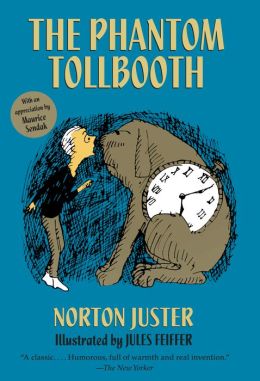
Sunday Salon: Reading The Phantom Tollbooth (1961)

The Phantom Tollbooth. Norton Juster. Illustrated by Jules Feiffer. 1961/2011. Random House. 272 pages. [Source: Review copy]

There was once a boy named Milo who didn't know what to do with himself--not just sometimes, but always.

I loved, loved, loved this one! It is easily one of those books I could read over and over and over again. I didn't discover it as a child, but, I'm very glad I've discovered it now!

Milo, our hero, is about to have an "impossible" adventure. His day starts out very ordinary, however, by the end of the day Milo will be quite transformed!

It starts with a mysterious gift-box. It holds a tollbooth for him to construct, also included are instructions, rule books, and a map. He randomly chooses to go to Dictionopolis. But though that is his original destination, Milo finds that travels--magical or not--take some thought and intention.

The writing is AMAZING. It is clever, rich in meaning and symbolism. And it is oh so quotable! One of those rare books where you could almost open up the book to any page and find a gem worth quoting!

Loved the writing, loved the creativity, loved the characters!

Favorite quotes:
“Expect everything, I always say, and the unexpected never happens.”
“You may not see it now," said the Princess of Pure Reason, looking knowingly at Milo's puzzled face, "but whatever we learn has a purpose and whatever we do affects everything and everyone else, if even in the tiniest way. Why, when a housefly flaps his wings, a breeze goes round the world; when a speck of dust falls to the ground, the entire planet weighs a little more; and when you stamp your foot, the earth moves slightly off its course. Whenever you laugh, gladness spreads like the ripples in the pond; and whenever you're sad, no one anywhere can be really happy. And it's much the same thing with knowledge, for whenever you learn something new, the whole world becomes that much richer.”
“So many things are possible just as long as you don't know they're impossible.”
“Everybody is so terribly sensitive about the things they know best.”
“And remember, also," added the Princess of Sweet Rhyme, "that many places you would like to see are just off the map and many things you want to know are just out of sight or a little beyond your reach. But someday you'll reach them all, for what you learn today, for no reason at all, will help you discover all the wonderful secrets of tomorrow.”
“In this box are all the words I know…Most of them you will never need, some you will use constantly, but with them you may ask all the questions which have never been answered and answer all the questions which have never been asked. All the great books of the past and all the ones yet to come are made with these words. With them there is no obstacle you cannot overcome. All you must learn to do is to use them well and in the right places.” 
© 2013 SukaYuka.com of SukaYuka's Book Reviews