Showing posts with label biography. Show all posts

Monday, January 20, 2014

Alexander the Conqueror (2004)

Alexander the Conqueror: The Epic Story of the Warrior King. Laura Foreman. 2004. Da Capo Press. 211 pages. [Source: Library]

I enjoyed reading this biography of Alexander the Great. Though the size of this one was a bit bulky at times, the use of so many photographs made this one less intimidating. Readers are provided with background into his country, his culture, his family. Plenty of time is spent on his father, Philip II, and Alexander's upbringing. Half of the book focuses on his rise and fall, what happens when his father dies and he comes into power and begins his conquest.

I liked the writing style. I found it reader-friendly and at times quite conversational. It had just enough detail to be interesting as an introduction to the subject. Too much detail might prove overwhelming or intimidating. This was the first biography I'd read, and I found it just right for the most part.

© 2014 SukaYuka.com of SukaYuka's Book Reviews

Monday, November 25, 2013

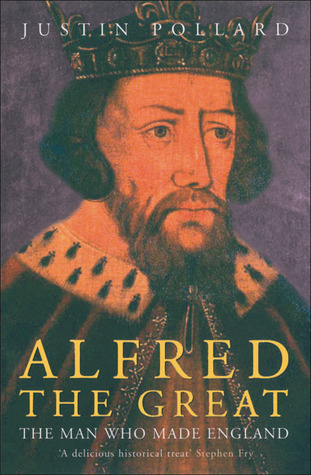
Alfred the Great (2005)

Alfred the Great. Justin Pollard. 2005. John Murray. 368 pages. [Source: Library]

I liked this biography of Alfred the Great. I can see why it might not appeal to every reader. Why it might not be considered a must-read by everyone. Not everyone gets excited by history. But I did enjoy learning more about Alfred the Great. This biography was pleasantly complex. It was rich in detail; it wasn't always the easiest to follow. I wouldn't want to be quizzed necessarily. But at the same time I was fascinated that there was so much to know, that so much has been passed down to us, that there are historians who specialize in this time period. There is a great deal about Vikings in this biography, which is just what I was looking for...

Since falling in love with Vikingland, I wanted to learn more. The song goes, "We split your isles diagonally from south-east to north-west. Our section was called the Danelaw, King Alfred ruled the rest" and "though we began as raiders so well-planned you accepted us as traders." The song does have a propaganda feel (in a good way) to it.

I found plenty within this one to interest me. Readers can learn a lot about Anglo-Saxon culture through the centuries. My goal was mainly big-picture. As I said earlier, there was a lot of information that could be absorbed by a careful reader or scholar. I wasn't trying to learn-to-remember every little thing. 

© 2013 SukaYuka.com of SukaYuka's Book Reviews

Monday, October 21, 2013

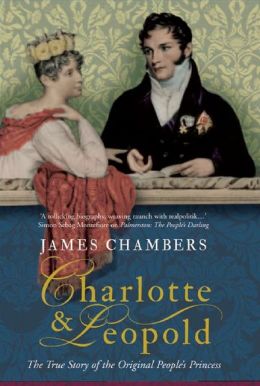
Charlotte & Leopold

Charlotte & Leopold: The True Story of the Original People's Princess. James Chambers. 2007. 256 pages.

During her life, Princess Charlotte was the most popular member of the royal family. She was more popular than her grandfather, George III, and her father, the Prince Regent (George IV). Her life was certainly interesting. Her father and mother were CHARACTERS. They often made fools of themselves to the media and society in general. They were always fighting one another, always bickering, always trying to outdo one another. I'd already read a biography of Caroline. The focus on her parents is almost necessary to explain her childhood and upbringing. It also helps explain her popularity, to a certain degree.

The second half focuses on her love life, on her suitors and would-be suitors. The book focuses, of course, on the man she married, Prince Leopold. He's an interesting character as well! And his story does not end with his wife's death. The last chapters of the book follow his life...

I liked this one. I did. I also really loved Becoming Queen Victoria: The Tragic Death of Princess Charlotte and the Unexpected Rise of Britain's Greatest Monarch. The books overlap on their focus of Princess Charlotte. Both books bring the Georgian royalty to life, highlighting some of the more interesting members of the family!

© 2013 SukaYuka.com of SukaYuka's Book Reviews
Monday, September 9, 2013

Below Stairs (1968)

Below Stairs: The Classic Kitchen Maid's Memoir That Inspired Upstairs, Downstairs and Downton Abbey. Margaret Powell. 1968/2012. St. Martin's Press. 224 pages. [Source: Library]

Below Stairs is one of two memoirs by Margaret Powell. As a young teen--fifteen, I believe--she entered service. (She left school to begin working to support her family a year or two earlier however.) Her first positions in service were as a kitchen maid. She later promoted herself to cook and sought out other positions with other families. The book tells of her experiences and shocks. One shock, for example, was when she found out she was to iron the shoe laces every morning in addition to polishing the shoes. It's a detailed look at work. Work as a maid is anything but fun, glamorous, exciting. Dreary, repetitive, exhausting comes more to mind. This memoir does not focus on any particular wealthy family; it is not a dramatic romance like Downton Abbey. 

I enjoyed reading Below Stairs. I found it to be a quick read. I liked that Powell enjoyed reading and tried her best to read what she could, when she could, even though there wasn't always a lot of free time. She worked very long hours, had very little time to herself, and was at times discouraged from seeking out books and wanting 'more'.

© 2013 SukaYuka.com of SukaYuka's Book Reviews
Monday, August 12, 2013

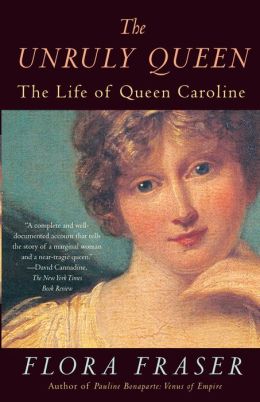
The Unruly Queen (1996)

The Unruly Queen: The Life of Queen Caroline. Flora Fraser. 1996/2009. Anchor Books. 560 pages. [Source: Library]

George IV married Caroline because his father (and/or parliament) agreed to pay off his debts if he got married. This marriage was a complete disaster. Not only was it a loveless marriage, it was extremely bitter! He HATED his wife. And I believe she hated him as well. Half the biography focuses on the bickering and the back-and-forth correspondence between her legal advisers, his legal advisers, and King George III. The situation was complex because George III and George IV (he was Prince of Wales, but it's easier for me to just call him George IV) did not get along at all. They fought continuously. Their relationship was extremely strained. There were times when George III sided with "the injured Princess" Caroline instead of with his son. His wife was at various times popular with the people as well. George IV, well, he wasn't very well-liked. He had a habit of spending lots of money and wanting parliament to pay all the bills. He also had more than a few mistresses. Some of these mistresses were in favor with society--were popular enough, I suppose--others were NOT. He was never faithful to Caroline; he never even pretended to like her or love her. He made it clear that he hated to be even in the same room with her. For better or worse, the two did have one child together. (Princess Charlotte was conceived within the first month of marriage.) Princess Charlotte was more popular than her mother and father.

The biography is very detailed. It details correspondence and records. It follows Caroline's movements from her marriage to George through her death--just three weeks after her husband's coronation. She was banned from attending. For Caroline was not always on good terms with her in-laws. Sometimes she enjoyed the favor of George III and his wife. Other times, her treatment was barely civil. There were definitely times she embarrassed the family and they disapproved of her.

The Unruly Queen was an interesting read.


© 2013 SukaYuka.com of SukaYuka's Book Reviews
Monday, August 5, 2013

Queen Emma and the Vikings (2005)

Queen Emma and the Vikings. Harriet O'Brien. 2005. Bloomsbury. 288 pages. [Source: Library]

I enjoyed reading this biography. This biography starts around the year 1000 and ends around 1052.  As a young girl, Emma was married to Aethelred (the Unready), the Anglo-Saxon king of England. The couple had two sons and a daughter. One of those sons, Edward, would later become king himself as "Edward the Confessor." England during this time was a mess with plenty of Vikings raiding and pillaging. After her husband's death (and I am simplifying the story in this summary), she married the Viking king, Cnut. This couple would have two children. Their son, Harthacnut, would eventually be king as well. As if that wasn't quite complex enough, Emma is the great-aunt of William the Conqueror. So Emma's importance is clear.

I found this biography complex but fascinating. The author did a great job in providing clarifying resources for her readers. The front of the book contains an extremely helpful dramatis personae. There is a full paragraph of background and summary for each person in the book. There are family trees. There are maps. There is a timeline. The text itself is as clear as it probably can be. If it reads like a tangled mess at times, it is precisely because it was a tangled state of affairs. This biography is full of tension between the Anglo-Saxons, the Normans, the Vikings, the Church, the "old ways" and "the new ways." There is a focus on politics, the economy, law-making, and the church. (Plenty of talk about monks and their record-keeping and book writing. I was surprised by all the texts and records kept during this period.)

One of the things discussed in this biography is the shaping or crafting of history. Emma commissioned a monk to write a history for her, this book could be seen, in a way, as a tool of propaganda. Writing with a specific audience and purpose in mind and "making" the facts fit that purpose.

Two Horrible Histories Songs:


© 2013 SukaYuka.com of SukaYuka's Book Reviews
Monday, July 15, 2013

Four Nonfiction Biographies (2013)

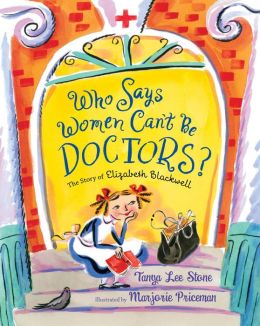
Who Says Women Can't Be Doctors? The Story of Elizabeth Blackwell. Tanya Lee Stone. Illustrated by Marjorie Priceman. 2013. 40 pages. [Source: Library]

I'll bet you've met plenty of doctors in your life. And I'll bet lots of them were women. Well, you might find this hard to believe, but there once was a time when girls weren't allowed to become doctors. Back int he 1830s, there were lots of things girls couldn't be. Girls were only supposed to become wives and mothers. Or maybe teachers, or seamstresses. Being a doctor was definitely not an option. What do you think changed all that? Or should I say....WHO?

I love this picture book biography of Elizabeth Blackwell. I love the narrative! It isn't just sharing simple information with readers; it is telling a vibrant, exciting story. Elizabeth Blackwell has PERSONALITY in this one. And that is what I love most in this one. History comes alive in this one! The illustrations by Marjorie Priceman are just perfect: so bold, so colorful, so expressive! (Especially the illustration showing Elizabeth Blackwell with her acceptance letter.)

This picture book biography would make a great read aloud.

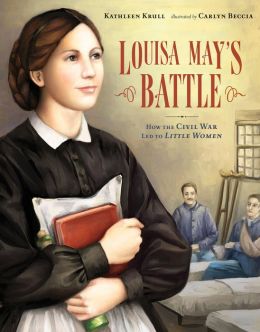
Louisa May's Battle: How the Civil War Led to Little Women. Kathleen Krull. Illustrated by Carlyn Beccia. 2013. Walker Books. 48 pages. [Source: Library]

For older readers, Louisa May's Battle is an interesting biographical story starring Louisa May Alcott. (The book is not a complete biography; it focuses specifically on Louisa May Alcott's life in the 1860s as she first becomes a nurse during the Civil War, and then becomes an author first publishing Hospital Sketches and later Little Women.)

Before the Civil War, there weren't many women nurses. But the war gave women the opportunity to fill an urgent need, and also the opportunity to prove themselves capable and skilled. For women who met these qualifications: at least thirty, very plain, unmarried, strong, and two reference letters proving their moral quality, there was an opportunity to serve their country well during a time of great need. Louisa May Alcott was one woman who answered the call.

After several months nursing, Louisa May Alcott became very ill. She was unable to keep nursing; it took her months in bed to recover her health. After she recovered, she wrote Hospital Sketches. This was her first publication. This book was very significant. And its success in part led her to write another book: Little Women.

I enjoyed Kathleen Krull's newest biography.

Look Up! Henrietta Leavitt, Pioneering Woman Astronomer. Robert Burleigh. Illustrated by Raul Colon. 2013. Simon & Schuster. 32 pages. [Source: Library]

Night after night, Henrietta sat on her front porch, gazing up at the stars. How high? How high is the sky? She wanted to know everything about the wonderful bigness of all she saw. The more she looked up, the bigger the sky seemed to get. It seemed endless!

Look up! is a picture book biography of the astronomer Henrietta Leavitt. The story is of a little girl who loved the night sky, who loved the stars, who followed her dream and persevered academically in a man's field. Most astronomers, at the time, being men, of course. But she knew what she wanted, and she knew she could do it. Henrietta's job--she got paid thirty cents an hour--was not to gaze through the telescope. Her job was to examine, to study, the photographs taken by others. She was good at her job, and through her measuring, through her detailed study, she made an important discovery, a discovery having to do with measuring distances and the vastness of galaxies.

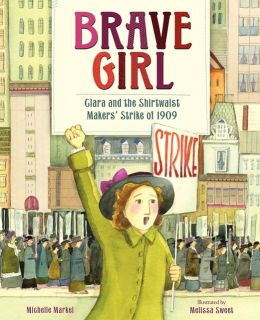
Brave Girl: Clara and the Shirtwaist Makers' Strike of 1909. Michelle Markel. Illustrated by Melissa Sweet. 2013. HarperCollins. 32 pages. [Source: Library]

A steamship pulls into the harbor, carrying hundreds of immigrants--and a surprise for New York City. The surprise is dirt poor, just five feet tall, and hardly speaks a word of English. Her name is Clara Lemlich. This girl's got grit, and she's going to prove it. Look out, New York!

Brave Girl is a picture book biography of Clara Lemlich, a young woman who led women factory workers to strike. This picture book focuses on the social injustices of the times, and how important it was for workers to be able to form unions, and make a stand together for what they believed to be right and fair. Clara's story is inspiring. Her determination and strength seem incredible. "She wants to read, she wants to learn! At the end of her shift, though her eyes hurt from straining in the gaslight and her back hurts from hunching over the sewing machine, she walks to the library. She fills her empty stomach with a single glass of milk and goes to school at night. When she gets home in the late evening, she sleeps only a few hours before rising again."

Definitely recommended.

© 2013 SukaYuka.com of SukaYuka's Book Reviews

Monday, July 8, 2013

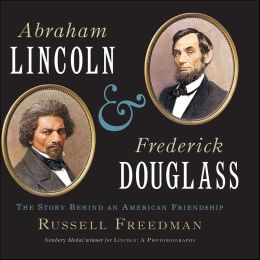
Abraham Lincoln and Frederick Douglass (2012)

Abraham Lincoln and Frederick Douglass. The Story Behind An American Friendship. Russell Freedman. 2012. Houghton Mifflin Harcourt. 128 pages. [Source: Review Copy]

I do enjoy Russell Freedman's nonfiction works for children and teens. Abraham Lincoln and Frederick Douglass includes a brief biography or introduction to two well-known men; each man, of course, deserving fuller treatment than this one book allows. The book begins with Frederick Douglass waiting to meet the President, Mr. Lincoln. The president has visiting hours every day, and Mr. Douglass is hopeful that he will get the chance to speak with him. Though Douglass hasn't always supported Lincoln's politics completely, or his policies completely. It is because of certain grievances that he is visiting there. He wants the president to be aware of certain conditions facing black soldiers. He wants the president to do something, to act. After that first brief glimpse of a meeting, readers then get the opportunity to learn about both men. There are chapters devoted to Frederick Douglass and chapters devoted to Abraham Lincoln. Through the biographies of both men--well partial biographies bringing the reader up to date, up to the Civil War--readers get a glimpse of the problems facing the nation. There is a definite focus on the war years 1861-1865.


© 2013 SukaYuka.com of SukaYuka's Book Reviews
Monday, May 27, 2013

The Bronte Sisters (2012)

The Bronte Sisters: The Brief Lives of Charlotte, Emily, and Anne. Catherine Reef. 2012. Clarion. 240 pages.

This is a young adult biography of three Victorian writers: Charlotte, Emily, and Anne Bronte. While it is titled Bronte Sisters it is in all honesty a look at the whole Bronte family, plenty of attention is given to their father, aunt, and brother. Beyond giving biographical details, the book focuses on the creative writing and creative world-making of all the Brontes. The author does discuss the works of each sister in some detail. For better or worse, the book discussions involve major spoilers. It was interesting to see how each book was received by the reading public or by the reviewing public! And how perceptions changed with each additional publication! For example, how perceptions of Jane Eyre changed a bit after Wuthering Heights was published!
Jane Eyre is one of my favorite books, so I just loved reading about its publication and initial impressions.

The book is a personal look into their lives. It also provides some context for readers interested in this time period. I liked this one. I would recommend it for those looking for an introduction to these writers.

© 2013 SukaYuka.com of SukaYuka's Book Reviews
Thursday, May 23, 2013

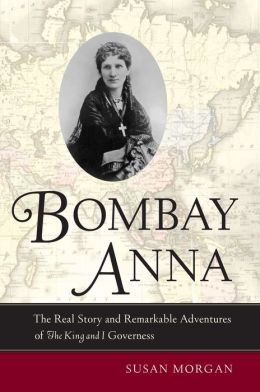
Bombay Anna (2008)

Bombay Anna: The Real Story and Remarkable Adventures of the King and I Governess. Susan Morgan. 2008. University of California Press. 300 pages.

A few weeks ago, I read and reviewed The English Governess and the Siamese Court. I found it boring and confusing. This biography of Anna Leonowens seeks to tell the "real story" of the governess of the King of Siam. Why is it necessary for the "real story" to be told? There are two very good reasons: first, Leonowens' own works--her memoirs and travel guides--were fictionalized in varying degrees, and, second, her life was further fictionalized by Margaret Landon in her 1944 novel, Anna and the King of Siam. These two portraits of Anna are different from one another, and neither are quite true enough, genuine enough. Anna and the King of Siam has inspired several film adaptations (musical and non-musical). There was a real story to be uncovered, a story that was not discovered until several decades after The King and I. Bombay Anna tries to unveil a third portrait of Anna that explains and to a degree justifies the lies.
  • Did you know that Anna was biracial? Her mother and grandmother were Indian or perhaps Indian-Portuguese. 
  • Did you know that Anna was born in India? Despite her created biography, Anna was not born in England or Wales. She had never been to the UK at all when she entered into Siam.
  • Did you know that Anna was raised in a diverse, vibrant multicultural environment? Siam was not Anna's introduction to other cultures or faiths. Christianity was not the only exposure, by any means, she grew up playing with children of other faiths; she respected and admired many faiths. She was definitely opposed to all forms of proselytizing. She felt the last thing Buddhists needed was conversion to Christ. 
  • Did you know that Anna spoke many languages, that she continued to learn many languages throughout her life? Anna was GREAT at learning foreign languages. She excelled in reading, writing, translating, speaking other languages. 
  • Did you know that Anna was well-traveled? The first twenty or twenty-five years of her life were spent in India; but, she later traveled with her husband to Singapore, and, then Australia. She then worked in Siam. After leaving Siam, she finally visited Ireland and England. She spent time in the United States, Canada, and Germany. She also spent months traveling in Russia. 
  • Did you know that she raised many of her grandchildren? 
  • Did you know Anna was a socialist?
  • Did you know that her son Louis died in 1919 during the Great Influenza?
  • Did you know that her great-nephew was Boris Karloff?
 Essentially, once Anna became a widow, she completely reinvented herself, erased her past, and cut off all connections with her family in India. She wanted to be an upper class British woman, and, so she BECAME a "proper" British woman. She sent one daughter to boarding school (in Ireland, I believe) and kept her youngest son with her and took him to Siam. (He returned to Siam as an adult, and spent the majority of his life there. Once his wife died, he brought his children to his mother to raise.) The stories she told her children, her grandchildren was the fictional one of her creation. She wove in her (fictional) history--her life story--into her written works and lectures. It was a complete new life she wanted, and she was successful her whole life through in keeping that story the real story.

Bombay Anna shares details about Anna's family background. Readers learn about her maternal grandparents, her parents, her step-father, her siblings, her husband, her children, her grandchildren, etc. Readers learn about India in the nineteenth century. Several communities or areas are described in great detail. Bombay Anna discusses Anna's new identities and how those identities were purposefully crafted, shaped, and controlled. Time is spent discussing Anna's life before, during, and after her time in Siam. There are chapters about her role as an educator, her role as a popular lecturer and writer, and her role as a parent and grandparent. The most time is spent on her time in India, Siam, and Canada. (She spent decades of her life in Canada).

Susan Morgan's enthusiasm for the subject is evident. She at times praises and justifies Anna Leonowens creative "truth-telling." She acknowledges to a degree that Leonowens lied in her works, that she crafted her facts, that she sometimes completely embellished those facts, yet, she maintains that her works contain important truths. Morgan does spend a good deal of time discussing slavery, imperialism, and women's rights.

Bombay Anna was certainly interesting, and at times quite fascinating. While it didn't answer all my questions, it certainly provided some context! My one question remains why would she personally believe and behave in such a way in real life and then write about her experiences and present them to the world completely differently? The Anna presented in Bombay Anna was caring, compassionate, concerned. She loved the women and children she met; she valued them, respected them, wanted them to have more freedom. Yet the way she chose to write about them in her memoir was very condescending!

Favorite quotes:
Never discovered, never unmasked, Anna went on to perform that new identity for the rest of her life, actually becoming the character she had made. On the basis of her self-invention, Anna led a wildly adventurous and influential life. A world traveler, she became a well-known travel writer and public lecturer at a time when most women stayed home. She remains the one and only foreigner to spend years inside the royal harem of Siam. She crossed all of Russia on her own just before the revolution. She emigrated to the United States, mingling with the rich and famous, the literary, and political abolitionists in the Northeast, and in her seventies settled down to raise eight children. Hers was a vigorous, intense, and inspiring life. (1)
Anna stepped off that boat with a brand-new identity and began a new life. She had chosen her new biography with care. It had to be a story that would account for her having no money, no available family, and no ties to her past, and--at the same time--would render plausible that she was a gentlewoman, entitled by birth to be part of the higher social classes, and also educated enough to qualify for work as a teacher. The story Anna came up with was, in fact, a very clever choice... She was, she said, Mrs. Leonowens, born in Wales and daughter of Captain Crawford, who died heroically in the Sikh rebellion, widow of Major Thomas Leonowens, with two children born in England. She was, regrettably, without family or income. Her grief-stricken mother, widowed in Bombay, had remarried a crude and materialistic man, and brought her teenage daughters out there from England. The crass stepfather disapproved of Anna's marriage choice and all intercourse between them had ceased. Anna's first child had died in Bombay, Anna's mother died virtually the same moment, and a second baby had died in New South Wales after their ship returning to England foundered there. She and her husband, after spending time back in England where they produced two children who lived--bless the English climate!--had returned east when he was reassigned to the Straits Settlements. But all her fortune had been lost in the bank failures after the terrible Indian Mutiny, and her beloved husband was dead, prostrated by heat after a tiger hunt. She found herself, alas, alone, unprotected, with little money, and with two children to raise. But she had come to Singapore full of determination. She was, after all, a British lady, well born and well brought up, well educated and firm of character, quite the right sort of person to earn a genteel living for herself and her dear children by educating the young. And so the new Anna was born. It was an excellent role, suited both to her passionate nature, so nourished by Tom's love, and to her deep intelligence. (70-71)
The beauty of Anna's story, her virtually uncheckable story, was that all it required was that she be able to act the part. Everything depended on how well Anna could play the role, could put across her new identity as a lady. And it is a tribute to her extraordinary intelligence and the extent of her knowledge and skill that Anna was able to play the part. She definitely rose to the occasion. She met the challenge of accent, that immediate giveaway of race and class in India. She was able to speak in the tones of the British upper class and even provided herself and her accent with a little leeway by locating her birthplace in Wales. And she knew how to behave like a lady as well. (72)
Her children never doubted their heritage. The conviction that they were born in England, were British and upper class, significantly shaped both their futures. (79)
Of course there was no romantic interest between Anna and King Mongkut, on either of their parts. He was a monarch utterly engaged in protecting and improving his kingdom, and she was a teacher mourning her beloved husband and struggling to make a professional life for herself and a future for her children. To cast their relationship in the frame of conventional romance is to do an injustice to them both. And it is also to do an injustice to what really is interesting about Anna's life. We tend too often to think, as George Eliot said, that the greatest stories are those of romantic love. But there are other stories, stories of the shaping of a character or a career or a country, that are at least as passionate and as deserving of being told. One such story is that of Anna Leonowens in Siam. (103)
One advantage her background gave her was that Anna never thought it her Christian duty to try to convert her Buddhist students. She was one of those rare Christians in the East in the nineteenth century who knew better than to judge the Buddhists, Muslims, and Hindus she was acquainted with as somehow inferior in their beliefs and practices. (125)

© 2013 SukaYuka.com of SukaYuka's Book Reviews