Showing posts with label 2004. Show all posts

Monday, January 20, 2014

Alexander the Conqueror (2004)

Alexander the Conqueror: The Epic Story of the Warrior King. Laura Foreman. 2004. Da Capo Press. 211 pages. [Source: Library]

I enjoyed reading this biography of Alexander the Great. Though the size of this one was a bit bulky at times, the use of so many photographs made this one less intimidating. Readers are provided with background into his country, his culture, his family. Plenty of time is spent on his father, Philip II, and Alexander's upbringing. Half of the book focuses on his rise and fall, what happens when his father dies and he comes into power and begins his conquest.

I liked the writing style. I found it reader-friendly and at times quite conversational. It had just enough detail to be interesting as an introduction to the subject. Too much detail might prove overwhelming or intimidating. This was the first biography I'd read, and I found it just right for the most part.

© 2014 SukaYuka.com of SukaYuka's Book Reviews

Thursday, October 31, 2013

Handel Who Knew What He Liked

Handel, Who Knew What He Liked. M.T. Anderson. Illustrated by Kevin Hawkes. 2004/2013. Candlewick. 48 pages. [Source: Review copy]

Oh, how I loved this little chapter-book biography of Handel!!! M.T. Anderson should write more books just like this! I loved the book's liveliness. It was clever and full of personality. I love the touch of humor and wit!

Favorite quotes:
Right from an early age, George Frideric Handel knew just what he liked. He wanted to study music. His father said he couldn't. His father said nobody ever made any money as a musician. He told the boy to study something that would make him money. Handel's father was a doctor. But little Handel knew what he liked. What he liked was music. So he smuggled a clavichord up into the attic without his parents knowing. Late at night, he taught himself to play. Handel was an unusual boy. Not everyone has the courage to smuggle a clavichord past their parents. (1)
Handel studied first in his own city of Halle, and later, when he was eighteen, in the city of Hamburg. One of his best friends in Hamburg was a composer named Mattheson. They both loved music. In particular, they loved operas. Sometimes they even performed operas together. Mattheson couldn't get enough opera--especially his own. He would write an opera, and then he would star in it himself. He would often arrange to play a character who died partway through the opera. That way he could jog down and lead the orchestra from the harpsichord. Handel, who'd be playing when Mattheson got there, would have to stop and move aside for his friend. Handel thought Mattheson was a bit of a pain. One night when Mattheson had killed himself onstage and come down to play the harpsichord, Handel refused to get up. Mattheson threatened him. Handel was very stubborn; he kept right on playing. So right there and then, Mattheson challenged Handel to a duel. They walked out of the theater into the cold winter's night. They drew their swords and set upon each other in the square. Mattheson thrust his rapier right toward Handel's heart--but luckily the blade hit Handel's coat button, and broke. Later that night, they went out for a big dinner. After all, they were still good friends. Big dinners always made Handel feel a lot better. (6, 8)
© 2013 SukaYuka.com of SukaYuka's Book Reviews

Monday, October 7, 2013

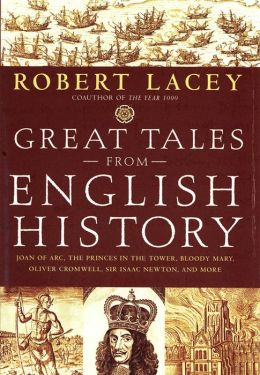
Great Tales From English History #2

Great Tales From English History, vol. 2. Robert Lacey. 2004. Little, Brown. 288 pages. [Source: Library]

There are three volumes in Robert Lacey's series entitled Great Tales From English History. I loved, loved, loved the first volume. One of the reasons this series is so wonderful is the author's philosophy on history.
Our very first historians were storytellers--our best historians still are--and in many languages 'story' and 'history' remain the same word. Our brains are wired to make sense of the world through narrative--what came first and what came next--and once we know the sequence, we can start to work out the how and why. (xiii)
Great Tales From English History...is written by an eternal optimist--albeit one who views the evidence with a skeptical eye. In these books I have endeavored to do more than just retell the old stories; I have tried to test the accuracy of each tale against the latest research and historical thinking, and to set them in a sequence from which meaning can emerge. (xiv)
The things we do not know about history far outnumber those that we do. But the fragments that survive are precious and bright. They offer us glimpses of drama, humour, frustration, humanity, the banal and the extraordinary--the stuff of life. (xvi)
The second volume begins in the reign of Richard II and ends during the reign of William and Mary. Highlights from this volume include:
  • Geoffrey Chaucer and the Mother Tongue
  • The Deposing of King Richard II
  • Turn Again, Dick Whittington
  • Henry IV And His Extra-virgin Oil
  • We Happy Few -- the Battle of Azincourt
  • Joan of Arc, the Maid of Orleans
  • House of Lancaster: The Two Reigns of Henry VI
  • The House of Theodore
  • House of York: Edward IV, Merchant King
  • Whodunit? The Princes in the Tower
  • The Battle of Bosworth Field
  • King Henry VIII's Great Matter
  • Let There Be Light -- William Tyndale and the English Bible
  • Divorced, Beheaded, Died...
  • ...Divorced, Beheaded, Survived
  • Lady Jane Grey -- The Nine Day Queen
  • Bloody Mary and the Fires of Smithfield
  • Elizabeth -- Queen of Hearts
  • Mary Queen of Scots
  • By Time Surprised
  • 5/11: England's First Terrorist
  • King James's Authentical Bible
  • Roundheads v. Caviliers
  • Behold the Head of a Traitor
  • Charles II and the Royal Oak
  • London Burning
  • Titus Oates and the Popish Plot
  • Monmouth's Rebellion and the Bloody Assizes
  • The Glorious Invasion
I loved this second volume. I just LOVED it. Lacey has such a narrative gift. He informs and entertains! I loved his selection of stories. I read it in one sitting; I just couldn't put this one down!

Favorite quotes:
For England, Agincourt has inspired quite a different national myth. London welcomed Henry home with drums, trumpets and tambourines and choirs of children dressed as angels. Flocks of birds were released into the air and gigantic carved effigies spelled out the meaning of the victory--a David defeating Goliath.
'We few, we happy few, we band of brothers', were the words with which Shakespeare would later enshrine Agincourt's model of bravery against the odds--the notion that the English actually do best when they are outnumbered. This phenomenon came to full flower in 1940 during the Battle of Britain, when Britain faced the might of Germany alone and Churchill spoke so movingly of the 'few.' To further fortify the bulldog spirit, the Ministry of Information financed the actor Laurence Olivier to film a Technicolor version of Agincourt as depicted in Shakespeare's Henry V. 'Dedicated to the Airborne Regiments' read a screen title in medieval script as the opening credits began to roll. (22)
If the Wars of the Roses were fought by the men, it was the women who eventually sorted out the mess. By the late 1400s the royal family tree had become a crazy spider's web of possible claimants to the throne, and it took female instinct to tease out the relevant strands from the tangle. The emotions of mothers and wives were to weave new patterns--and eventually they produced a most unlikely solution. (38)
Wars and Roses...we have seen that roses were rare on the battle banners of fifteenth century England. Let's now take a closer look at the 'wars' themselves. In the thirty-two years that history textbooks conventionally allot to the 'Wars of the Roses,' there were long periods of peace. In fact, there were only thirteen weeks of actual fighting--and though the battles themselves were bitter and sometimes very bloody, mayhem and ravaging seldom ensured. (46)
 Connections to Horrible Histories:

Plague Song
Owain Glyndwr Song
Agincourt the Movie
Joan of Arc
War of the Roses Reports & Richard III Song 
Wives of Henry VIII
Philip and Mary Love Story
Mary Tudor Song
The Axe Factor
William Shakespeare & The Quills
Spanish Armada Movie
Blue-Blooded Blues
English Civil War (Bob Hale)
English Civil War Song, Cromwell Laws, King of Bling

© 2013 SukaYuka.com of SukaYuka's Book Reviews