Showing posts with label Nonfiction. Show all posts

Monday, January 13, 2014

The Boys in the Boat (2013)

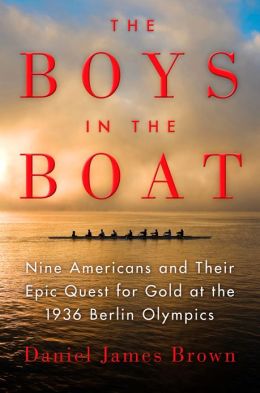
The Boys in the Boat. Daniel James Brown. 2013. Viking. 416 pages. [Source: Library]

Wow! What a book! I knew that I would probably end up loving this one despite my complete lack of interest in sports simply because of the dynamic storytelling. The Boys in the Boat focuses on personalities. It is powerful examination of human resiliency. Readers learn of the nine men on the Olympic team; readers learn of the coaches whose hard work and discipline and instinct, perhaps, led them there; readers learn of the man who made the rowing shells--not just for this one team, but, for so MANY in the rowing program. It's a story spanning a decade or two. Not every team member gets the full treatment, but, what we do learn is so emotionally compelling. It won't come as a big surprise, perhaps, to learn how much I LOVED, LOVED, LOVED learning Joe Rantz's story. But really, the whole book is so good, so worth reading...

Boys in the Boat is nonfiction at its best!!!


© 2014 SukaYuka.com of SukaYuka's Book Reviews

Monday, December 2, 2013

How To Create the Perfect Wife (2013)

How To Create the Perfect Wife: Britain's Most Ineligible Bachelor And His Enlightened Quest to Train the Ideal Mate. Wendy Moore. Basic Books. 344 pages. [Source: Library]

How To Create the Perfect Wife was a fascinating read, fascinating in a despicable way, I suppose. Most readers will probably not enjoy getting to know the "hero", Thomas Day.

Who was Thomas Day? He was well-known several centuries ago. He lived and wrote during the reign of George III. He wrote two books for children: The History of Sandford and Merton and The History of Little Jack. Writing for children was definitely a new phenomenon. He also co-wrote a best-selling abolitionist poem called "The Dying Negro."

The focus of How To Create The Perfect Wife is not on Thomas Day's writing career. The focus is on the man's eccentricities. Day was a bit OBSESSED with Jean-Jacques Rousseau. It wasn't just that Emile was his most-favorite book. He was determined to live-out the philosophy, to run experiments on human subjects. His love life was a big mess, a complete failure. Why couldn't he find a wife? a good wife? a perfect wife? Society was to blame. He couldn't find an untainted woman free from contamination with the world, with society. He couldn't find a woman who shunned fashion, music, dance, art, good conversation. He wanted a brilliant wife who loved to listen, was willing to listen, obey, and serve. He wanted to be worshiped, and obeyed. Since there wasn't an eligible woman ready and willing to marry him now, the solution was simple. He would look for a young girl, a trainable child, one whom he could raise according to Rousseau's principles and philosophy, one whose training and upbringing he could control almost from start to finish. (I think he picked an eleven year old and a twelve year old?) He picked TWO girls and put them in competition with each other. Though of course neither girl knew they were an experiment, that they were being trained to be one man's notion of the perfect wife. After a year, he chose one girl to continue on...

The focus of the book is just as much on the one girl, Sabrina....

I won't tell you if Day's experiment is a success...and if he ever married....

I enjoyed reading How to Create The Perfect Wife because of the glimpse into the culture and society. I enjoyed meeting Day's friends the best. He kept surprisingly good company: Richard Lovell Edgeworth (father of Maria Edgeworth), Erasmus Darwin, and Anna Seward. Sabrina also became quite close to the Burney family: Charles Burney, Frances Burney, Sarah Burney. 

The book discusses Ovid's Metamorphoses and George Bernard Shaw's Pygmalion (1912). The myth was very popular in the 18th century. It inspired many operas and melodramas, including one by Rousseau. Thomas Day's experiment inspired many novelists including Anthony Trollope (Orley Farm), Henry James (Watch and Ward), Maria Edgeworth (Belinda). 

© 2013 SukaYuka.com of SukaYuka's Book Reviews
Monday, November 11, 2013

How The Barbarian Invasions Shaped The Modern World

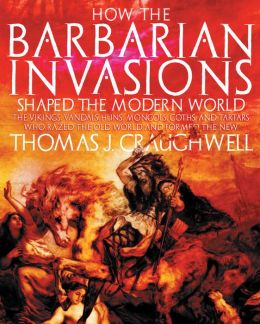
How The Barbarian Invasions Shaped The Modern World. Thomas J. Craughwell. 2008. Fair Winds Press. 320 pages. [Source: Library]

The full subtitle of this one is "The Vikings, Vandals, Huns, Mongols, Goths, and Tartars Who Razed the Old World and Formed the New."

I'd describe this book as readable. It is a broad overview of the subject; it provides a framework for further study perhaps. It serves as a good introduction. It isn't the most thorough book on the Vikings or the Vandals or the Huns or the Mongols or the Goths or the Tartars.

I found it fascinating and quite entertaining. I knew practically nothing on the subject, and yet I found this one compelling instead of confusing. I wasn't sure what to expect when I began, but by the end, I was a fan. I loved the middle section the best. The Viking chapters were just what I was looking for.
  • "The Brightest Light of the Whole World Is Extinguished" The Goths Sack Rome
  • "They Filled The Whole Earth With Slaughter and Panic" The Arrival of the Huns
  • The Scourge of God: Attila the Hun
  • King of the Land and the Sea: Gaiseric and the Glory Days of the Vandals
  • An Empire of Their Own, The Vandals and the Second Sacking of Rome
  • The Groans of the Britons: The Angle, Saxon, and Jute Invasion of Britain
  • The Long-Haired Kings: The Franks
  • The First Viking Invasion of England: The Sacking of Lindisfarne Abbey
  • The Last King: Alfred the Great
  • "Floods of Danes and Pirates" The Vikings in Ireland
  • The Wasteland: The Vikings in the Frankish Empire
  • The Resurrection of Hastein: Vikings in the Mediterranean
  • The Blood of Heroes: Irish and Vikings at the Battle of Clontarf
  • The End of the Viking Age: The Battle of Stamford Bridge
  • Vengeance On Her Mind, Olga of Kiev
  • The Prince Who Made Kiev Christian: Vladimir of Kiev
  • Spitting on the Emperor: The Mongols in China
  • The Golden Horde: The Mongols in Russia
  • Sacks Full of Ears: The Mongols in Eastern Europe
The legacy of the Vikings in England is destruction. Libraries burned. Rare works of art looted and lost forever. Towns and villages wiped off the landscape. Lives destroyed. And the future of England--the nation that has had an immeasurable impact on the world's ideas about civil rights, representational government, and personal freedom--placed in severe jeopardy.
Some historians have tried to find positive contributions that the Vikings brought to England. But aside from teaching the English a better method of shipbuilding and adding Scandinavian words such as "skate" and "skiff" and "anger" and "muck" to the English language, and giving Scandinavian names to about 1,400 locations in England (places ending in -by, -thorpe, -toft, and -thwaite), Viking influence in England was almost nil. With one exception: By annihilating six of the seven English royal families, the Vikings inadvertently transformed the country from a patchwork of little kingdoms into a single realm under one kind. And once England was unified, it became a political and cultural powerhouse. (128)
Once the Vikings and the English intermarried, and especially once the Vikings began to convert to Christianity, their assimilation into English society was virtually painless. But that integration came decades after the first Viking raid in England. Between 793 and 865, the Vikings were marauders who brought nothing but pain and anguish to the people of England. (130)
© 2013 SukaYuka.com of SukaYuka's Book Reviews

Sunday, November 10, 2013

Sunday Salon: Reading Our Island Story

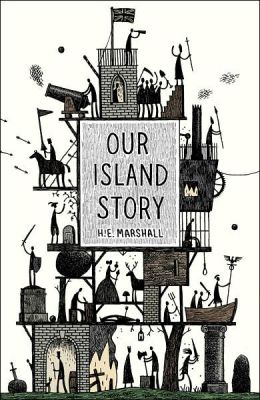
Our Island Story. H.E. Marshall. 1905/? 512 pages. [Source: Bought]

Our Island Story blends fact and fiction. It is technically a history book, an introduction to British history. But included in this "history" book are legends and myths. Marshall definitely attributes motives to various historical figures and makes definite judgments. It is a subjective history book with an emphasis on story and personality. It isn't exactly scholarly and accu-rat. (In fact there were a few chapters here and there where I was singing right along with "It's Not True.") But it is almost thoroughly enjoyable all the way through. True, I didn't always agree with her conclusions, and she was very reliant on Shakespeare's history plays perhaps. But. Still I think this one offers an enjoyable overview of a large period of history--over a thousand years! It covers Romans, Anglo-Saxons, Vikings, Normans, and all the rest! Every monarch gets covered, some more than others. So even if you find yourself disagreeing with a fact or two in a couple of stories, chances are you'll find something to appreciate at least! The narrative style is "for children" in that it is simplified and written in a traditional story style. It is a tame presentation of history in a way. If you're familiar with some of the monarchs, you'll understand why that might be needed!

The edition I read went through World War I and discussed the founding of the League of Nations. I cannot find a date for a subsequent edition or reprinting.

© 2013 SukaYuka.com of SukaYuka's Book Reviews

Monday, November 4, 2013

Becoming Shakespeare (2007)

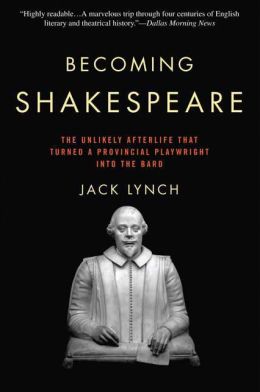
Becoming Shakespeare: The Unlikely Afterlife That Turned a Provincial Playwright Into the Bard. Jack Lynch. 2007. Walker. 320 pages. [Source: Library]

I'm so glad whimsy led me to Becoming Shakespeare! This is a little book about how Shakespeare became SHAKESPEARE, the one and only. After all, in his lifetime, he was one of many successful playwrights in Elizabethan England. But he wasn't recognized as THE BARD during his life. His universal genius was far from recognized. In chapter one, "Reviving Shakespeare" Lynch discusses how Shakespeare's resurrection was due in part to the restoration of the monarchy. Before Charles II was restored to the throne, plays were banned; theatres were sinful, don't you know! But the oh-so-merry monarch changed the rules. New plays were produced, of course, during this time. But Shakespeare was revived as well. In chapter two, "Performing Shakespeare," Lynch discusses several centuries worth of actors whose claim to fame was due in part to playing Shakespeare roles. Notable actors mentioned include: Thomas Betterton, Colley Cibber, James Quin, David Garrick, John Philip Kemble, Sarah Kemble Siddons, Fanny Kemble, Mary Robinson, Dorothy Jordan, and Edmund Kean. Chapter three, "Studying Shakespeare" is the story of Shakespeare scholarship through the centuries. This focuses on publishing and editing and various editions, changes to the texts, etc. This chapter is not about censoring Shakespeare, that story is saved for another chapter. Chapter Four, "Improving Shakespeare," is about adapting or editing Shakespeare for the stage. This chapter focuses on producers changing or rewriting Shakespeare to meet their needs and satisfy their audiences. This included changing endings in some cases! It also included adding scenes, adding characters, adding lines. In some cases, these "new" editions of Shakespeare were produced on the stage for decades while the original play was not. So one's new-and-improved King Lear might be the only one seen by many generations! Chapter five, "Co-opting Shakespeare" is all about politics, about using Shakespeare lines or quotes for your own purposes, to prove your point or make an argument, as propaganda in a way. This wasn't a favorite chapter. But it had its moments. It discusses how people read politics into his plays. How they could watch a play on the stage and come away with an opinion about modern politics. Chapter six, "Domesticating Shakespeare" is about making Shakespeare family-friendly and safe for all ages. This is about censorship or "bowdlerizing" the text. Removing puns and innuendos and such. But this is also the chapter that talks about retelling Shakespeare the right way (Tales from Shakespear). Chapter seven, "Forging Shakespeare" is about writers or historians who have "found" or "discovered" documents (signatures, plays, poems, etc.) It is about various attempts to hoax the public and achieve fame. Chapter eight, "Worshipping Shakespeare" is all about celebrating Shakespeare making him larger-than-life in some instances. This is about cultivating and celebrating his legacy. For example, Shakespeare celebrations and Shakespeare-related tourist attractions.

I definitely enjoyed this one! Some chapters I appreciated more than others. Some I thought did a great job in capturing culture and society.

© 2013 SukaYuka.com of SukaYuka's Book Reviews
Tuesday, October 29, 2013

Outcasts United (2012)

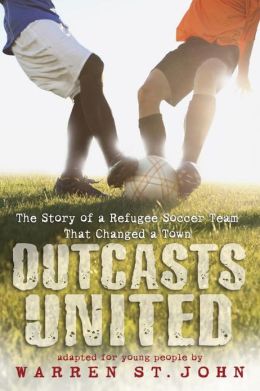
Outcasts United: The Story of a Refugee Soccer Team. Warren St. John. 2012. Random House. 240 pages. [Source: Review Copy]

I did not know what to expect from Outcasts United. On the one hand, I do not like sports--watching sports or reading about sports. On the other hand, I do like compelling personal accounts, people working, struggling, hoping, believing. The hero of Outcasts United is Luma Mufleh, a woman soccer coach. Mufleh was born and raised in Jordan; she came to the United States for college and decided that this is where she wanted to live. Staying in the U.S. meant breaking apart the family, and angering her family. But she'd had a taste of freedom, and wanted more. She knew it would be work, work, work. She knew it would not be easy, but she knew this would be her best chance. This isn't her story alone, it is the story of lives touching and connecting--immigrant stories. Readers learn a handful of stories about boys mainly, these are those Luma came to know in her role as coach. She wasn't just teaching soccer, she was also teaching discipline, self-control, responsibility, and respect.

Mufleh's three teams are mentioned: her under 17, her under 15, and her under 13 teams. But for the most part, it is the two younger teams that are the focus of the book. The book highlights specific players from specific seasons of the game.

This one has a definite sports emphasis. It is a book dedicated to the sport of soccer. If you have zero interest in that subject, you may or may not get enough satisfaction from the other stories. I liked some chapters better than others.

© 2013 SukaYuka.com of SukaYuka's Book Reviews
Monday, October 28, 2013

The Time Traveler's Guide to Elizabethan England (2013)

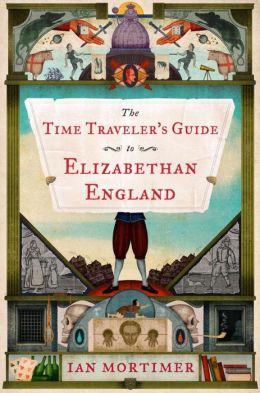
The Time Traveler's Guide to Elizabeth England. Ian Mortimer. 2013. Viking. 416 pages. [Source: Library]

I really enjoyed reading Ian Mortimer's The Time Traveler's Guide to Medieval England. I was excited to learn of his newest book, The Time Traveler's Guide to Elizabethan England. Like the first book, it is broken down into sections:

The Landscape
The People
Religion
Character
Basic Essentials
What To Wear
Traveling
Where To Stay
What to Eat and Drink
Hygiene, Illness, and Medicine
Law and Disorder
Entertainment

Each chapter is broken down into sections as well. This makes it perfect for skimming and browsing. Of course, it is a fascinating read almost cover to cover. Personally, I'm not as excited about "landscape" as I am "entertainment." But for the most part, the book was packed with interesting information and presented in a conversational way. It was easy to read. It was fun! The premise is to provide readers with the information they would need IF they were to themselves travel back in time. So the focus is different than other history books. The focus is on the ordinary and every day. It is on the little details. 
"It is often said of Shakespeare that he is "not of an age but for all time" -- a line originally penned by Ben Jonson. But Shakespeare is of an age--Elizabethan England. It makes him. It gives him a stage, a language, and an audience. If Shakespeare is "for all time," then so too is Elizabeth England." (325)
The chapter "Character" is subdivided into these sections: "Violence and Cruelty," "Bribery and Corruption," "Wit," "Literacy and Printing," "Education," "Knowledge of the Wider World," "Attitudes to Foreigners," "Racism," "Scientific Knowledge," "Superstition and Witchcraft," and "A Sense of History." There is a lot of information! And 'Character' doesn't really do justice to it!!!

From the division, "Wit"
Let one more example suffice, for quickness of wit on the spur of the moment. John Manningham of the Middle Temple records in his journal for March 13, 1602, a performance of Shakespeare's play Richard the Third, in which Richard Burbage plays the title role. A female member of the audience grows so smitten with Burbage that she urges him to come to her that same night. She tells him to knock on her door and announce himself as "Richard the Third." Shakespeare overhears their conversation, and goes to the lady's chamber first. When the appointed hour arrives Burbage knocks on the door and announces that "Richard the Third" has arrived--only to hear Shakespeare reply from within: "William the Conqueror came before Richard the Third." (84)
The chapter Entertainment is subdivided into these sections: "Sightseeing," "Alehouses and Taverns," "Games," "Music and Dancing," "Literature," "The Theater."

From "Music and Dancing"
Although no one has yet conclusively proved that music is the food of love, there is little doubt that Shakespeare himself thinks it is. More than 170 passages in his plays allude to music or musicians, airs or madrigals, and nearly all do so in a positive way. The words for many songs are reproduced verbatim in the plays. (301)
There were sections of this book that I just LOVED. I didn't love every chapter equally. But what I loved, I really loved. I really only found one chapter boring.


© 2013 SukaYuka.com of SukaYuka's Book Reviews
Monday, October 21, 2013

Charlotte & Leopold

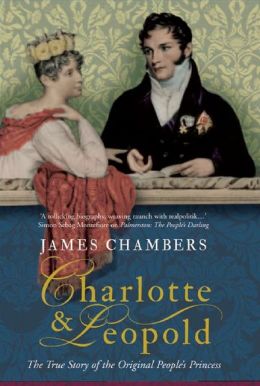
Charlotte & Leopold: The True Story of the Original People's Princess. James Chambers. 2007. 256 pages.

During her life, Princess Charlotte was the most popular member of the royal family. She was more popular than her grandfather, George III, and her father, the Prince Regent (George IV). Her life was certainly interesting. Her father and mother were CHARACTERS. They often made fools of themselves to the media and society in general. They were always fighting one another, always bickering, always trying to outdo one another. I'd already read a biography of Caroline. The focus on her parents is almost necessary to explain her childhood and upbringing. It also helps explain her popularity, to a certain degree.

The second half focuses on her love life, on her suitors and would-be suitors. The book focuses, of course, on the man she married, Prince Leopold. He's an interesting character as well! And his story does not end with his wife's death. The last chapters of the book follow his life...

I liked this one. I did. I also really loved Becoming Queen Victoria: The Tragic Death of Princess Charlotte and the Unexpected Rise of Britain's Greatest Monarch. The books overlap on their focus of Princess Charlotte. Both books bring the Georgian royalty to life, highlighting some of the more interesting members of the family!

© 2013 SukaYuka.com of SukaYuka's Book Reviews
Monday, October 14, 2013

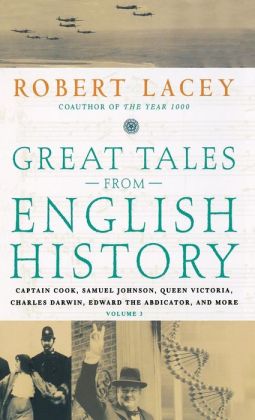
Great Tales From English History, vol. 3

Great Tales from English History, volume 3. Robert Lacey. 2008. Little, Brown. 320 pages. [Source: Library]

This is the third volume in Robert Lacey's Great Tales from English History. I have reviewed both previous volumes: one, two. It covers the years 1690-1953. Diverse subjects are covered as well: religion, politics, science, philosophy, war, inventors and inventions, explorers and travelers. One thing I definitely noticed was the focus is less on royalty and the aristocrats.
The job of the historian is to deal objectively with the available facts. But history is in the eye of the beholder and also of the historian who, as a human being, has feelings and prejudices of his own... So let me try to be candid about some of my own prejudices. I believe passionately in the power of good storytelling, not only because it is fun, but because it breathes life into the past. It is also through accurate narrative--establishing what happened first and what happened next--that we start to perceive the cause of things, and what influences human beings to act in the noble and cruel ways that they do. I believe that nobility actually secures more effective outcomes than cruelty, though the story of the slave trade in the pages that follow might seem to challenge that. I also believe that ideas matter, that change is possible, that knowledge dispels fear, and that good history both explains and facilitates all those things. (3)
Overall, this series has been wonderful. I've loved these short tales. I've loved the focus on individuals, loved the chronological arrangement, loved seeing the big picture come together. I enjoyed the first two volumes in this series a little bit more than this third and final volume. But I am so glad I discovered the series!!!

Highlights from this volume include:
  • John Locke and Toleration
  • Union Jack
  • Britain's First Prime Minister
  • Born Again
  • Dick Turpin -- Stand and Deliver
  • God Save the King!
  • Dr. Johnson's Dictionary
  • The Madness of George III
  • Wellington and Waterloo
  • Stone Treasures Mary Anning and the Terror Lizards
  • I Will Be Good -- Victoria Becomes Queen
  • Prince Albert's Crystal Palace
  • Women and Children First -- The Birkenhead Drill
  • The Lady of the Lamp and the Lady with the Teacup
  • The Great Stink and the Tragedy of the Princess Alice
  • The King's Horse and Emily Davison
  • The Greatest History Book Ever
  • Dunkirk -- Britain's Army Saved by the Little Boats
  • Battle of Britain -- the Few and the Many
  • Code-making, Code-breaking - 'The Life That I Have'
  • Decoding the Secret of Life
Horrible Histories connections:

Dick Turpin
George the I Doesn't Understand English (Creation of First Prime Minister)
Born 2 Rule (The 4 Georges) (song)
Bonnie Prince Charlie
Queen Victoria and Albert(song)
Victorian Inventions (song)
Transportation Song
Florence Nightingale 
Mary Seacole Song
Suffragettes Song
RAF Song
Stinky Parliament
Napoleon Report

© 2013 SukaYuka.com of SukaYuka's Book Reviews
Monday, September 30, 2013

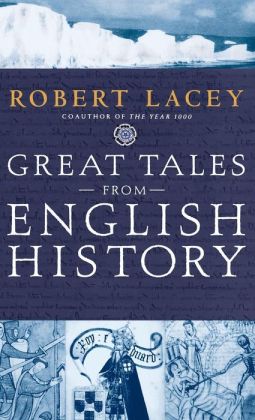
Great Tales From English History (2003)

Great Tales from English History, vol. 1. Robert Lacey. 2003. Little, Brown. 272 pages. [Source: Library]

I loved, loved, loved this history book. From the start, I knew it was just the book for me.
'History' and 'story' derive from the same linguistic root, and if history can never escape its authorship, it should at least try to make the authorship readable and bright. (xiv)
and
But personality -- human nature -- is surely the essence of history, and I have deliberately made personalities the essence of this book. Brief though each chapter is, Great Tales seeks to create a coherent, chronological picture of our island story, while following the guiding principle that all men and women have heroism inside them -- along with generous and fascinating measures of incompetence, apathy, evil and lust. (xv)
This is the first of three volumes. This book concentrates on the dark ages (or early medieval if you prefer) and the first part of the middle ages. Only three stories are dated BEFORE the birth of Christ (AD). Highlights from this volume include:
  • Boadicea, Warrior Queen
  • Arthur, Once and Future King
  • Caedmon, The First English Poet
  • The Venerable Bede
  • Edward the Confessor
  • The Legend of Lady Godiva
  • The Domesday Book
  • The Mysterious Death of William Rufus
  • Stephen and Matilda
  • Murder in the Cathedral
  • Richard the Lionheart
  • John Lackland and Magna Carta
  • Simon de Montfort and His Talking-place
  • The Fair Maid of Kent and the Order of the Garter
  • The Great Mortality
Angles, Saxons, Celts, Romans, Vikings, Normans...all are to be found in this first volume. Reading this little book will give you a starting place to grasp the English rulers. (William the Conqueror to Richard II in this volume).

Each story is just a few pages long; it is all so reader-friendly! There is nothing dry and boring in this little volume!!!

Love Horrible Histories? Then these videos pair well with this little book.

Boudicca
Celtic Boast Battles
Saxon Invasion, Invasion, Invasion
Kidnapped and Kidnapped 2
Anglo-Saxons Ordeals
Monks Song
Viking Song "Literally"
Domesday Book
Normonoply
Death of William Rufus
English Rulers
Norman Family Tree Song
King John Online
Plague Song

© 2013 SukaYuka.com of SukaYuka's Book Reviews
Monday, September 23, 2013

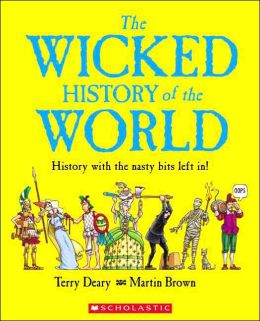
The Wicked History of the World

The Wicked History of the World: History With the Nasty Bits Left In. Terry Deary. Illustrated by Martin Brown. 2006. Scholastic. 96 pages. [Source: Library]

The Wicked History of the World is a reader-friendly introduction to world history. A lot of subjects are introduced and discussed quite briefly; it is not a complete and thorough introduction to any time period. This one seems perfect for browsing. It isn't just prose; there are quizzes, "diary entries," and comics too.

This is one of many books published in the "Horrible Histories" series. (Before the television show, there were books.) For those wanting to make a connection to the WONDERFUL show...

Roman Funerals 
Vikings Song "Literally"
Blackbeard's Song
Dick Turpin's Song

I liked this one. I wish my library had more of the series. 

© 2013 SukaYuka.com of SukaYuka's Book Reviews
Monday, September 16, 2013

The Life of Cesare Borgia (1912)

The Life of Cesare Borgia: A History and Some Criticisms. Rafael Sabatini. 1912. 326 pages. [Source: Bought]

Rafael Sabatini would NOT have approved of Horrible Histories' Borgia Family. The truth is, however, that I would never have sought out Sabatini's biography of Cesare Borgia if I'd not fallen in love with the video. It was Mat's "I am the mostest, powerfulest, evilest of all" that made me curious and seeking. I wasn't that impressed by my first attempt to learn more. The fictional Borgia Bride was awful. Fortunately, I discovered Sabatini's biography. It was LOVE.  It wasn't love because it fit into any preconceived notions about how I wanted the Borgia family to be. It was love because it respected human nature and historical fact. It embraced common sense and used dry wit, in part, to argue and persuade.

I journaled my reading in four parts. The first post tackled the preface and introduced Sabatini's goal in writing. It was WONDERFUL. The second post examined Cesare's father, Alexander VI (Rodrigo). The third post focused almost exclusively on Cesare. The fourth post focused on Sabatini as an author, his narrative style, his technique of criticizing other authors and sources. 
Life is an ephemeral business, and we waste too much of it in judging where it would beseem us better to accept, that we ourselves may come to be accepted by such future ages as may pursue the study of us.
But if it be wrong to judge a past epoch collectively by the standards of our own time, how much more is it not wrong to single out individuals for judgement by those same standards, after detaching them for the purpose from the environment in which they had their being? How false must be the conception of them thus obtained! We view the individuals so selected through a microscope of modern focus. They appear monstrous and abnormal, and we straight-way assume them to be monsters and abnormalities, never considering that the fault is in the adjustment of the instrument through which we inspect them, and that until that is corrected others of that same past age, if similarly viewed, must appear similarly distorted.
Hence it follows that some study of an age must ever prelude and accompany the study of its individuals, if comprehension is to wait upon our labours.
Sabatini just came across to me as practical, witty, sometimes wise, and sometimes poetic.
Mind being the seat of the soul, and literature being the expression of the mind, literature, it follows, is the soul of an age, the surviving and immortal part of it; (6)
Anyway, here is Sabatini's thesis--his goal for writing this biography. If you can embrace this premise, then chances are you'll find this one well worth the read!!!
Before we admit facts, not only should we call for evidence and analyse it when it is forthcoming, but the very sources of such evidence should be examined, that, as far as possible, we may ascertain what degree of credit they deserve. In the study of the history of the Borgias, we repeat, there has been too much acceptance without question, too much taking for granted of matters whose incredibility frequently touches and occasionally oversteps the confines of the impossible. (12)
If the author has a mercy to crave of his critics, it is that they will not impute it to him that he has set out with the express aim of "whitewashing"—as the term goes—the family of Borgia. To whitewash is to overlay, to mask the original fabric under a superadded surface. Too much superadding has there been here already. By your leave, all shall be stripped away. The grime shall be removed and the foulness of inference, of surmise, of deliberate and cold-blooded malice, with which centuries of scribblers, idle, fantastic, sensational, or venal, have coated the substance of known facts.
But the grime shall be preserved and analysed side by side with the actual substance, that you may judge if out of zeal to remove the former any of the latter shall have been included in the scraping.
(13)
If Sabatini was alive to refute current fictional portrayals of Cesare in romance novels...
Women play no part whatever in his history. Not once shall you find a woman's influence swaying him; not once shall you see him permitting dalliance to retard his advancement or jeopardize his chances. With him, as with egotists of his type, governed by cold will and cold intellect, the sentimental side of the relation of the sexes has no place. With him one woman was as another woman; as he craved women, so he took women, but with an almost contemptuous undiscrimination. 
The biography is rich in detail. It doesn't just focus on Cesare. It tries to cover more than that--to look at an age, to capture a time and place. It is ALL ABOUT context for Rafael Sabatini. And I really enjoyed his technique overall. 

© 2013 SukaYuka.com of SukaYuka's Book Reviews
Monday, July 8, 2013

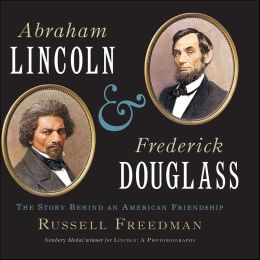
Abraham Lincoln and Frederick Douglass (2012)

Abraham Lincoln and Frederick Douglass. The Story Behind An American Friendship. Russell Freedman. 2012. Houghton Mifflin Harcourt. 128 pages. [Source: Review Copy]

I do enjoy Russell Freedman's nonfiction works for children and teens. Abraham Lincoln and Frederick Douglass includes a brief biography or introduction to two well-known men; each man, of course, deserving fuller treatment than this one book allows. The book begins with Frederick Douglass waiting to meet the President, Mr. Lincoln. The president has visiting hours every day, and Mr. Douglass is hopeful that he will get the chance to speak with him. Though Douglass hasn't always supported Lincoln's politics completely, or his policies completely. It is because of certain grievances that he is visiting there. He wants the president to be aware of certain conditions facing black soldiers. He wants the president to do something, to act. After that first brief glimpse of a meeting, readers then get the opportunity to learn about both men. There are chapters devoted to Frederick Douglass and chapters devoted to Abraham Lincoln. Through the biographies of both men--well partial biographies bringing the reader up to date, up to the Civil War--readers get a glimpse of the problems facing the nation. There is a definite focus on the war years 1861-1865.


© 2013 SukaYuka.com of SukaYuka's Book Reviews
Thursday, April 18, 2013

Four Board Books (2013)

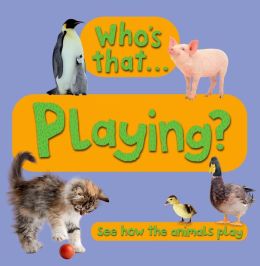
Who's That...Playing? See How The Animals Play.  Kingfisher. 2013. 14 pages.
Who's that playing?
Tip tap
I am a kitten.
I have long fur and pointed ears.

Who's that splashing?
Splish splosh
I am a duckling.
I have a beak and webbed feet.
Who's That...Playing is a fun board book for young readers--toddlers and preschoolers. Each two-page spread focuses on a different animal at play: kittens, puppies, ducklings, bear cubs, lambs, penguin chicks, piglets. Real photographs are used throughout. It is in a series of board books published by Kingfisher. Other titles include: "Who's That? Roaring," "Who's That? Jumping," "Who's That? Eating."

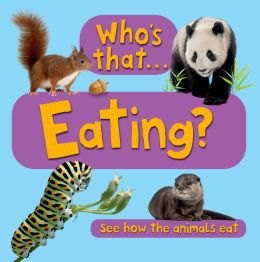
Who's That...Eating? See How The Animals Eat. Kingfisher. 2013. 14 pages.
Who's that eating?
Chomp
I am a giant panda.
I have black and white fur and I like munching bamboo.

Who's that gnawing?
Gnaw
I am an otter.
I have whiskers and I use my tail to help me swim.
If you're looking to share simple animal facts with your little one, this new series by Kingfisher would be a great choice. There are four books in this series, each focusing on a different aspect of animal life. Different animals are featured in each book. In this title, the focus is on eating. The animals featured include pandas, otters, caterpillars, squirrels, anteaters, chickens, and giraffes.

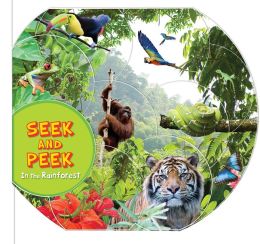
Seek and Peek In the Rainforest. Kingfisher. 2013. 8 pages.

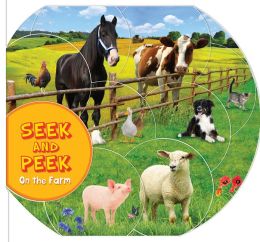
Another series published by Kingfisher is the Seek and Peek series. There are four titles in the series: Seek and Peek in the Rainforest, Seek and Peek On the Farm, Seek and Peek Dinosaurs, and Seek and Peek at the Zoo. The books are oddly shaped, which may appeal to young readers who love to grasp. Readers can choose which animal they want to read about--learn about--and turn directly to that page. But some pages feature more than one animal. And some animals are not featured on the cover.

Seek and Peek On the Farm. Kingfisher. 2013. 8 pages.

The final book I'll be reviewing today is another in the Kingfisher's Seek and Peek series. I'm curious if little hands will appreciate the oddly shaped board book--it is almost a circle. It is easy to grasp and turn pages, which may be a plus! Farm books are almost always fun, and this one isn't an exception. Little ones can learn simple facts about farm animals like pigs, horses, chickens, cows, ducks, etc.


© 2013 SukaYuka.com of SukaYuka's Book Reviews