Tuesday, March 5, 2013

The Talisman Ring (1936)

The Talisman Ring. Georgette Heyer. 1936/2009. Sourcebooks. 316 pages.

It can be easy to forget just how much you enjoyed a particular Heyer romance when you've read so many. The Talisman Ring is certainly enjoyable and quite satisfying...even if it doesn't necessarily stay as fresh in one's memory as being a favorite-favorite. I enjoyed the two romances in this one. But above all, I enjoyed the dramatic, suspenseful mystery! It reminded me a bit of the promise of Northanger Abbey, except in this case, there was actually plenty of adventure and danger and mystery!

One of the heroines, Eustacie, is quite fun because she is so over-the-top silly and dramatic. She CRAVES romantic adventures and dangers--the stuff of novels. While she's willing to settle, to a certain degree, for a marriage of convenience, she really, truly wants a soul mate just as imaginative and expressive as she is. She wants to be made much of, she wants to be adored, she wants to be rescued, she wants to feel like life is one thrill after another. Her grandfather wants her to marry one cousin, Tristam Shield, one of the heroes of the novel; but these two just do not suit one another! They would drive each other crazy if the marriage actually took place! But Eustacie is determined to run away--in the middle of the night. And oh the adventure she stumbles into that night, SMUGGLERS. How perfect, how romantic. One of the smugglers turns out to be another cousin, Ludovic, a man who had to flee England several years earlier because he's suspected of murder....

And that's just the start!

A scene between Eustacie and Tristam:
“You would more probably have gone to the guillotine,' replied Sir Tristram, depressingly matter of fact.
'Yes, that is quite true,' agreed Eustacie. 'We used to talk of it, my cousin Henriette and I. We made up our minds we should be entirely brave, not crying, of course, but perhaps a little pale, in a proud way. Henriette wished to go to the guillotine en grande tenue, but that was only because she had a court dress of yellow satin which she thought became her much better than it did really. For me, I think one should wear white to the guillotine if one is quite young, and not carry anything except perhaps a handkerchief. Do you not agree?'
'I don't think it signifies what you wear if you are on your way to the scaffold,' replied Sir Tristram, quite unappreciative of the picture his cousin was dwelling on with such evident admiration.
She looked at him in surprise. 'Don't you? But consider! You would be very sorry for a young girl in a tumbril, dressed all in white, pale, but quite unafraid, and not attending to the canaille at all, but--'
'I should be very sorry for anyone in a tumbril, whatever their age or sex or apparel,' interrupted Sir Tristram.
'You would be more sorry for a young girl--all alone, and perhaps bound,' said Eustacie positively.
'You wouldn't be all alone. There would be a great many other people in the tumbril with you,' said Sir Tristram.
Eustacie eyed him with considerable displeasure. 'In my tumbril there would not have been a great many other people,' she said.” 
I loved this one; I just LOVED it. It's so delightful and fun! I am just loving my 2013 project of reading and rereading all of Georgette Heyer's romances in chronological order!

Read The Talisman Ring
  • If you enjoyed Northanger Abbey
  • If you enjoy historical romance with a good bit of mystery
  • If you like drama, romance, mystery, adventure set in the 1790s
  • If you enjoy Georgette Heyer

© 2013 SukaYuka.com of SukaYuka's Book Reviews

Monday, March 4, 2013

Dear Enemy (1915)

Dear Enemy. Jean Webster. 1915. 236 pages.

Dear Judy:
Your letter is here. I have read it twice, and with amazement. Do I understand that Jervis has given you, for a Christmas present, the making over of the John Grier Home into a model institution, and that you have chosen me to disburse the money?

I liked Daddy-Long-Legs. But I LOVED Dear Enemy. Sallie McBride, a friend first introduced in Daddy-Long-Legs, has at the request of her friend taken leadership of the John Grier Home. So much work, so much responsibility, is it even something that she wants to do short-term? Yes, she's agreed to it. But it was in the moment. She wanted to show her politician boyfriend that she COULD do it if she wanted to do it. That it wasn't because she wasn't CAPABLE that she was hesitating. But now that she's there, now that she's seen all those children that NEED, always need, need, need. What has she gotten herself into?! And the people she has to work with?! Readers get to know all the details through her correspondence...

There are two men in Sallie's life. The first is the politician, Gordon Hallock, who is willing to indulge Sallie's ambitions for a while at least until she's ready to admit she's ready to settle down and be his wife. (He's very generous to the John Grier Home.) The second is a (Scottish) doctor, Robin McRae, who is the physician for the orphanage. Sallie and the doctor don't always get along, in fact, they argue quite a bit. Both tend to be passionate and opinionated. But there are times when they don't argue, times when they're on the same side. There are times her 'dear enemy' is her closest friend....

I found Dear-Enemy to be giddy-making! I really loved this book.

Her description of the doctor:
Usually, he's scientific and as hard as granite, but occasionally I suspect him of being quite a sentimental person underneath his official casing. For days at a time he will be patient and kind and helpful and I begin to like him; then without any warning an untamed wild man swells up from the innermost depths, and--oh, dear! the creature's impossible. I always suspect that sometime in the past he has suffered a terrible hurt, and that he is still brooding over the memory of it. All the time he is talking you have an uncomfortable feeling that in the far back corners of his mind he is thinking something else. But this may be merely by romantic interpretation of an uncommonly bad temper. In any case, he's baffling. (144-5)
Her description of the politician:
There is no doubt about it, Gordon is the most presentable man that ever breathed. He is so good looking and easy and gracious and witty, and his manners are impeccable. Oh, he would make a wonderfully decorative husband! But after all, I suppose you do live with a husband. You don't just show him off at dinners and teas. (164)
Read Dear Enemy
  • If you liked Daddy-Long-Legs
  • If you like epistolary novels
  • If you like romance or historical romance
© 2013 SukaYuka.com of SukaYuka's Book Reviews

Sunday, March 3, 2013

Sunday Salon: Reading Daddy Long Legs (1912)

Daddy Long Legs. Jean Webster. 1912. 208 pages.

Judy Abbot has a wonderful opportunity before her. If she'll agree to write her anonymous sponsor (or benefactor) a letter each and every month, then he will pay for her to attend four years of college. It is more than she ever hoped for, and so, of course, she agrees. The book chronicles all four years of her college experiences--including her summer vacations. Her benefactor manages to still manage her even during her school breaks. Not that she hears from him very often...

The book focuses on many aspects of college life: making friends, learning to get along with disagreeable people, learning how to be responsible, studying, attending classes, taking tests, spending time with friends, becoming interested in boys and dating, balancing everything just so.

I enjoyed this one. I like the letter-format, for the most part. But I can't exactly say that I'm kindred spirits with the heroine.
It isn't the big troubles in life that require character. Anybody can rise to a crisis and face a crushing tragedy with courage, but to meet the petty hazards of the day with a laugh--I really think that requires spirit. (51)
Thank heaven I don't inherit my God from anybody! I am free to make mine up as I wish Him. (67)
I have a beautiful play that I invented a long time ago when I first learned to read. I put myself to sleep every night by pretending I'm the person (the most important person) in the book I'm reading at the moment. (88)
It isn't the great big pleasures that count the most; it's making a great deal out of the little ones--I've discovered the true secret of happiness, Daddy, and that is to live in the now. (141)

© 2013 SukaYuka.com of SukaYuka's Book Reviews

Saturday, March 2, 2013

Week in Review: February 24-March 2

The Story Girl. L.M. Montgomery. 1911. 220 pages.
A Tangle of Knots. Lisa Graff. 2013. Penguin. 240 pages.
The Center of Everything. Linda Urban. 2013. Harcourt. 208 pages.
The Lightning Dreamer. Margarita Engle. 2013. Houghton Mifflin Harcourt. 182 pages.
Cranford. Elizabeth Gaskell. 1851. 257 pages.
Convert: From Adam to Christ. Emilio Ramos. 2012. Bridge-Logos Foundation. 183 pages.
Thru the Bible Commentary Series: Romans Chapters 1-8. J. Vernon McGee. Thomas Nelson. 170 pages.
Thru the Bible Commentary Series: Romans 9-16. J. Vernon McGee. Thomas Nelson. 144 pages.
Revelation 1-5. (Thru the Bible Commentary Series) J. Vernon McGee. Thomas Nelson. 152 pages.

© 2013 SukaYuka.com of SukaYuka's Book Reviews

The Lightning Dreamer (2013)

The Lightning Dreamer. Margarita Engle. 2013. Houghton Mifflin Harcourt. 182 pages.

Books are door-shaped
portals
carrying me
across oceans
and centuries,
helping me feel
less alone.

But my mother believes
that girls who read too much
are unladylike
and ugly,
so my father's books are locked
in a clear glass cabinet. I gaze
at enticing covers
and mysterious titles,
but I am rarely permitted
to touch
the enchantment 
of words. (3)

I definitely enjoy Margarita Engle's verse novels. Her newest is a verse novel about Cuban abolitionist poet, Gertrudis Gomez de Avellaneda, who was nicknamed Tula. For a young girl--a young woman--who dreamed so big, wanted so much, her environment was quite oppressive. Her family wanted, NEEDED, her to marry well. But. Tula had different ideas. She held onto the notion that she could have ideas of her own:

Girls are not supposed to think,
but as soon as my eager mind
begins to race, free thoughts
rush in
to replace
the trapped ones. (4)

 Tula discovers a whole new world within the convent library, and once she begins her journey, there will be no dissuading her...

Opinions.
Ideas.
Possibilities.
So many!
How can I choose?
Between bursts
of lightning-swift energy,
I enjoy peaceful moment
when the whole world
seems to be a flowing river
of verse
and all I have to do is learn
how to swim.
During those times,
I find it so easy to forget
that I'm just a girl who is expected
to live
without thoughts. (41)

The novel is rich and descriptive. I love the writing...

"I feel certain that words
can be as human 
as people,
alive
with the breath
of compassion." (26)

So many people 
have not yet learned
that souls have no color
and can never
be owned. (69)


Love is as tricky as a wall
of mirrors that make
narrow hallways
seem open
and wide. (146)

I would definitely recommend this one! 

Read The Lightning Dreamer
  • If you enjoy verse novels
  • If you enjoy historical novels based on real people and events
  • If you enjoy Margarita Engle's works
  • If you are looking for YA books set in Cuba

© 2013 SukaYuka.com of SukaYuka's Book Reviews

Library Loot: First Week in March

New Loot:
  • The World of Cars: Radiator Springs Alan J. Porter
  • Old, New, Red, Blue by Melissa Lagonegro
  • The World of Cars: The Rookie by Alan J. Porter
  • The Great Race by Rev. W. Awdry
  • Secret of the Green Engine
  • Penny and Her Marble by Kevin Henkes
  • Barbie Numbers Book
  • Five Fast Tales: A Collection of Five Early Readers
Leftover Loot:
  • Knit Your Bit: A World War I Story by Deborah Hopkinson
  • Bright Island by Mabel L. Robinson 
  • Bomb: The Race to Build and Steal the World's Most Dangerous Weapon by Steve Sheinkin
  • Bliss by Kathryn Littlewood
  • The Queen's Lady by Eve Edwards
     Library Loot is a weekly event co-hosted by Claire and Marg that encourages bloggers to share the books they’ve checked out from the library. If you’d like to participate, just write up your post-feel free to steal the button-and link it using the Mr. Linky any time during the week. And of course check out what other participants are getting from their libraries.


© 2013 SukaYuka.com of SukaYuka's Book Reviews
Friday, March 1, 2013

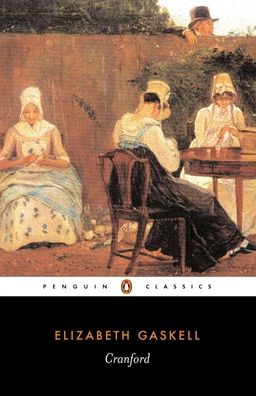
Cranford (1851)

Cranford. Elizabeth Gaskell. 1851. 257 pages.

Cranford is a wonderful read! It can be delightful and quirky and quite satisfying. It can be very funny, but it can also get quite sentimental. This novel focuses on a community of women; a strong, opinionated community of women. These women can be the best of friends and truly come together at times, but, there are other times when disagreements keep them apart. Readers catch glimpses of Cranford and its residents at various times through the eyes of a frequent visitor, Mary Smith, niece of Miss Matty. It's a novel that catches life just as it is--for better or worse.

Cranford is very different from Mary Barton and North and South, two books also by Elizabeth Gaskell. Though like both Mary Barton and North and South it remains realistic and at times tragic. Death being a part, a natural part of life. 

Here's how Cranford begins:
  In the first place, Cranford is in possessions of the Amazons; all the holders of houses, above a certain rent, are women. If a married couple come to settle in the town, somehow the gentleman disappears; he is either fairly frightened to death by being the only man in the Cranford evening parties, or he is accounted for by being with his regiment, his ship, or closely engaged in business all the week in the great neighboring commercial town of Drumble, distant only twenty miles on railroad. In short, whatever does become of the gentlemen, they are not at Cranford. What could they do if they were there? The surgeon has his round of thirty miles, and sleeps at Cranford; but every man cannot be a surgeon.
Favorite quotes:
“I'll not listen to reason... reason always means what someone else has got to say.”  
“Miss Jenkyns wore a cravat, and a little bonnet like a jockey-cap, and altogether had the appearance of a strong-minded woman; although she would have despised the modern idea of women being equal to men. Equal, indeed! she knew they were superior.” 
One of my favorite scenes, it is between Miss Jenkyns (Miss Matty's older sister) and Captain Brown:
When the trays re-appeared with biscuits and wine, punctually at a quarter to nine, there was conversation, comparing of cards, and talking over tricks; but by-and-by Captain Brown sported a bit of literature.
“Have you seen any numbers of ‘The Pickwick Papers’?” said he.  (They we’re then publishing in parts.)  “Capital thing!”
Now Miss Jenkyns was daughter of a deceased rector of Cranford; and, on the strength of a number of manuscript sermons, and a pretty good library of divinity, considered herself literary, and looked upon any conversation about books as a challenge to her.  So she answered and said, “Yes, she had seen them; indeed, she might say she had read them.”
“And what do you think of them?” exclaimed Captain Brown.  “Aren’t they famously good?”
So urged Miss Jenkyns could not but speak.
“I must say, I don’t think they are by any means equal to Dr Johnson.  Still, perhaps, the author is young.  Let him persevere, and who knows what he may become if he will take the great Doctor for his model?”  This was evidently too much for Captain Brown to take placidly; and I saw the words on the tip of his tongue before Miss Jenkyns had finished her sentence.
“It is quite a different sort of thing, my dear madam,” he began.
“I am quite aware of that,” returned she.  “And I make allowances, Captain Brown.”
“Just allow me to read you a scene out of this month’s number,” pleaded he.  “I had it only this morning, and I don’t think the company can have read it yet.”
“As you please,” said she, settling herself with an air of resignation.  He read the account of the “swarry” which Sam Weller gave at Bath.  Some of us laughed heartily.  I did not dare, because I was staying in the house.  Miss Jenkyns sat in patient gravity.  When it was ended, she turned to me, and said with mild dignity -
“Fetch me ‘Rasselas,’ my dear, out of the book-room.”
When I had brought it to her, she turned to Captain Brown -
“Now allow me to read you a scene, and then the present company can judge between your favourite, Mr Boz, and Dr Johnson.”
She read one of the conversations between Rasselas and Imlac, in a high-pitched, majestic voice: and when she had ended, she said, “I imagine I am now justified in my preference of Dr Johnson as a writer of fiction.”  The Captain screwed his lips up, and drummed on the table, but he did not speak.  She thought she would give him a finishing blow or two.
“I consider it vulgar, and below the dignity of literature, to publish in numbers.”
“How was the Rambler published, ma’am?” asked Captain Brown in a low voice, which I think Miss Jenkyns could not have heard.
“Dr Johnson’s style is a model for young beginners.  My father recommended it to me when I began to write letters - I have formed my own style upon it; I recommended it to your favourite.”
“I should be very sorry for him to exchange his style for any such pompous writing,” said Captain Brown.
Miss Jenkyns felt this as a personal affront, in a way of which the Captain had not dreamed.  Epistolary writing she and her friends considered as her forte.  Many a copy of many a letter have I seen written and corrected on the slate, before she “seized the half-hour just previous to post-time to assure” her friends of this or of that; and Dr Johnson was, as she said, her model in these compositions.  She drew herself up with dignity, and only replied to Captain Brown’s last remark by saying, with marked emphasis on every syllable, “I prefer Dr Johnson to Mr Boz.”
Another sampling, this time about peas served by Mr. Holbrook!
 When the ducks and green peas came, we looked at each other in dismay; we had only two-pronged, black-handled forks.  It is true the steel was as bright as silver; but what were we to do?  Miss Matty picked up her peas, one by one, on the point of the prongs, much as AminĂ© ate her grains of rice after her previous feast with the Ghoul.  Miss Pole sighed over her delicate young peas as she left them on one side of her plate untasted, for they would drop between the prongs.  I looked at my host: the peas were going wholesale into his capacious mouth, shovelled up by his large round-ended knife.  I saw, I imitated, I survived!  My friends, in spite of my precedent, could not muster up courage enough to do an ungenteel thing; and, if Mr Holbrook had not been so heartily hungry, he would probably have seen that the good peas went away almost untouched.

© 2013 SukaYuka.com of SukaYuka's Book Reviews