Showing posts with label 1912. Show all posts

Monday, September 16, 2013

The Life of Cesare Borgia (1912)

The Life of Cesare Borgia: A History and Some Criticisms. Rafael Sabatini. 1912. 326 pages. [Source: Bought]

Rafael Sabatini would NOT have approved of Horrible Histories' Borgia Family. The truth is, however, that I would never have sought out Sabatini's biography of Cesare Borgia if I'd not fallen in love with the video. It was Mat's "I am the mostest, powerfulest, evilest of all" that made me curious and seeking. I wasn't that impressed by my first attempt to learn more. The fictional Borgia Bride was awful. Fortunately, I discovered Sabatini's biography. It was LOVE.  It wasn't love because it fit into any preconceived notions about how I wanted the Borgia family to be. It was love because it respected human nature and historical fact. It embraced common sense and used dry wit, in part, to argue and persuade.

I journaled my reading in four parts. The first post tackled the preface and introduced Sabatini's goal in writing. It was WONDERFUL. The second post examined Cesare's father, Alexander VI (Rodrigo). The third post focused almost exclusively on Cesare. The fourth post focused on Sabatini as an author, his narrative style, his technique of criticizing other authors and sources. 
Life is an ephemeral business, and we waste too much of it in judging where it would beseem us better to accept, that we ourselves may come to be accepted by such future ages as may pursue the study of us.
But if it be wrong to judge a past epoch collectively by the standards of our own time, how much more is it not wrong to single out individuals for judgement by those same standards, after detaching them for the purpose from the environment in which they had their being? How false must be the conception of them thus obtained! We view the individuals so selected through a microscope of modern focus. They appear monstrous and abnormal, and we straight-way assume them to be monsters and abnormalities, never considering that the fault is in the adjustment of the instrument through which we inspect them, and that until that is corrected others of that same past age, if similarly viewed, must appear similarly distorted.
Hence it follows that some study of an age must ever prelude and accompany the study of its individuals, if comprehension is to wait upon our labours.
Sabatini just came across to me as practical, witty, sometimes wise, and sometimes poetic.
Mind being the seat of the soul, and literature being the expression of the mind, literature, it follows, is the soul of an age, the surviving and immortal part of it; (6)
Anyway, here is Sabatini's thesis--his goal for writing this biography. If you can embrace this premise, then chances are you'll find this one well worth the read!!!
Before we admit facts, not only should we call for evidence and analyse it when it is forthcoming, but the very sources of such evidence should be examined, that, as far as possible, we may ascertain what degree of credit they deserve. In the study of the history of the Borgias, we repeat, there has been too much acceptance without question, too much taking for granted of matters whose incredibility frequently touches and occasionally oversteps the confines of the impossible. (12)
If the author has a mercy to crave of his critics, it is that they will not impute it to him that he has set out with the express aim of "whitewashing"—as the term goes—the family of Borgia. To whitewash is to overlay, to mask the original fabric under a superadded surface. Too much superadding has there been here already. By your leave, all shall be stripped away. The grime shall be removed and the foulness of inference, of surmise, of deliberate and cold-blooded malice, with which centuries of scribblers, idle, fantastic, sensational, or venal, have coated the substance of known facts.
But the grime shall be preserved and analysed side by side with the actual substance, that you may judge if out of zeal to remove the former any of the latter shall have been included in the scraping.
(13)
If Sabatini was alive to refute current fictional portrayals of Cesare in romance novels...
Women play no part whatever in his history. Not once shall you find a woman's influence swaying him; not once shall you see him permitting dalliance to retard his advancement or jeopardize his chances. With him, as with egotists of his type, governed by cold will and cold intellect, the sentimental side of the relation of the sexes has no place. With him one woman was as another woman; as he craved women, so he took women, but with an almost contemptuous undiscrimination. 
The biography is rich in detail. It doesn't just focus on Cesare. It tries to cover more than that--to look at an age, to capture a time and place. It is ALL ABOUT context for Rafael Sabatini. And I really enjoyed his technique overall. 

© 2013 SukaYuka.com of SukaYuka's Book Reviews

Friday, April 26, 2013

Pygmalion (1912)

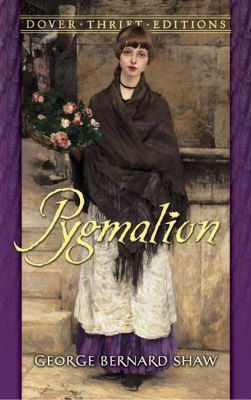
Pygmalion. George Bernard Shaw. 1912. 96 pages.

Pygmalion is another book I read for the book to movie reading challenge. There is a lovely 1938 movie starring Leslie Howard and Wendy Hiller. If you've only seen Leslie Howard in Gone With The Wind, you should really make a point to see either Pygmalion OR The Scarlet Pimpernel (1934). Pygmalion was also the inspiration, of course, for the musical My Fair Lady starring Rex Harrison and Audrey Hepburn. Don't ask me to choose between Pygmalion and My Fair Lady. I happen to LOVE musicals, but Leslie Howard is oh-so-good in this one!!!

Pygmalion is certainly the inspiration for My Fair Lady. And I feel the musical stays, perhaps until the very end, true to the spirit of the original play. The songs fill in the gaps between the acts and scenes. The songs are quite expressive and provide insight on the individual characters. Through song, we learn more about what is going on in the house and about the months of training involved. On the other hand, in the book, there's a big gap between when Henry Higgins agrees to the experiment with Eliza Doolittle and her first outing. The first outing in the book is to Professor Higgins' mother's house. (The racing scene isn't in the original play.) Another big difference is that readers don't witness the big scene, the triumphant scene firsthand. Readers simply see the three returning home all dressed up. Readers hear the boasting and learn of the success after the fact. I really enjoyed the way My Fair Lady added to the original while keeping up the spirit.

Pygmalion is a short read, and it's also quite enjoyable!  

© 2013 SukaYuka.com of SukaYuka's Book Reviews
Sunday, March 3, 2013

Sunday Salon: Reading Daddy Long Legs (1912)

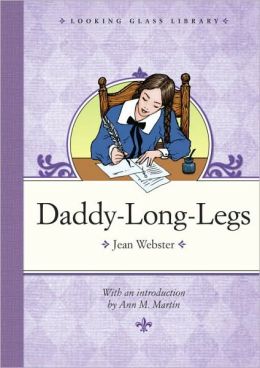
Daddy Long Legs. Jean Webster. 1912. 208 pages.

Judy Abbot has a wonderful opportunity before her. If she'll agree to write her anonymous sponsor (or benefactor) a letter each and every month, then he will pay for her to attend four years of college. It is more than she ever hoped for, and so, of course, she agrees. The book chronicles all four years of her college experiences--including her summer vacations. Her benefactor manages to still manage her even during her school breaks. Not that she hears from him very often...

The book focuses on many aspects of college life: making friends, learning to get along with disagreeable people, learning how to be responsible, studying, attending classes, taking tests, spending time with friends, becoming interested in boys and dating, balancing everything just so.

I enjoyed this one. I like the letter-format, for the most part. But I can't exactly say that I'm kindred spirits with the heroine.
It isn't the big troubles in life that require character. Anybody can rise to a crisis and face a crushing tragedy with courage, but to meet the petty hazards of the day with a laugh--I really think that requires spirit. (51)
Thank heaven I don't inherit my God from anybody! I am free to make mine up as I wish Him. (67)
I have a beautiful play that I invented a long time ago when I first learned to read. I put myself to sleep every night by pretending I'm the person (the most important person) in the book I'm reading at the moment. (88)
It isn't the great big pleasures that count the most; it's making a great deal out of the little ones--I've discovered the true secret of happiness, Daddy, and that is to live in the now. (141)

© 2013 SukaYuka.com of SukaYuka's Book Reviews
Monday, February 11, 2013

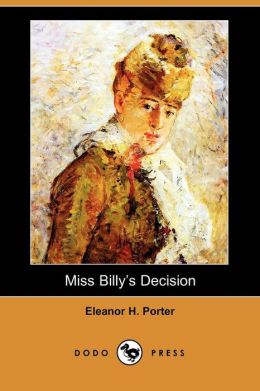
Miss Billy's Decision (1912)

Miss Billy's Decision. Eleanor H. Porter. 1912. Dodo Press. 248 pages. 

Miss Billy is engaged to Bertram Henshaw. Their engagement has just been announced. But life gets busy and the couple struggles in their relationship. Bertram is painting the portrait of a young, wealthy, beautiful woman--very temperamental, always changing her mind on what pose suits her best. Billy is occupied with a handful of things: first, planning the wedding of Cyril and Maria (the music teacher); second, writing or composing her own songs for publication: this time with a partner, "Mary Jane" Arkwright; third participating or organizing an operetta for charity: if she can play matchmaker for two of her new friends, it would be great. Through the months, Billy feels that Bertram is too focused on ART and not focused enough on her, and, Bertram feels that Billy is too focused on MUSIC and not focused enough on him. Each feels let down by the other. Perhaps each feeling that love should be easy now that they're together and planning to get married. The couple begins to grow apart from one another--very gradually. 

At one point in the novel, Miss Billy struggles to make the decision that is "right" for everyone. She's been told by a certain someone that she is ruining Bertram's life, that the two would never--could never--be happy together. That it would be best for Bertram's career if he were to remain single. It's not like Billy has never had doubts about their future together. So Billy starts looking for signs to help her decide...

One might think that Bertram would be more developed as a hero, as a character since he is the love of Miss Billy's life. But. He still wasn't as developed as he might have been. I still feel that readers never really get a chance to know him. Readers spend MOST of the novel seeing Miss Billy and "Mary Jane" (M.J. Arkwright) together. He LOVES Billy and honestly doesn't know that she's already engaged. And they have so much in common, at first glance. She's great at writing music; he's great at writing lyrics. Readers know that he loves her, but, does she love him in return?

I did enjoy this one more than Miss Billy.


Read Miss Billy's Decision
  • If you enjoy Eleanor Porter's writing style; she's VERY readable
  • If you enjoy light/clean romance
  • If you enjoy reading classics
  • If you're looking for vintage 'new adult' titles
© 2013 SukaYuka.com of SukaYuka's Book Reviews