Saturday, October 12, 2013

Library Loot: Second Trip in October

New Loot:
  • Don't Pigeonhole me! Two Decades of the Mo Willems Sketchbook
  • The September Queen by Gillian Bagwell
  • The Storybook of Legends by Shannon Hale
  • The Real Jane Austen: A Life in Small Things by Paula Byrne

Leftover Loot:
  • Dynasty: The Stuarts, 1560-1807 by John Macleod 
  • Georgette Heyer by Jennifer Kloester  
  • The Rose Garden by Susanna Kearsley
  • Brownie and Pearl See the Sights by Cynthia Rylant
  • Brownie and Pearl Hit the Hay by Cynthia Rylant
  • The Big Wet Balloon by Liniers
  • So Close to You by Rachel Carter
  • The Year of Billy Miller by Kevin Henkes
  • The Romeo and Juliet Code by Phoebe Stone
  • A Life in Letters by P.G. Wodehouse
  • Rebekkah's Journey by Ann Burg
  • Siege and Storm by Leigh Bardugo
  • Fragments by Dan Wells
  • Rise by Anna Carey
  • The True Blue Scouts of Sugar Man Swamp by Kathi Appelt
     Library Loot is a weekly event co-hosted by Claire and Marg that encourages bloggers to share the books they’ve checked out from the library. If you’d like to participate, just write up your post-feel free to steal the button-and link it using the Mr. Linky any time during the week. And of course check out what other participants are getting from their libraries.  

© 2013 SukaYuka.com of SukaYuka's Book Reviews

Friday, October 11, 2013

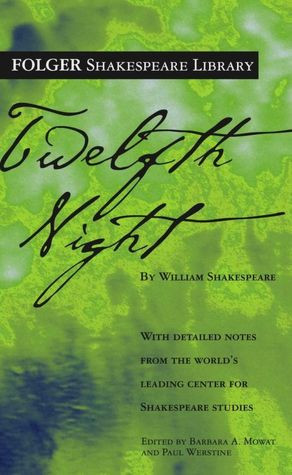
Twelfth Night

Twelfth Night. William Shakespeare. 1601-02. 272 pages. [Source: Bought]

If music be the food of love, play on;

I've always loved that line: "If music be the food of love, play on;" but I have to admit I love it even more after falling in love with this little music video.

This is one of the Shakespeare plays with cross-dressing. I love this Dorothy Sayers' quote in Whose Body: "I'm sure if I'd been a Shakespeare hero, the very minute I saw a slim-legged young page-boy I'd have said: "Odsbodikins! There's that girl again!"

Twelfth Night is one of the Shakespeare comedies that I am quite familiar with. I think this was my fourth time to read it. I don't love it because it's romantic or oh-so-magical. Of the couples that end up together, I'm not sure any of them are truly, deeply in love with each other. I don't doubt for one second that Viola loves the Duke (Orsino). But as for the Duke's oh-so-easy transference of love from Olivia to Viola, whom he has only known as Cesario, I'm not convinced. Same goes with Olivia's transference of her affections from Viola (dressed as Cesario) to Sebastian. Sebastian, well, he gets an instant wife, I'm not sure he's complaining though. The happy endings are rushed and superficial perhaps.

I think the reason I keep reading Twelfth Night is that it's enjoyable, entertaining, fun. It's also one of the few Shakespeare plays that I've seen performed. It's a merry little play with clever little exchanges between characters. I just like it.

Favorite quotes:
If music be the food of love, play on;
O spirit of love, how quick and fresh art thou!
If you be not mad, be gone; if you have reason, be brief:
It shall be inventoried; and every particle and utensil labeled to my will: as item, two lips indifferent red; item, two grey eyes with lids to them; item, one neck, one chin, and so forth. 
Some are born great, some achieve greatness, and some have greatness thrust upon them.
Them that dally nicely with words may quickly make them wanton.
Words are very rascals.
Words are grown so false I am loath to prove reason with them.
I would you were as I would have you be!
Love sought is good, but given unsought is better. 
Example of banter:
Duke: I know thee well. How dost thou, my good fellow?
Clown: Truly, sir, the better for my foes and the worse for my friends.
Duke: Just the contrary; the better for thy friends.
Clown: No, sir, the worse.
Duke: How can that be?
Clown: Marry, sir, they praise me and make an ass of me; now my foes tell me plainly I am an ass: so that by my foes, sir, I profit in the knowledge of myself, and by my friends I am abused; so that, conclusions to be as kisses, if your four negatives make your two affirmatives, why then, the worse for my friends and the better for my foes.  
© 2013 SukaYuka.com of SukaYuka's Book Reviews

Thursday, October 10, 2013

Caroline the Queen (1968)

Caroline the Queen. Jean Plaidy. 1968. 415 pages. [Source: Library]

Caroline, The Queen was my first introduction to the historical writer Jean Plaidy. (It is the third book in the Georgian Saga.) The novel opens shortly before the Prince of Wales, George Augustus, learns that his father (whom he REALLY hated) has died and he is now king. Caroline, his Queen, may be the main character of this one, but she is not our only point of view--far from it. This novel tells many stories from many different points of view.

Husband and wife. The novel spends some amount of time with George II and his wife, Caroline. She is presented as being oh-so-clever. Readers are never allowed to forget for a moment that Caroline is smarter and wiser than her husband. George is presented as a complete fool: short, ugly, boring, bad-tempered, easily flattered. Caroline loves being married to him because she can rule through him. But she has absolutely no respect for her husband. Caroline is presented as noble because she tolerates her husband's many mistresses.

King and mistresses. The novel mentions George II having many mistresses both in England and Hanover. His mistresses are presented as a necessary, oh-so-expected habit. Kings have mistresses, he is now king, therefore, to show how kingly he is, he must have mistresses, the people will love him even more because he is acting like other kings. Future kings must have mistresses as well. To be Prince of Wales gives you freedom to gather as many mistresses as possible and put them on display. Some of George II's mistresses are quite "old" by the time he is king. He visits them on schedule not out of desire but out of habit. The last half of the novel focuses on the King acquiring much younger, much prettier mistresses.

Family. The glimpses we get of Caroline and George as parents is disturbing, at least in my opinion. Frederick, the prince of Wales, is DESPISED by both of his parents. He is their oldest son, but both of his parents HATE him and wish that he'd never been born. Neither wants him around. And he knows it. He hates them both. At one point he's shown as hating his mother even more than his father because he feels his father is just being ruled. Some time is spent on their other children. But I can't say that Caroline and George were extraordinarily good parents to any of their children. Anne, the oldest girl, is given some time in the novel.

Prince of Wales. Some time is spent with Frederick and his friends and mistresses. Readers see people trying to get close to him so they can use him, people trying to get favors. Some spy on him and tell all to the powers-that-be.

Politics. Caroline has several politician friends--notably Sir Robert Walpole and Lord Hervey. She loves power and politics and manipulating things behind the scenes so that George does precisely what they want without being wise to the fact that he's being manipulated. 

The novel was quite interesting and very readable. The characters were all believably flawed; I found no one sympathetic, however. I liked this one.

© 2013 SukaYuka.com of SukaYuka's Book Reviews
Wednesday, October 9, 2013

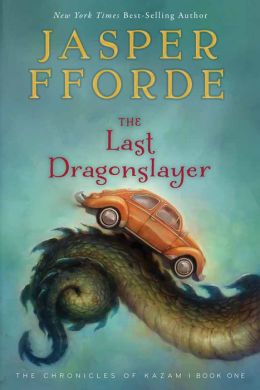
The Last Dragonslayer (2012)

The Last Dragonslayer. Jasper Fforde. 2012. Houghton Mifflin Harcourt. 296 pages. [Source: Review copy]

I liked The Last Dragonslayer. It definitely wasn't love, love, love.

Jennifer Strange is the heroine of this playful fantasy novel. This foundling may not want the job ahead of her, to fulfill her destiny that has been decreed for her for hundreds of years, but she may be the best chance for the world.

The Last Dragonslayer is peopled with some quirky characters. The writing was light and playful, the pacing tended to be just right as well. If I could have finished it in just one sitting, perhaps, I might not have realized the lack of connection I had with the characters and the story.

The characters were just substantive enough to be quirky and interesting at least from a distance. But I didn't feel there was much depth and substance to them beneath the surface. The exception probably being Jennifer Strange, our heroine.

Fantasies depend on world-building, great premises, and good storytelling. Characters are crucial as well. As is pacing. The Last Dragonslayer was entertaining and pleasant but it didn't really make itself unforgettable or memorable.

© 2013 SukaYuka.com of SukaYuka's Book Reviews

Tuesday, October 8, 2013

Rereading Divergent (Again)

Divergent. Veronica Roth. 2011. May 2011. HarperCollins. 496 pages. [Source: Library]

There is one mirror in my house. Our faction allows me to stand in front of it on the second day of every third month, the day my mother cuts my hair. It is behind a sliding panel in the hallway upstairs. 

If you noticed that this is my third time to review this book, you might guess how much I love, love, love this one. (My second review; my first review).

Factions are everything in Divergent; and there are five factions that make up the community: Abnegation values selflessness above all else; Amity values peace above all else; Candor values honesty above all else; the Erudite values knowledge above all else; Dauntless values courage above all else. Beatrice (Tris), our heroine, was born Abnegation, but she doesn't feel good enough for the faction. For, the truth is that she has selfish thoughts and desires. She's not exactly sure she could spend her whole life wearing gray, serving others, and blending into the background. Her test reveals something shocking--perhaps not shocking to readers, but certainly to her community IF it were to become known--she has aptitude for not one faction, but THREE. The simulation tests are supposed to show THE ONE place a person belongs. Beatrice's results make her Divergent. So when it comes time for Beatrice to choose--along with all the other of age teens--she has quite a decision to make. Should she remain in her own faction, keep her old friends, live the life that is perhaps expected of her? Any other choice essentially would divide her from her parents and keep them separated the rest of her life. Should she choose Erudite? No, that's not even a temptation. She knows that would be a mistake. Should she choose Dauntless? Part of her wants to risk it all and go with the unknown. Life with the Dauntless would be a complete change, offer a life of surprises, risks and dangers too.

Most of Divergent focuses on the initiation process, Tris' training as Dauntless. Readers get a chance to meet other transfers and other Dauntless-born initiates. It is a fierce competition. It is during this intense time that Tris meets Four. And meeting Four, well, it seems almost as life-changing as finding out her brain is different from everyone else's...

I absolutely love Four and Tris! I love them individually and as a couple. I love the characterization. I love the action, the drama, the suspense.

© 2013 SukaYuka.com of SukaYuka's Book Reviews
Monday, October 7, 2013

Great Tales From English History #2

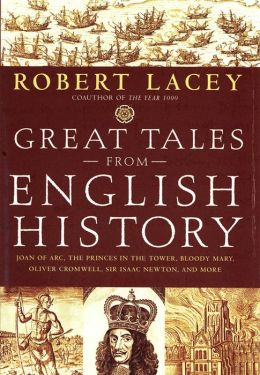
Great Tales From English History, vol. 2. Robert Lacey. 2004. Little, Brown. 288 pages. [Source: Library]

There are three volumes in Robert Lacey's series entitled Great Tales From English History. I loved, loved, loved the first volume. One of the reasons this series is so wonderful is the author's philosophy on history.
Our very first historians were storytellers--our best historians still are--and in many languages 'story' and 'history' remain the same word. Our brains are wired to make sense of the world through narrative--what came first and what came next--and once we know the sequence, we can start to work out the how and why. (xiii)
Great Tales From English History...is written by an eternal optimist--albeit one who views the evidence with a skeptical eye. In these books I have endeavored to do more than just retell the old stories; I have tried to test the accuracy of each tale against the latest research and historical thinking, and to set them in a sequence from which meaning can emerge. (xiv)
The things we do not know about history far outnumber those that we do. But the fragments that survive are precious and bright. They offer us glimpses of drama, humour, frustration, humanity, the banal and the extraordinary--the stuff of life. (xvi)
The second volume begins in the reign of Richard II and ends during the reign of William and Mary. Highlights from this volume include:
  • Geoffrey Chaucer and the Mother Tongue
  • The Deposing of King Richard II
  • Turn Again, Dick Whittington
  • Henry IV And His Extra-virgin Oil
  • We Happy Few -- the Battle of Azincourt
  • Joan of Arc, the Maid of Orleans
  • House of Lancaster: The Two Reigns of Henry VI
  • The House of Theodore
  • House of York: Edward IV, Merchant King
  • Whodunit? The Princes in the Tower
  • The Battle of Bosworth Field
  • King Henry VIII's Great Matter
  • Let There Be Light -- William Tyndale and the English Bible
  • Divorced, Beheaded, Died...
  • ...Divorced, Beheaded, Survived
  • Lady Jane Grey -- The Nine Day Queen
  • Bloody Mary and the Fires of Smithfield
  • Elizabeth -- Queen of Hearts
  • Mary Queen of Scots
  • By Time Surprised
  • 5/11: England's First Terrorist
  • King James's Authentical Bible
  • Roundheads v. Caviliers
  • Behold the Head of a Traitor
  • Charles II and the Royal Oak
  • London Burning
  • Titus Oates and the Popish Plot
  • Monmouth's Rebellion and the Bloody Assizes
  • The Glorious Invasion
I loved this second volume. I just LOVED it. Lacey has such a narrative gift. He informs and entertains! I loved his selection of stories. I read it in one sitting; I just couldn't put this one down!

Favorite quotes:
For England, Agincourt has inspired quite a different national myth. London welcomed Henry home with drums, trumpets and tambourines and choirs of children dressed as angels. Flocks of birds were released into the air and gigantic carved effigies spelled out the meaning of the victory--a David defeating Goliath.
'We few, we happy few, we band of brothers', were the words with which Shakespeare would later enshrine Agincourt's model of bravery against the odds--the notion that the English actually do best when they are outnumbered. This phenomenon came to full flower in 1940 during the Battle of Britain, when Britain faced the might of Germany alone and Churchill spoke so movingly of the 'few.' To further fortify the bulldog spirit, the Ministry of Information financed the actor Laurence Olivier to film a Technicolor version of Agincourt as depicted in Shakespeare's Henry V. 'Dedicated to the Airborne Regiments' read a screen title in medieval script as the opening credits began to roll. (22)
If the Wars of the Roses were fought by the men, it was the women who eventually sorted out the mess. By the late 1400s the royal family tree had become a crazy spider's web of possible claimants to the throne, and it took female instinct to tease out the relevant strands from the tangle. The emotions of mothers and wives were to weave new patterns--and eventually they produced a most unlikely solution. (38)
Wars and Roses...we have seen that roses were rare on the battle banners of fifteenth century England. Let's now take a closer look at the 'wars' themselves. In the thirty-two years that history textbooks conventionally allot to the 'Wars of the Roses,' there were long periods of peace. In fact, there were only thirteen weeks of actual fighting--and though the battles themselves were bitter and sometimes very bloody, mayhem and ravaging seldom ensured. (46)
 Connections to Horrible Histories:

Plague Song
Owain Glyndwr Song
Agincourt the Movie
Joan of Arc
War of the Roses Reports & Richard III Song 
Wives of Henry VIII
Philip and Mary Love Story
Mary Tudor Song
The Axe Factor
William Shakespeare & The Quills
Spanish Armada Movie
Blue-Blooded Blues
English Civil War (Bob Hale)
English Civil War Song, Cromwell Laws, King of Bling

© 2013 SukaYuka.com of SukaYuka's Book Reviews

Sunday, October 6, 2013

Five New(ish) Picture Books

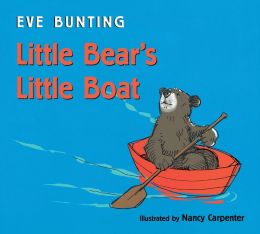
Little Bear's Little Boat. Eve Bunting. Illustrated by Nancy Carpenter.  2003/2012. Houghton Mifflin Harcourt. 30 pages. [Source: Review copy]

Little Bear loved his little boat. 

Little Bear loves sailing his boat on Huckleberry Lane. He loves, loves, loves his little boat. It is just perfect for him. But, as Little Bear begins to grow--slowly but surely--his little boat loses its just right-ness. Little Bear doesn't understand why it is his destiny to grow and his boat's destiny to stay exactly the same. But he does accept this truth and adds to it. It is the boat's destiny to find a new little bear. And it is equally important to let that new little bear know that he too will one day have to part with the oh-so-perfect little boat.  This is a charming story of growing up and letting go.

Text: 4 out of 5
Illustrations: 3 out of 5
Total: 7 out of 10

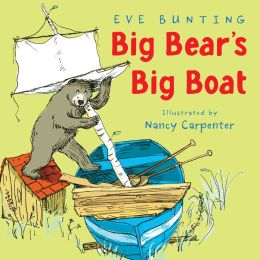
Big Bear's Big Boat. Eve Bunting. Illustrated by Nancy Carpenter. 2013. Houghton Mifflin Harcourt. 32 pages. [Source: Review copy]

When Big Bear grew too big for his little boat, he gave it to Little Bear. Now he was building a big boat for himself. 
"I want it to be just like my little boat, but bigger," Big Bear told his mother. His mother smiled, "You loved your little boat, and now Little Bear loves it. You will love your new one just as much."

Big Bear's Big Boat is a sequel to Little Bear's Little Boat. He is now a proper "big" bear, and when the book opens he is hard at work building a brand new boat--a big boat of course. And he does build a perfect boat--just the way he wants it. But. After he's finished, he begins listening to his friend. All of his friends have ideas and give him advice on how to make this boat even better. And Big Bear listens and follows... But will he be happy with his friends' vision of the perfect boat?! This little picture book has a good moral to it: "a bear should never let go of his own dream."

I definitely enjoyed both books!!! I would recommend both books!

Text: 4 out of 5
Illustrations: 3 out of 5
Total: 7 out of 10

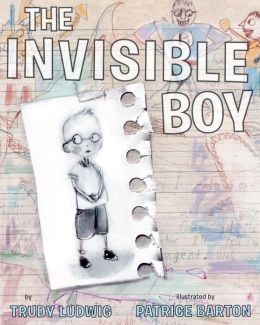
The Invisible Boy. Trudy Ludwig. Illustrated by Patrice Barton. 2013. Random House. 40 pages. [Source: Review copy]

Can you see Brian, the invisible boy? Even Mrs. Carlotti has trouble noticing him in her classroom. She's too busy dealing with Nathan and Sophie.

I definitely liked this picture book. It deals with the question: which is worse--being laughed at or feeling invisible?

Brian, our young hero, is the invisible boy. He's friendless. This is noticeable even in the classroom, but especially so in the lunchroom and at recess. But when a new student comes, Brian reaches out to him--via note, I might add--and soon Brian begins to lose his invisibility. It starts with the new kid, Justin, but soon expands to include others. It has a happy ending that may seem sudden and a bit too good to be true. But it makes for a satisfying conclusion. I liked Brian and Justin. I liked the fact that Brian had strengths, that he definitely was worth knowing and worth noticing.

The book is intentional. It is packed with social lessons. It is inviting the visible and invisible kids to think about their actions, their words, their choices. None of the children are "bad" children; some are thoughtless and impulsive, but nobody is vilified into a BULLY, which I thought was a good thing. The focus is on the little things. The little things that are more accidentally thoughtless than purposefully: I'm out to HURT you.   

Text: 4 out of 5
Illustrations: 3 out of 5
Total: 7 out of 10

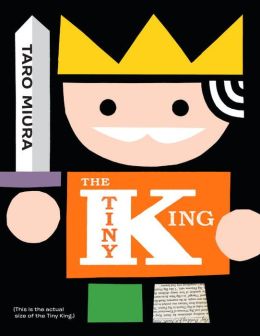
Tiny King. Taro Miura. 2013. Candlewick Press. 32 pages. [Source: Review copy]

Once upon a time, in a land far, far away, there was a Tiny King. The Tiny King lived all alone in a big, big castle. 

If I had to describe The Tiny King, I would say it was unusual, but unusual in a mostly good way. This picture book was first published in Japan. Candlewick is publishing it for the first time in the United States. It has a one-of-a-kind feel to it. And you'll pick up on this from the start. The cover says: THIS IS THE ACTUAL SIZE OF THE TINY KING.

The Tiny King is sad and lonely. At least he is in the beginning. But this is a happy fairy tale. He meets a BIG queen and they marry. He's soon the father of ten tiny children. And with the Queen and all ten children: his life isn't so empty and he doesn't feel so tiny after all.

The illustrations are interesting and fun. Very bright and bold. Original storytelling is complemented by original artwork.

Text: 3 out of 5
Illustrations 3 out of 5
Total: 6 out of 10

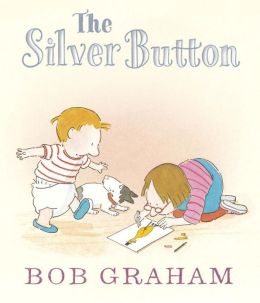
The Silver Button. Bob Graham. 2013. Candlewick. 32 pages. [Source: Review copy]

At 9:59 on Thursday morning, Jodie drew a duck. she gave the duck a top hat, cane, and boots of the softest leather. On the boots, she put silver buttons: one...two... Her pen hovered in the air before the final button.
Jodie's brother, Jonathan, pushed slowly to his feet. He swayed, he frowned, he tilted forward...and took his first step. He took that step like he was going somewhere.

Some people really LOVE Bob Graham. I am not one who "loves, loves, loves" his books. The Silver Button is an interesting look at one minute of time in the city. In that one minute, many things happen. Some, like the baby's very first steps, seem momentous. Others are very ordinary. For example, in that minute a soldier says goodbye to his mother (definitely emotional) and a little boy stops and has his shoes tied for the second time that morning (definitely not emotional). The book is seeking to capture life: a blend of simple and complex. One review calls it existential. I think this is a hit or miss book. You'll either really like it and think its brilliant or you won't. It has received plenty of starred reviews: Kirkus, School Library Journal, and Publishers Weekly.

Text: 3 out of 5
Illustrations: 2 out of 5
Total: 5 out of 10

© 2013 SukaYuka.com of SukaYuka's Book Reviews