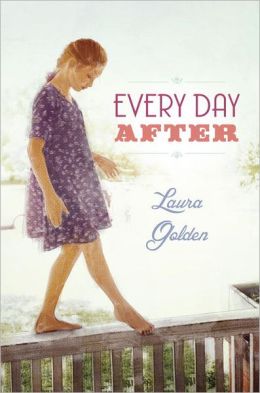
Every Day After. Laura Golden. 2013. Random House. 224 pages. [Source: Review Copy]
I loved, loved, loved Every Day After by Laura Golden. I love it not because the characters are oh-so-perfect. I love it because the characters are oh-so-human. Our heroine, Lizzie Hawkins, is flawed but lovable. Every Day After is her coming-of-age story, and it's a great one.
Every Day After is set in the early 1930s. Lizzie's father recently abandoned his family because he knew that they were about to lose their house. In addition, her mother has not been the same since he left. She has checked out mentally and emotionally. She has lost touch with reality.
Lizzie doesn't know why her father left; she even hopes that he will come back and save them all. But Lizzie is determined to be strong and brave and resourceful until then. She will take care of her mother. She will not let her mother be put into a mental hospital. She will not let the authorities put her into an orphanage.
Her father had a simple rule: never, ever accept charity. To ask for help is to show weakness, and weakness is to be despised. But does Lizzie have to be strong in the same way as her Dad?
Lizzie may feel she has to do it alone. But there are people in her life who do care.
Lizzie has a best friend, Ben, and a worst enemy, Erin. It drives Lizzie crazy that Ben doesn't hate Erin too. That Ben actually treats Erin with kindness and respect. She thinks that because Erin treats her awful, bullies and teases her, that Ben should hate Erin on principle. But it is not in Ben's nature to HATE anyone. He is gentle and sensitive and compassionate. He sees what Lizzie absolutely cannot: that Erin is in tremendous emotional pain. I loved the themes of this novel. How Lizzie "grew" through the novel, how she learned about life, love, friendship, and family.
What I loved the most about Every Day After was the characterization and the writing. I CARED DEEPLY about the characters. Some scenes were very intense and uncomfortable because I felt so much. I adored Ben!!!
© 2013 SukaYuka.com of SukaYuka's Book Reviews
Showing posts with label friendship. Show all posts
Wednesday, September 11, 2013
Tuesday, September 10, 2013
Year of the Baby (2013)
The Year of the Baby. Andrea Cheng. Illustrated by Patrice Barton. 2013. Houghton Mifflin Harcourt. 176 pages. [Source: Review copy]
Anna and her friends are back for a second adventure. The Year of the Baby is mainly focused on two things: Anna's new adopted (all the way) from China baby sister AND the fact that their class is participating in a science fair. When Anna's baby sister fails to thrive and starts losing weight, Anna decides her science project will be her baby sister. She teams up with her two best friends and they start their ongoing project. All the adults in her life (her parents, her teacher, the pediatrician) all act as if Anna and her friends "save the day." This bothered me. It's one thing to say "good job," or "great idea" and quite another to say it is because of YOU that the baby has gained several pounds. When the experiment only focuses on one snack of each day, and that snack consists of a handful of banana slices or pieces of Chinese burgers. That one snack is just a fraction of the meals and snacks (or feedings) consumed in a day. And most of the daily calories are coming from the other meals that have nothing to do with the experiment or observation. The experiment was fun and playful and a great chance to bond, but, I'm not convinced that it "saved the day." (The bonding might have led the baby to feel happier and more secure in her new home which might help overall in her health.)
I really wanted to love The Year of the Baby. I definitely enjoyed reading Year of the Book. However, I have hesitations about The Year of the Baby; my hesitations are about the science experiment or science fair.
© 2013 SukaYuka.com of SukaYuka's Book Reviews
Anna and her friends are back for a second adventure. The Year of the Baby is mainly focused on two things: Anna's new adopted (all the way) from China baby sister AND the fact that their class is participating in a science fair. When Anna's baby sister fails to thrive and starts losing weight, Anna decides her science project will be her baby sister. She teams up with her two best friends and they start their ongoing project. All the adults in her life (her parents, her teacher, the pediatrician) all act as if Anna and her friends "save the day." This bothered me. It's one thing to say "good job," or "great idea" and quite another to say it is because of YOU that the baby has gained several pounds. When the experiment only focuses on one snack of each day, and that snack consists of a handful of banana slices or pieces of Chinese burgers. That one snack is just a fraction of the meals and snacks (or feedings) consumed in a day. And most of the daily calories are coming from the other meals that have nothing to do with the experiment or observation. The experiment was fun and playful and a great chance to bond, but, I'm not convinced that it "saved the day." (The bonding might have led the baby to feel happier and more secure in her new home which might help overall in her health.)
I really wanted to love The Year of the Baby. I definitely enjoyed reading Year of the Book. However, I have hesitations about The Year of the Baby; my hesitations are about the science experiment or science fair.
© 2013 SukaYuka.com of SukaYuka's Book Reviews
Sunday, July 28, 2013
Sunday Salon: Reading The Magic Pudding (1918)
The Magic Pudding. Norman Lindsay. 1918. 144 pages. [Source: Bought]
This is a frontways view of Bunyip Bluegum and his Uncle Wattleberry. At a glance you can see what a fine, round, splendid fellow Bunyip Bluegum is, without me telling you. At a second glance you can see that the Uncle is more square than round, and that his face has whiskers on it. Looked at sideways you can still see what a splendid fellow Bunyip is, though you can only see one of his Uncle's whiskers. Observed from behind, however, you completely lose sight of the whiskers, and so fail to realize how immensely important they are. In fact, these very whiskers were the chief cause of Bunyip's leaving home to see the world, for as he often said to himself--
'Whiskers alone are bad enough
Attached to faces coarse and rough;
But how much greater their offence is
When stuck on Uncles' countenances.'
Thus begins the ever-delightful fantasy, The Magic Pudding. It is very important to read The Magic Pudding WITH illustrations. Without the illustrations, the book wouldn't be as charming, as perfect.
Bunyip Bluegum, our hero, is a koala who's about to have a great adventure. Soon after leaving home, he meets Bill Barnacle (a sailor) and Sam Sawnoff (a penguin). He also meets (and eats) Albert, a pudding--THE MAGIC PUDDING of the title. This is a fortunate meeting because he had forgotten to pack any food for his journey.
In this adventure, it's a fierce battle between the three professional puddin' owners and the two professional puddin' thieves. In all four slices, Bill, Sam, and Bunyip face off against the horrid thieves--a Wombat and a Possum. It's a delightful blend of prose and poetry.
I definitely recommend this Australian classic.
The Puddin' Owners' Anthem:
This is a frontways view of Bunyip Bluegum and his Uncle Wattleberry. At a glance you can see what a fine, round, splendid fellow Bunyip Bluegum is, without me telling you. At a second glance you can see that the Uncle is more square than round, and that his face has whiskers on it. Looked at sideways you can still see what a splendid fellow Bunyip is, though you can only see one of his Uncle's whiskers. Observed from behind, however, you completely lose sight of the whiskers, and so fail to realize how immensely important they are. In fact, these very whiskers were the chief cause of Bunyip's leaving home to see the world, for as he often said to himself--
'Whiskers alone are bad enough
Attached to faces coarse and rough;
But how much greater their offence is
When stuck on Uncles' countenances.'
Thus begins the ever-delightful fantasy, The Magic Pudding. It is very important to read The Magic Pudding WITH illustrations. Without the illustrations, the book wouldn't be as charming, as perfect.
Bunyip Bluegum, our hero, is a koala who's about to have a great adventure. Soon after leaving home, he meets Bill Barnacle (a sailor) and Sam Sawnoff (a penguin). He also meets (and eats) Albert, a pudding--THE MAGIC PUDDING of the title. This is a fortunate meeting because he had forgotten to pack any food for his journey.
'Dear me,' he said, 'I feel quite faint. I had no idea that one's stomach was so important. I have everything that I require, except food; but without food everything is rather less than nothing.It is the Pudding who invites Bunyip to lunch.
I've got a stick to walk with.
I've got a mind to think with.
I've got a voice to talk with.
I've got an eye to wink with.
I've lots of teeth to eat with,
A brand new hat to bow with,
A pair of fists to beat with,
A rage to have a row with.
No joy it brings
To have indeed
A lot of things
One does not need.
Observe my doleful plight.
For here I am without a crumb
To satisfy a raging tum--
O what an oversight!'
'There you are,' said Bill. 'There's nothing this Puddin' enjoys more than offering slices of himself to strangers.'It is during their meal that he learns of the pudding's magic: it is a "cut-an'-come-again Puddin'"
'How very polite of him,' said Bunyip, but the Puddin' replied loudly--
'Politeness be sugared, politeness be hanged,
Politeness be jumbled and tumbled and banged.
It's simply a matter of putting on pace,
Politeness has nothing to do with the case.'
In this adventure, it's a fierce battle between the three professional puddin' owners and the two professional puddin' thieves. In all four slices, Bill, Sam, and Bunyip face off against the horrid thieves--a Wombat and a Possum. It's a delightful blend of prose and poetry.
I definitely recommend this Australian classic.
The Puddin' Owners' Anthem:
The solemn word is plighted,© 2013 SukaYuka.com of SukaYuka's Book Reviews
The solemn tale is told,
We swear to stand united,
Three puddin'-owners bold.
When we with rage assemble,
Let puddin'-snatches groan;
Let puddin'-burglars tremble,
They'll never our puddin' own.
Hurrah for puddin-owning,
Hurrah for Friendship's hand,
The pudding'-thieves are groaning
To see our noble band.
Hurrah, we'll stick together,
And always bear in mind
To eat our puddin' gallantly,
Whenever we're inclined.
Friday, July 12, 2013
The Year of the Book (2012)
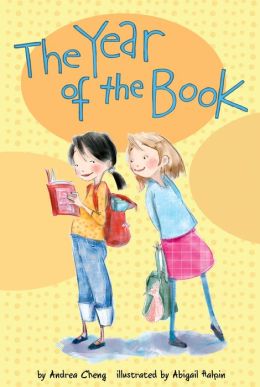
The Year of the Book. Andrea Cheng. Illustrated by Abigail Halpin. Houghton Mifflin Harcourt. 160 pages. [Source: Library]
The Year of the Book has a cozy feel to it, perhaps because of the hopeful outlook. Though Anna, our heroine, isn't absolutely loving all the changes that come with being in fourth grade, she has much to be thankful for. Anna gets great joy out of reading. Almost every chapter in this one includes Anna reading a new book or talking about a new book. Sometimes she's sharing memories of a book she loved, loved, loved long ago like Little Blue and Little Yellow (by Leo Lionni), and other times she's talking about her newest favorite-favorite book like A Wrinkle in Time or From the Mixed-Up Files of Mrs. Basil E. Frankweiler. I love her approach to life, if she has vacation, of course, she's going to spend it reading a new library book each day?! What else would she do?! But a love of book isn't all there is to Anna. She also loves to sew and make crafts. And it isn't hard to see that Anna cares about people deeply too. Sure, at the beginning, Anna seems like she is guarding herself a bit, hesitant to trust her old friend, Laura, since Laura has seemed so different, not quite herself since the start of the new school year. I love how open her heart is, though. How Anna takes time to care for people that may not receive a lot of attention or notice or care. There is something real about Anna and that is what I appreciated most in this tender novel.
© 2013 SukaYuka.com of SukaYuka's Book Reviews

The Year of the Book has a cozy feel to it, perhaps because of the hopeful outlook. Though Anna, our heroine, isn't absolutely loving all the changes that come with being in fourth grade, she has much to be thankful for. Anna gets great joy out of reading. Almost every chapter in this one includes Anna reading a new book or talking about a new book. Sometimes she's sharing memories of a book she loved, loved, loved long ago like Little Blue and Little Yellow (by Leo Lionni), and other times she's talking about her newest favorite-favorite book like A Wrinkle in Time or From the Mixed-Up Files of Mrs. Basil E. Frankweiler. I love her approach to life, if she has vacation, of course, she's going to spend it reading a new library book each day?! What else would she do?! But a love of book isn't all there is to Anna. She also loves to sew and make crafts. And it isn't hard to see that Anna cares about people deeply too. Sure, at the beginning, Anna seems like she is guarding herself a bit, hesitant to trust her old friend, Laura, since Laura has seemed so different, not quite herself since the start of the new school year. I love how open her heart is, though. How Anna takes time to care for people that may not receive a lot of attention or notice or care. There is something real about Anna and that is what I appreciated most in this tender novel.
© 2013 SukaYuka.com of SukaYuka's Book Reviews
Tuesday, June 25, 2013
The Language Inside (2013)
The Language Inside. Holly Thompson. 2013. Random House. 528 pages.
Emma Karas may not be the first heroine in a YA novel to ask the ever-important question: where do I belong? but her story--told in verse--is powerful and compelling. Emma may have been born in America, but she's spent practically all of her almost-sixteen years living in Japan. Now that her parents have returned to the U.S.--to Lowell, Massachusetts--because of her mom's recent breast cancer diagnosis, Emma is understandably upset. It's not like her life was completely problem free in Japan, the recent tsunami is proof of that. But it was without a doubt, her HOME. Emma was a part of everything, she belonged. But struggling with her doubts and fears about her mom's cancer in addition to her anxieties about starting a new school, starting a new life, is so overwhelming. And the stress certainly isn't helping her migraines. But some of the changes are interesting if not AMAZING. And in part this is because of her grandmother's insistence that she volunteer at a care center. A couple of times a week, Emma goes and works with Zena, a paralyzed woman unable to even speak. She communicates with a letter board and the rolling of her eyes. Together Emma and Zena write poetry and discuss life--the past, the present, the future. I loved these sections with Zena. Part of her volunteer life includes seeing Samnang on a regular basis. And these two become quite close!
The Language Inside is a verse novel.
lonely is when the language outside
isn't the language inside
and words are made of just 26 letters (130)
letter by letter
word by word
Zena spells
like this poem was just
sitting in her head:
my stroke beached me like a whale on hot sand
come home! my daughter called and called
but I couldn't answer and finally she swam away
by the time I could look up to talk
and tell her to lean over my face
so I could feel the tickle of her hair
she no longer felt like my daughter
come back! I called and called
but she swam away
with my sister (336)
© 2013 SukaYuka.com of SukaYuka's Book Reviews
Emma Karas may not be the first heroine in a YA novel to ask the ever-important question: where do I belong? but her story--told in verse--is powerful and compelling. Emma may have been born in America, but she's spent practically all of her almost-sixteen years living in Japan. Now that her parents have returned to the U.S.--to Lowell, Massachusetts--because of her mom's recent breast cancer diagnosis, Emma is understandably upset. It's not like her life was completely problem free in Japan, the recent tsunami is proof of that. But it was without a doubt, her HOME. Emma was a part of everything, she belonged. But struggling with her doubts and fears about her mom's cancer in addition to her anxieties about starting a new school, starting a new life, is so overwhelming. And the stress certainly isn't helping her migraines. But some of the changes are interesting if not AMAZING. And in part this is because of her grandmother's insistence that she volunteer at a care center. A couple of times a week, Emma goes and works with Zena, a paralyzed woman unable to even speak. She communicates with a letter board and the rolling of her eyes. Together Emma and Zena write poetry and discuss life--the past, the present, the future. I loved these sections with Zena. Part of her volunteer life includes seeing Samnang on a regular basis. And these two become quite close!
The Language Inside is a verse novel.
lonely is when the language outside
isn't the language inside
and words are made of just 26 letters (130)
letter by letter
word by word
Zena spells
like this poem was just
sitting in her head:
my stroke beached me like a whale on hot sand
come home! my daughter called and called
but I couldn't answer and finally she swam away
by the time I could look up to talk
and tell her to lean over my face
so I could feel the tickle of her hair
she no longer felt like my daughter
come back! I called and called
but she swam away
with my sister (336)
© 2013 SukaYuka.com of SukaYuka's Book Reviews

Monday, May 20, 2013
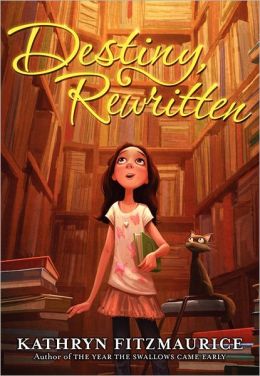
Destiny, Rewritten (2013)
Destiny, Rewritten. Kathryn Fitzmaurice. 2013. HarperCollins. 176 pages.
I really enjoyed The Year The Swallows Came Early, and I loved, loved, LOVED A Diamond in the Desert. How did I feel about Destiny, Rewritten? I really, really liked it. I appreciated so many things about the heroine, Emily Elizabeth Davis. She's a heroine who needs to believe in happy endings, who writes out her favorite happy endings from books, who checks to see that there is a happy ending before even reading books, who regularly writes Danielle Steel. She's presented as smart and kind, a girl you want for a best friend, a sister, a daughter. But her life isn't perfect. Emily feels some slight pressure from her mom to live up to her destiny. Emily doesn't embrace poetry; she doesn't feel called to BE a poet just because her mom named her after Emily Dickinson. The inspiring story about how her mom found a first edition complete poems of Emily Dickinson just days before she was born? Well, it makes her love and appreciate her mom--the book of poems is updated in the margins with details from her life--but it doesn't make her want to write poetry or even write about poetry.
One day, this treasured book is LOST, donated by accident. Emily and her friends and family come together to search the city for this one-of-a-kind book. Her mom is relaxed, reassuring. If the book is meant to come back to her, then it will. Her mom is all about how destiny can't be forced or rushed, that you just have to accept it, embrace it one day at a time. Emily NEEDS the book, NOW. Why? She's just learned that the name of her father is hidden inside its pages. She never discovered this because she's never read it cover to cover. (Her mom won't tell her who her father is, won't explain why he's not a part of their lives.)
So will Emily get her happy ending?!
I definitely recommend this one! I really love Kathryn Fitzmaurice's writing. One of the reasons I love her writing is the great characterization.
© 2013 SukaYuka.com of SukaYuka's Book Reviews
I really enjoyed The Year The Swallows Came Early, and I loved, loved, LOVED A Diamond in the Desert. How did I feel about Destiny, Rewritten? I really, really liked it. I appreciated so many things about the heroine, Emily Elizabeth Davis. She's a heroine who needs to believe in happy endings, who writes out her favorite happy endings from books, who checks to see that there is a happy ending before even reading books, who regularly writes Danielle Steel. She's presented as smart and kind, a girl you want for a best friend, a sister, a daughter. But her life isn't perfect. Emily feels some slight pressure from her mom to live up to her destiny. Emily doesn't embrace poetry; she doesn't feel called to BE a poet just because her mom named her after Emily Dickinson. The inspiring story about how her mom found a first edition complete poems of Emily Dickinson just days before she was born? Well, it makes her love and appreciate her mom--the book of poems is updated in the margins with details from her life--but it doesn't make her want to write poetry or even write about poetry.
One day, this treasured book is LOST, donated by accident. Emily and her friends and family come together to search the city for this one-of-a-kind book. Her mom is relaxed, reassuring. If the book is meant to come back to her, then it will. Her mom is all about how destiny can't be forced or rushed, that you just have to accept it, embrace it one day at a time. Emily NEEDS the book, NOW. Why? She's just learned that the name of her father is hidden inside its pages. She never discovered this because she's never read it cover to cover. (Her mom won't tell her who her father is, won't explain why he's not a part of their lives.)
So will Emily get her happy ending?!
I definitely recommend this one! I really love Kathryn Fitzmaurice's writing. One of the reasons I love her writing is the great characterization.
© 2013 SukaYuka.com of SukaYuka's Book Reviews
Friday, May 17, 2013
Penny and Her Marble (2013)
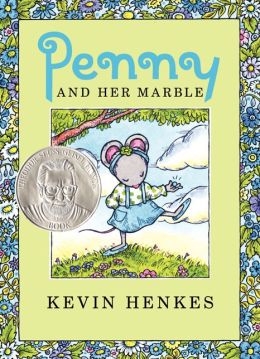
Penny and Her Marble. Kevin Henkes. 2013. HarperCollins. 48 pages.
Penny was pushing her doll, Rose, in her stroller. They went back and forth on the front sidewalk. "Only go as far as Mrs. Goodwin's house," called Mama. Penny pretended they were in a big city. "Look at the tall buildings, Rose," said Penny. When they got to Mrs. Goodwin's house, they turned around. Then Penny pretended they were in a forest...
I am really loving Kevin Henkes new series starring Penny and her family. I have loved each of the books in the series so far. Penny is such a fun heroine! The first book was Penny and Her Song; the second book was Penny And Her Doll. In her latest adventure, Penny struggles with her conscience. That day she picked up a marble she found in her neighbor's yard or perhaps on the sidewalk in front of her neighbor's house. She took it without thinking of it being someone else's property. And at first, she takes pure delight in it! Though small, this marble is bringing her nothing but joy. But then she starts thinking that maybe someone is missing it, maybe it wasn't hers to take after all. Penny and Her Marble is a thoughtful book for young readers, and it's a book with a happy ending!
© 2013 SukaYuka.com of SukaYuka's Book Reviews
Penny was pushing her doll, Rose, in her stroller. They went back and forth on the front sidewalk. "Only go as far as Mrs. Goodwin's house," called Mama. Penny pretended they were in a big city. "Look at the tall buildings, Rose," said Penny. When they got to Mrs. Goodwin's house, they turned around. Then Penny pretended they were in a forest...
I am really loving Kevin Henkes new series starring Penny and her family. I have loved each of the books in the series so far. Penny is such a fun heroine! The first book was Penny and Her Song; the second book was Penny And Her Doll. In her latest adventure, Penny struggles with her conscience. That day she picked up a marble she found in her neighbor's yard or perhaps on the sidewalk in front of her neighbor's house. She took it without thinking of it being someone else's property. And at first, she takes pure delight in it! Though small, this marble is bringing her nothing but joy. But then she starts thinking that maybe someone is missing it, maybe it wasn't hers to take after all. Penny and Her Marble is a thoughtful book for young readers, and it's a book with a happy ending!
© 2013 SukaYuka.com of SukaYuka's Book Reviews
Friday, April 5, 2013
The Wall (2013)
The Wall. William Sutcliffe. 2013. Walker. 304 pages.
The Wall is a thought-provoking coming of age novel. What is missing from Joshua's life is peace. He HATES his step-father, and readers learn there is good reason for this. But it isn't just family turmoil leading to his uneasiness. Perhaps it all starts when Joshua discovers a tunnel that goes under the wall, a tunnel that he explores. He visits the other side of the wall, he walks the streets, sees the "enemy" up, close, for the first time perhaps, and realizes that there aren't really any discernible differences. The way Joshua's father RANTS about them, he expected the "them" to be obvious threats, but that isn't the case. In fact, one of "them," a pretty young girl, risks her life to help him get back to his own side (he becomes lost). He can't forget the girl he met, can't forget her kindness and her needs. He feels he can help her, but is it the kind of help she'd welcome? That her family would welcome? The Wall gives readers an opportunity to see a boy's social awareness awaken. Joshua begins to think, deeply think about the world around him, to test what he's been taught, to make his own decisions about what is right and what is wrong.
Read The Wall
The Wall is a thought-provoking coming of age novel. What is missing from Joshua's life is peace. He HATES his step-father, and readers learn there is good reason for this. But it isn't just family turmoil leading to his uneasiness. Perhaps it all starts when Joshua discovers a tunnel that goes under the wall, a tunnel that he explores. He visits the other side of the wall, he walks the streets, sees the "enemy" up, close, for the first time perhaps, and realizes that there aren't really any discernible differences. The way Joshua's father RANTS about them, he expected the "them" to be obvious threats, but that isn't the case. In fact, one of "them," a pretty young girl, risks her life to help him get back to his own side (he becomes lost). He can't forget the girl he met, can't forget her kindness and her needs. He feels he can help her, but is it the kind of help she'd welcome? That her family would welcome? The Wall gives readers an opportunity to see a boy's social awareness awaken. Joshua begins to think, deeply think about the world around him, to test what he's been taught, to make his own decisions about what is right and what is wrong.
Read The Wall
- If you enjoy thought-provoking coming-of-age stories
Monday, March 25, 2013
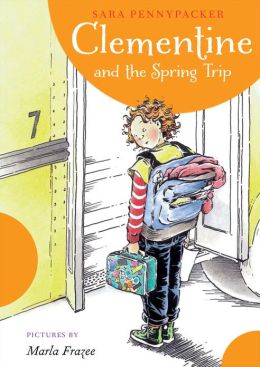
Clementine and The Spring Trip (2013)
Clementine and the Spring Trip. Sara Pennypacker. 2013. Hyperion. 160 pages.
Clementine has to be one of my favorite heroines. I just LOVE spending time with her. I love reading about her family life AND I love reading about her school days too. She always has an opinion, and she's always got something on her mind! In this book, Clementine is excited but nervous about an upcoming field trip to Plimoth Plantation. At first she felt comfortable about going because she was going to partner with fourth grader, Margaret. (Clementine is in third grade.) Clementine was going to help Margaret by doing all the "dirty" work, and Margaret was going to help Clementine by teaching her to eat quietly. The "rule" of the fourth graders being that no noisy foods are ever allowed. But when a new student arrives, a girl named Olive, well, plans change. The teacher assigns Olive to Clementine, and with the teacher and the principal telling Clementine that this will be a GOOD thing, she has to accept her disappointment. But noisy eating isn't the only thing worrying Clementine and her classmates, no, there is the dreaded bus number seven with "the cloud." This is the SMELLIEST bus ever, a thing of nightmares. And oh how the kids like to make comparisons as to what it smells like and why!!!
The novel is great fun focusing on Clementine at school and home. I would definitely recommend this series.
Read Clementine and the Spring Trip
© 2013 SukaYuka.com of SukaYuka's Book Reviews
Clementine has to be one of my favorite heroines. I just LOVE spending time with her. I love reading about her family life AND I love reading about her school days too. She always has an opinion, and she's always got something on her mind! In this book, Clementine is excited but nervous about an upcoming field trip to Plimoth Plantation. At first she felt comfortable about going because she was going to partner with fourth grader, Margaret. (Clementine is in third grade.) Clementine was going to help Margaret by doing all the "dirty" work, and Margaret was going to help Clementine by teaching her to eat quietly. The "rule" of the fourth graders being that no noisy foods are ever allowed. But when a new student arrives, a girl named Olive, well, plans change. The teacher assigns Olive to Clementine, and with the teacher and the principal telling Clementine that this will be a GOOD thing, she has to accept her disappointment. But noisy eating isn't the only thing worrying Clementine and her classmates, no, there is the dreaded bus number seven with "the cloud." This is the SMELLIEST bus ever, a thing of nightmares. And oh how the kids like to make comparisons as to what it smells like and why!!!
The novel is great fun focusing on Clementine at school and home. I would definitely recommend this series.
Read Clementine and the Spring Trip
- If you love children's books
- If you're looking for a heroine to love and adore (like Ramona, Moxy Maxwell, or Ida May, etc.)
- If you've enjoyed Clementine, The Talented Clementine, Clementine's Letter, Clementine, Friend of the Week, Clementine and the Family Meeting.
© 2013 SukaYuka.com of SukaYuka's Book Reviews
Subscribe to:
Posts (Atom)