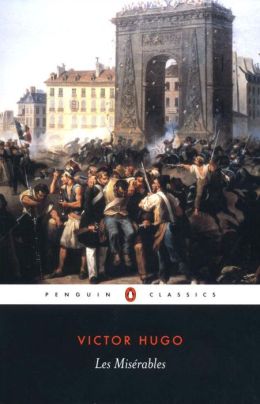
Les Miserables. Victor Hugo. Translated and Introduced by Norman Denny. 1862/1976/2012. Penguin. 1232 pages.
Reading Les Miserables was an experience! For six or seven days, I kept good company with the novel. I definitely was not expecting to finish this chunkster in one week! But I found the story so compelling. Political, philosophical, spiritual, dramatic, and romantic. Each word describes the novel,
in part. While there are many characters in this novel, I loved the narrator the best of all. Who are some of the characters? Bishop Myriel, Jean Valjean, Fantine, Inspector Javert, Cosette, Marius, Eponine, Enjolras, and Gavroche--just to name a few.
Jean Valjean is an ex-convict who seeks shelter from Bishop Myriel one night. Though he's been treated only with kindness, Valjean in his bitterness (he was sent to prison for stealing a loaf of bread), he steals the bishop's silver. When the theft is discovered, the bishop is all compassion telling the officials that there has been a misunderstanding. Valjean did not steal the silver; it was given as a gift. In fact, he's happy to give Valjean his silver candlesticks as well. Valjean is shocked and overwhelmed. The meeting turns out to be quite life-changing.
When readers next meet Valjean, he has a new name and life. Monsieur Madeleine is a successful business man. He has a BIG heart. He's always giving. He's always thinking of others. He's always doing what he can, when he can to make a difference when and where it matters most. One woman he is determined to help is a young, single mother, Fantine. Circumstances have separated Fantine from her child, Cosette, but, Valjean is determined to correct as many wrongs as he can in this situation. He will see to it personally.
Unfortunately, his past catches up with him. He learns that a man has been arrested; "Jean Valjean" has been caught. Of course, Madeleine knows this is nonsense. Can he let another take his place in prison? If he tells the truth then he can no longer help the poor, but if he doesn't tell the truth, how could he live with himself? He does the honorable thing--though it is one of the greatest challenges he's faced so far.
But that means, for the moment, that Cosette is left in unpleasant circumstances...
There comes a time, an opportunity for Valjean to escape. What he does with his freedom--this time he's assumed drowned, I believe--is go and find Cosette. The two become everything to one another. Cosette is the family he's never had, never even knew he needed or wanted... the two end up in Paris.
Almost half of the novel follows the love story between Marius and Cosette. But it isn't only a love story. Marius is a poor man in conflict with his rich grandfather. The two disagree about many things. But their main source of disagreement is politics. At first, Marius is swept up in his father's politics, with a new awareness of who his father was as a soldier, as a man, as a possible hero. But later, Marius begins to think for himself, to contemplate political and philosophical things for himself. He becomes friendly with a political group at this time. But his love of politics dims when he falls in love with Cosette...and she becomes his whole reason for being. For the longest time these two don't even know each other's names! This romance isn't without challenges...
This novel has so much drama! I found it beautifully written. So many amazing passages! Such interesting characters! I'm not sure I loved the ending. And I was frustrated with Marius at times. But. I definitely loved this book!
Favorite quotes:
What is reported of men, whether it be true or false, may play as large a part in their lives, and above all in their destiny, as the things they do. (19)
We do not claim that the portrait we are making is the whole truth, only that it is a resemblance. (25)
The flesh is at once man's burden and his temptation. He bears it and yields to it. He must keep watch over it and restrain it, and obey it only in the last resort. Such obedience may be a fault, but it is a venial fault. It is a fall, but a fall on to the knees which may end in prayer. To be a saint is to be an exception; to be a true man is the rule. Err, fail, sin if you must, but be upright. To sin as little as possible is the law for men; to sin not at all is a dream for angels. All earthly things are subject to sin; it is like the force of gravity. (29-30)
'The beautiful is as useful as the useful.' Then, after a pause, he added: "More so, perhaps.' (38)
I was not put into this world to preserve my life but to protect souls. (40)
Conscience is the amount of inner knowledge that we possess. (52)
The brutalities of progress are called revolutions. When they are over we realize this: that the human race has been roughly handled, but that it has advanced. (56)
He pondered on the greatness and the living presence of God, on the mystery of eternity in the future and, even more strange, eternity in the past, on all the infinity manifest to his eyes and to his senses; and without seeking to comprehend the incomprehensible he contemplated these things. He did not scrutinize God but let his eyes be dazzled. (67)
There are no bounds to human thought. At its own risk and peril it analyzes and explores its own bewilderment. (68)
We can no more pray too much than we can love too much. (69)
There are men who dig for gold; he dug for compassion. Poverty was his goldmine; and the universality of suffering a reason for the universality of charity. 'Love one another.' To him everything was contained in those words, his whole doctrine, and he asked no more. (69)
The bishop, seated at his side, laid a hand gently on his arm.
'You need have told me nothing. This house is not mine but Christ's. It does not ask a man his name but whether he is in need. You are in trouble, you are hungry and thirsty, and so you are welcome. You need not thank me for receiving you in my house. No one is at home here except those seeking shelter. Let me assure you, passer-by though you are, that this is more your home than mine. Everything in it is yours. Why should I ask your name? In any case I knew it before you told me.'
The man looked up with startled eyes. 'You know my name?'
'Of course,' said the bishop. 'Your name is brother.' (87)
Is there not true evangelism in the delicacy which refrains from preaching and moralizing? To avoid probing an open wound, is not that the truest sympathy? (90)
'Do not forget, do not ever forget, that you have promised me to use the money to make yourself an honest man.'
Valjean, who did not recall having made any promise, was silent. The bishop had spoken the words slowly and deliberately. He concluded with a solemn emphasis: 'Jean Valjean, my brother, you no longer belong to what is evil but to what is good. I have bought your soul to save it from black thoughts and the spirit of perdition, and I give it to God.' ( 111)
Gold and pearls were her dowry, but the gold was on her head and the pearls were in her mouth. She worked in order to live, and presently fell in love, also in order to live, for the heart, too, has its hunger. (125)
Animals are nothing but the portrayal of our virtues and vices made manifest to our eyes, the visible reflections of our souls. (164)
What is the riddle of these countless scattered destinies, whither are they bound, why are they as they are? He who knows the answer to this knows all things. He is alone. His name is God. (180)
There is a prospect greater than the sea, and it is the sky; there is a prospect greater than the sky, and it is the human soul. (208)
To make a poem of the human conscience, even in terms of a single man and the least of men, would be to merge all epics in a single epic transcending all. (208)
We can no more prevent a thought from returning to the mind than we can prevent the sea from rising on the foreshore. To the sailor it is the tide, to the uneasy conscience it is remorse. God moves the soul as He moves the oceans. (213)
The sisters, then, had this in common when they were girls, that each had her dream, each had wings, those of an angel in the one case and those of a goose in the other. (519)
He never left home without a book under his arm, and often came back with two. (593)
Our imaginings are what most resemble us. Each of us dreams of the unknown and the impossible in his own way. (597)
There comes a moment when the bud bursts overnight into flower and yesterday's little girl becomes a woman to entrap our hearts. This one had not merely grown but was transformed. Just as three April days may suffice for some trees to cover themselves with blossom, so six months had sufficed to clothe her with beauty. Her April had come. (606)
Of all things God has created it is the human heart that sheds the brightest light, and alas, the blackest despair. (844)
'After all, what is a cat?' he demanded. 'It's a correction. Having created the mouse God said to himself, "That was silly of me!" and so he created the cat. The cat is the erratum of the mouse. Mouse and cat together represent the revised proofs of Creation.' (995)
© 2013 SukaYuka.com of
SukaYuka's Book Reviews